


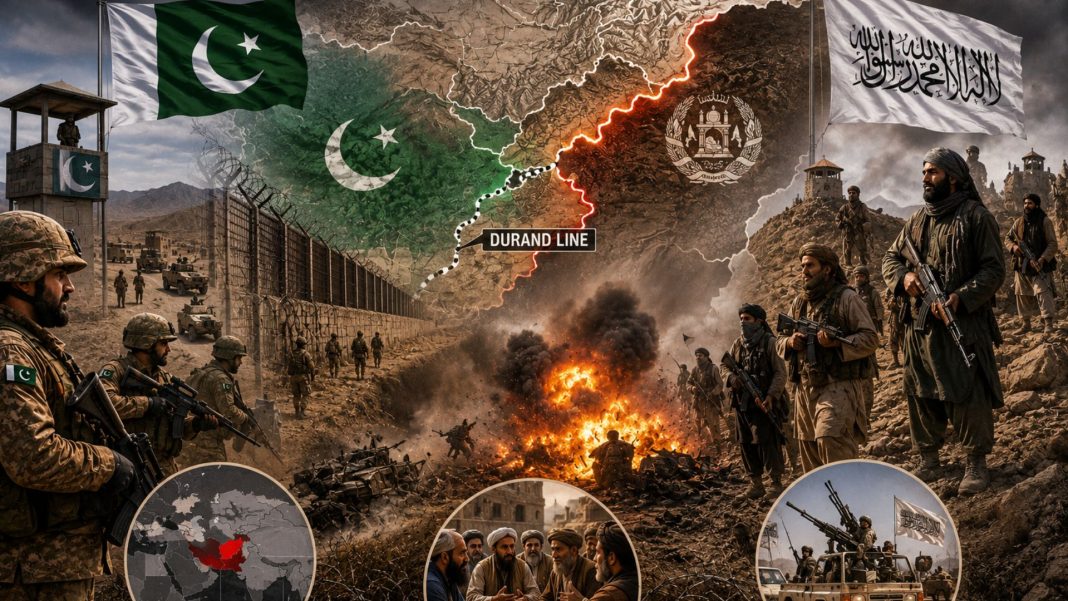

The Durand Line Firestorm: The volatile geopolitical landscape of South Asia took a dangerous turn on June 29, 2026. What began months ago as sporadic cross-border skirmishes has now spiraled into an all-out localized war between two nuclear-adjacent neighbors: Pakistan and Taliban-led Afghanistan.
Following a major military offensive by Pakistani security forces, Afghan officials reported that Pakistani air and ground strikes left at least 36 civilians dead and over 160 injured across Paktika, Paktia, and Kunar provinces.
This latest flashpoint has effectively shattered a brief month-long window of peace, plunging the region back into a state of high-stakes military confrontation.
The Trigger: The Karachi Rangers Base Attack
The Durand Line Firestorm: The sudden cross-border military operation by Pakistan was not a random action; it was a swift, calculated retaliation.
Just 24 hours prior to the border strike, heavily armed militants equipped with explosives launched a suicide raid on the regional headquarters of the paramilitary Sindh Rangers in the southern port city of Karachi. The attack resulted in the deaths of three paramilitary troops.
Pakistan’s security forces neutralized three attackers and captured a fourth wounded assailant, whom the military identified as an Afghani national. Shortly after, Jamaat-ul-Ahrar, a lethal breakaway faction of the Tehreek-e-Taliban Pakistan (TTP), claimed full responsibility for the Karachi assault.
For Islamabad, this was the final straw. Within hours, Pakistan’s Information Minister, Attaullah Tarar, announced a highly coordinated ground and air offensive targeting what Islamabad defines as “militant safe havens” inside Afghan territory.
The Core Dispute: The TTP and the Dual-Taliban Dilemma
The Durand Line Firestorm: To understand why this border is burning, one must look at the complicated relationship between the Pakistani Taliban (TTP) and the Afghan Taliban.
Pakistan’s core grievance rests on a single claim: Kabul is harboring the TTP. Since the Afghan Taliban swept back to power in Kabul in August 2021, Pakistan has witnessed a catastrophic surge in domestic terrorism, primarily targeting police checkpoints, military bases, and security personnel.
While the Afghan Taliban and the TTP operate as separate structural entities, they are bound by a deep ideological alliance and a shared history of fighting Western forces. Consequently, the Afghan Taliban is highly reluctant to turn its guns on its fellow Islamist allies (TTP) inside its borders.
Kabul routinely brushes off Pakistan’s claims, calling the TTP insurgency an internal security problem of Pakistan. This ideological protection has created an unsustainable security environment for Islamabad, forcing its military to take matters into its own hands via cross-border incursions.
- The Failure of International Diplomacy
This recent round of fighting marks the collapse of multiple high-profile diplomatic interventions.
Since the undeclared border war broke out in late February 2026, international mediators have repeatedly attempted to de-escalate tensions along the 2,640-km Durand Line.
Even global superpower China hosted both nations for peace talks in April 2026, extracting a fragile verbal commitment from both Islamabad and Kabul to explore non-military solutions and halt further escalation.
However, the structural realities on the ground have proven far more powerful than diplomatic treaties. As long as TTP factions launch attacks inside Pakistan from across the border, and as long as Pakistan uses its air force to drop bombs inside sovereign Afghan territory, diplomatic ceasefire agreements remain nothing more than paper promises.
- The Civilian Cost and the Retaliation Loop
The primary tragedy of this calibrated violence is the mounting civilian toll, which acts as fuel for the next cycle of revenge.
According to Taliban spokesperson Zabiullah Mujahid, Pakistan’s latest air strikes targeted residential areas, claiming the lives of women, children, and elderly villagers. In Paktia’s Chamkani district, a double-tap strike pattern was observed:
an initial strike hit a civilian home, and when local villagers rushed to rescue survivors, a secondary strike occurred, driving up the casualty list to 28 dead in that single village.
Kabul has fiercely condemned these actions as a cowardly act of aggression and an outright violation of its sovereignty. History shows that whenever Pakistan launches air strikes, the Afghan military responds by firing heavy artillery, mortars, and rockets across the border into Pakistani military outposts. This creates a highly volatile tit-for-tat retaliation loop that makes long-term peace nearly impossible.
What Lies Ahead?
The Pakistan-Afghanistan border crisis is no longer a localized border dispute; it has evolved into a low-intensity, highly volatile state of war.
Neither country can afford an all-out, conventional conflict. Pakistan is currently grappling with a severe domestic economic crisis and internal political instability, while Afghanistan remains heavily isolated internationally and economically crippled under global sanctions.
Yet, as long as the underlying issue, the TTP’s presence in Afghanistan and the disputed nature of the Durand Line, remains unresolved, the border lands will continue to see bloodshed, turning this neighborly friction into a permanent security threat for South Asia.