


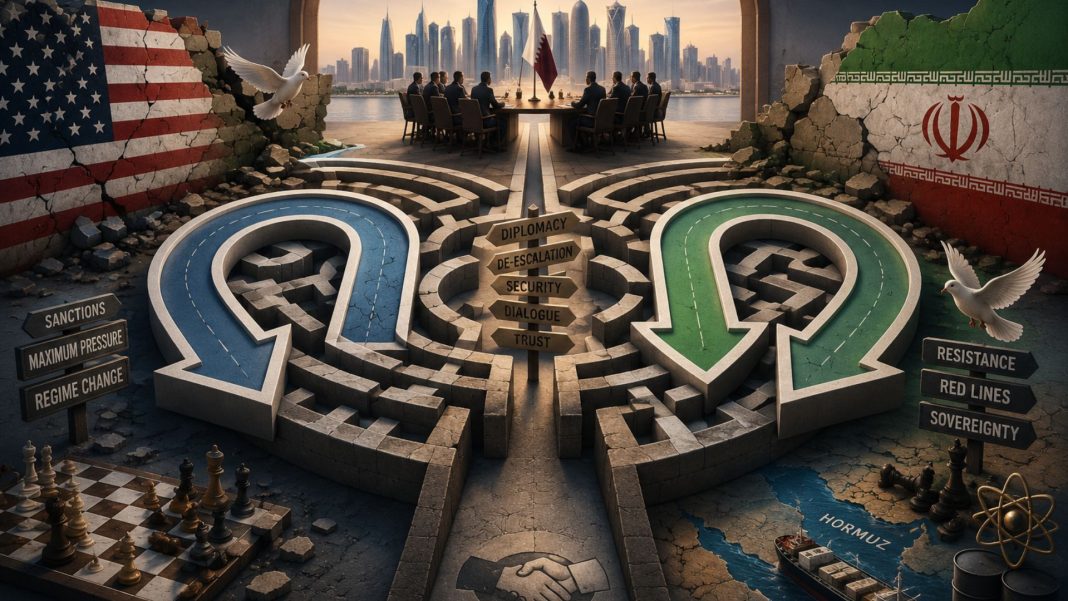

The Maze of Words: The geopolitical theater of the Middle East is witnessing one of its most unpredictable U-turns in history. Just days after exchanging heavy missile strikes, threatening shipping lanes, and vowing to destroy each other, the United States and Iran are suddenly ready to sit together at the negotiating table in Doha, Qatar.
According to a report by US media outlet Axios, American and Iranian officials will meet face-to-face on Tuesday, June 30, 2026. A senior US official confirmed, “We have decided to stop all kinetic activity [military attacks] to allow the safe passage of commercial vessels.”
This emergency meeting is a desperate attempt to save the fragile Islamabad Memorandum of Understanding (MoU), which was signed on June 17, 2026, but ended up in critical condition within a week due to heavy US airstrikes and Iranian counterattacks.
But can a simple table talk end decades of deep-rooted hostility?
A look at history reveals that peace agreements between Washington and Tehran usually choke inside a maze of words, where both nations change their statements whenever it suits them.
The Timeline of U-Turns: From Heavy Threats to Calls for Peace
The Maze of Words: If we look at the timeline of this crisis from its start in February 2026 to today, the statements, promises, and threats from the US administration show massive contradictions. Washington has repeatedly gone back on its own word.
Phase 1: “We Will Wipe Out Iran’s Missiles” (February – March 2026)
When attacks on commercial ships began in the Strait of Hormuz in late February 2026 and the US blamed Iran, President Donald Trump took a very aggressive stance. In early March 2026, the White House stated:
“If Iran tries to challenge the US Navy or global trade, the US military will turn Iran’s missile industry into a pile of rubble.”
Even as recently as Saturday, June 27, 2026, Trump repeated his harsh rhetoric, warning that if Iran retaliated against US strikes, “it would face total destruction.” Yet, just 24 hours after this aggressive statement, on Sunday night, US officials announced they were heading to Doha with a peace proposal.
Phase 2: The Sudden Flip-Flop on Sanctions (May – June 2026)
For years, the official US position was clear: sanctions on Iran would not be lifted until Tehran completely stopped uranium enrichment and gave up its ballistic missiles. The Trump administration swore by a policy of “maximum pressure.”
However, when the Islamabad MoU was signed on June 17, 2026, the US suddenly walked away from this major promise. On June 22, the US Treasury Department issued general licenses, lifting several strict sanctions on Iranian oil exports and giving Tehran immediate financial relief. Critics ask: why was an economy previously labeled a global threat suddenly given a financial lifeline?
Phase 3: Trump’s Shocking Statement on Iran’s Missiles
The biggest contradiction in US foreign policy came when Donald Trump himself defended the new MoU by saying, “It would be unfair to ask Iran to give up its missiles while other countries in the region hold nuclear and ballistic weapons”.
This shocked analysts, as destroying this very missile program was the primary reason the US had set up a naval blockade around the Gulf in the first place.
From Switzerland to Qatar: How the ‘Islamabad MoU’ Crumbled in One Week
The Maze of Words: When US President Donald Trump and Iranian President Masoud Pezeshkian agreed to the Islamabad MoU on June 17, 2026, it was celebrated as a new era for the Middle East. The main conditions of the deal were:
Both countries would immediately pull back their military forces.
Ships would pass through the Strait of Hormuz without any transit fees for the next 60 days.
During these 60 days, both sides would work on a permanent peace treaty.
The Military Hotline That Never Started
To implement this deal, US Vice President JD Vance met with an Iranian delegation in Switzerland last week. They agreed to set up a direct military hotline between the US military and Iran’s Islamic Revolutionary Guard Corps (IRGC) to prevent any misunderstandings at sea.
However, the reality on the ground was completely different. By Saturday, June 27, the hotline existed only on paper. Meanwhile, Iran began stopping ships in the Strait of Hormuz, demanding they coordinate their routes with Tehran.
The US saw this as a violation of the MoU and launched heavy airstrikes on Iranian radars, drones, and missile sites. Iran retaliated by striking US military bases in Kuwait and Bahrain, claiming Washington broke the deal first.
Because of this sudden spike in violence, the original Switzerland meeting, which was supposed to discuss Iran’s nuclear program, was canceled. The entire agenda shifted to the “Hormuz Crisis,” and the venue was rushed to Doha, Qatar.
Why the Doha Talks Will Struggle to Succeed: Three Core Friction Points
The central question now is: Will the Doha talks on June 30 be successful? Based on realistic political analysis, this meeting will not bring a permanent solution. It is simply a strategy to buy time. Long-term peace is unlikely because of three deep-rooted issues where both sides have completely opposite views:
Issue 1: Ownership of the Strait of Hormuz
The US insists that the Strait of Hormuz is an international waterway. They demand “freedom of navigation,” meaning trade ships from any country must be allowed to travel through it without any interference.
On the other side, Iranian Foreign Minister Abbas Araghchi has clearly stated that no foreign power can use this route without Tehran’s permission. Iran views the strait as its sovereign territory. Bringing these two opposite ideas to a compromise in Doha will be nearly impossible.
Issue 2: The 60-Day Toll Tax Trick
The Islamabad MoU stated that no fees would be charged to ships for 60 days. But what happens after that? Iran fully intends to impose heavy transit fees or “toll taxes” on commercial ships and oil tankers once the 60-day window expires. The US will never accept this tax because it would hurt the global economy. This 60-day deadline is essentially a time bomb ticking toward August 2026.
Issue 3: Proxy Wars and Cyber Attacks
Washington does not just want safe shipping lanes; US intelligence agencies demand that Iran stop funding regional proxy groups and halt cyberattacks against Israel and US assets.
However, even while peace talks were happening this June, cyberattacks from Iranian networks against Israeli infrastructure reached a peak. Iran refuses to give up its regional influence for a maritime treaty, as these proxy networks are its biggest leverage.
The Verdict: An Endless Cycle of Break and Repair
The Doha meeting on June 30 will likely result in a joint statement claiming “progress.” Missiles will probably stop flying for a few weeks, shipping routes will temporarily stabilize, and oil prices might settle down. Qatar will likely succeed as a mediator in getting both sides to agree to a temporary ceasefire.
However, from a long-term perspective, this peace is built on sand. Until the US stops changing its policy goals overnight, and until Iran stops its aggressive claims over the Strait of Hormuz, no treaty will last. The Doha talks are a good tool to delay a larger war, but a real, permanent solution remains lost in a maze of broken words.
Also Read : The Washington Breakthrough: Can US Mediation Deliver Real Peace Between Israel and Lebanon?