


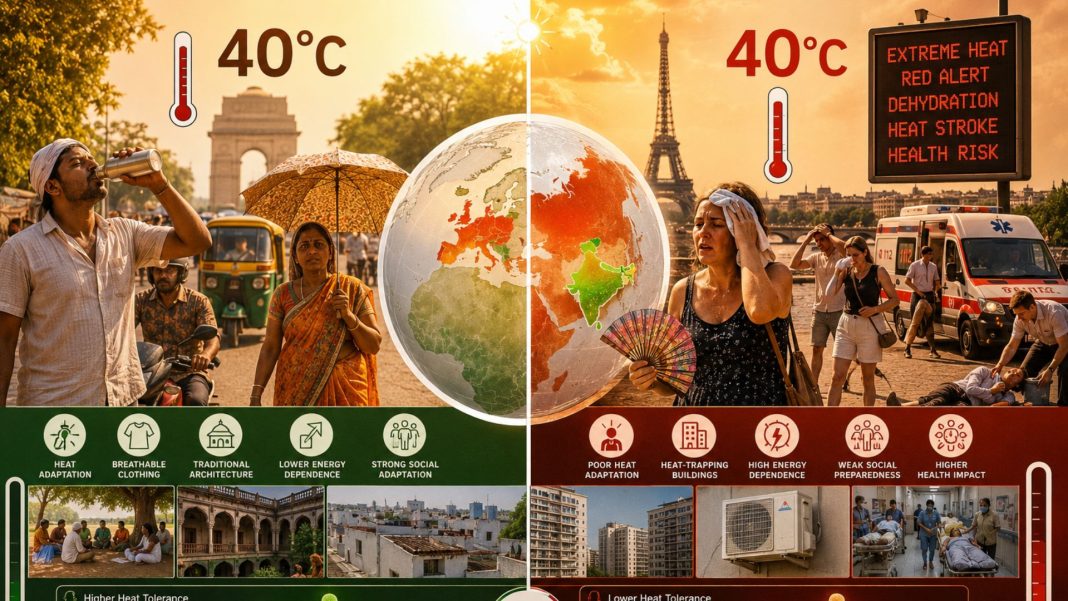

Europe Climate Crisis: When the temperature hits 43°C or 45°C in New Delhi, Mumbai, or Jaipur, life doesn’t come to a standstill. Millions of Indians wrap a cotton gamcha around their heads, drink a glass of Aam Panna or Lassi, and comfortably head out to work. It is just another typical summer day.
However, when the mercury crosses 40°C in London, Paris, and Berlin, it triggers red alerts, causes thousands of excess deaths, warps railway tracks, and is immediately declared a national disaster.
Why does the exact same number on a thermometer cause a minor inconvenience in India but a literal humanitarian crisis in Europe? It is not about human willpower; it is a profound combination of atmospheric physics, architectural engineering, and human biology. This deep analysis explains why 40°C behaves so differently across these two worlds.
The Architectural Trap: Greenhouses vs. Breathing Houses
Europe Climate Crisis: The most significant reason people are dying inside their homes in Europe during a heatwave comes down to how buildings are engineered.
Europe’s Ovens
For centuries, European homes were designed with one structural goal: keep the freezing winter cold out and trap the heat inside. Buildings are heavily insulated with thick materials, possess double or triple-glazed windows, and are tightly sealed to maximize central heating efficiency.
When a 40°C heatwave strikes, these houses act like literal greenhouses. They absorb heat all day long and completely fail to release it at night. Without cooling systems, the indoor temperature can easily exceed the outdoor temperature, turning bedrooms into suffocating traps.
India’s Cool Cavities
Conversely, traditional and modern Indian architecture is designed to reject heat. Houses feature high ceilings, allowing hot air to rise away from living spaces, thick concrete or brick walls, and open layouts that promote cross-ventilation. Flooring made of marble, granite, or mosaic tiles stays naturally cool, helping dissipate ambient heat rather than storing it.
The Air Conditioning Deficit
Europe Climate Crisis: In India, air conditioning has become a staple of urban life. Even in households without AC, ceiling fans, exhaust fans, and desert coolers that utilize water evaporation are universal. No Indian home is built without a fan.
In Europe, air conditioning was historically viewed as an unnecessary luxury because summers were short and mild. Today, fewer than 5% of residential homes in the UK, France, and Germany have air conditioning. When temperatures spike, citizens have absolutely no mechanical way to cool down their indoor spaces. Standing fans merely circulate the trapped 40°C air without actually lowering the room temperature.
The Danger of “Wet-Bulb” Temperature (Humidity vs. Dry Heat)
Temperature alone does not kill; it is the combination of heat and humidity that determines how dangerous weather is to the human body. This is known scientifically as the Wet-Bulb Temperature.
India’s Dry Summer Advantage
In North and Central India, peak summer brings an intensely dry heat. Because the humidity is very low, the human body’s primary cooling mechanism, sweating, works perfectly. The moment you sweat, it evaporates into the dry air, immediately pulling heat away from your skin and lowering your internal body temperature.
Europe’s Humid Suffocation
Europe is surrounded by major water bodies like the Atlantic Ocean and the Mediterranean Sea. When hot air masses settle over the continent, they absorb massive amounts of moisture. In a humid 40°C environment, sweat cannot evaporate because the air is already saturated with water. The sweat stays sticky on the skin, the body cannot cool down, and internal core temperatures skyrocket, leading to heat strokes within hours.
Human Biology and the “Thermoregulation” Shock
Human bodies undergo evolutionary and physiological changes based on the climate they inhabit over generations.
The Indian Body
People living in India have a highly adapted thermoregulation system. From childhood, their bodies are conditioned to handle sudden shifts to high temperatures. Their sweat glands activate faster, sweat output is higher, and the cardiovascular system is highly efficient at pumping blood to the skin to dissipate heat.
The European Body
Populations in Northern and Western Europe are genetically and physically acclimated to a cooler baseline. When hit with an abrupt 40°C surge, their cardiovascular systems experience acute thermal shock. The heart has to pump blood at a frantic rate to cool the body down, which explains why the vast majority of heatwave casualties in Europe are elderly citizens suffering from sudden cardiovascular or organ failure.
Industrial and Transport Meltdown
It is not just human bodies that aren’t built for 40°C in Europe, their modern infrastructure isn’t either.
Warping Railway Tracks
European train tracks are made of steel tensioned to perform best in cold-to-moderate weather. When the air temperature is 40°C, direct sunlight bakes the dark iron rails to over 55°C. The metal expands and begins to buckle, threatening train derailments. This forces train operators to implement emergency speed limits or cancel lines entirely.
The Energy and Reactor Paradox
As Europeans turn to fans, electricity grids overload. Paradoxically, countries like France that rely on nuclear energy are forced to cut power production. Nuclear plants use river water to cool their reactors. Because the rivers have already warmed up due to the heatwave, plants cannot pull water in or dump it back without destroying river ecosystems, crippling the energy supply right when it is needed most.
A Warning for the Future
The sudden European heatwave has shattered the myth that climate change only severely impacts tropical, developing nations.
While India has spent generations adapting its lifestyle, architecture, and biology to survive extreme heat, Europe is caught completely off guard. As global jet streams buckle and “Heat Domes” become regular summer phenomena, the Global North is realizing that 40°C is no longer just a tropical number, it is a global reality that requires a complete overhaul of Western infrastructure.
Also Read : India’s Strong Message in the Indian Ocean: PM Modi’s Seychelles Visit and the Signal to China