


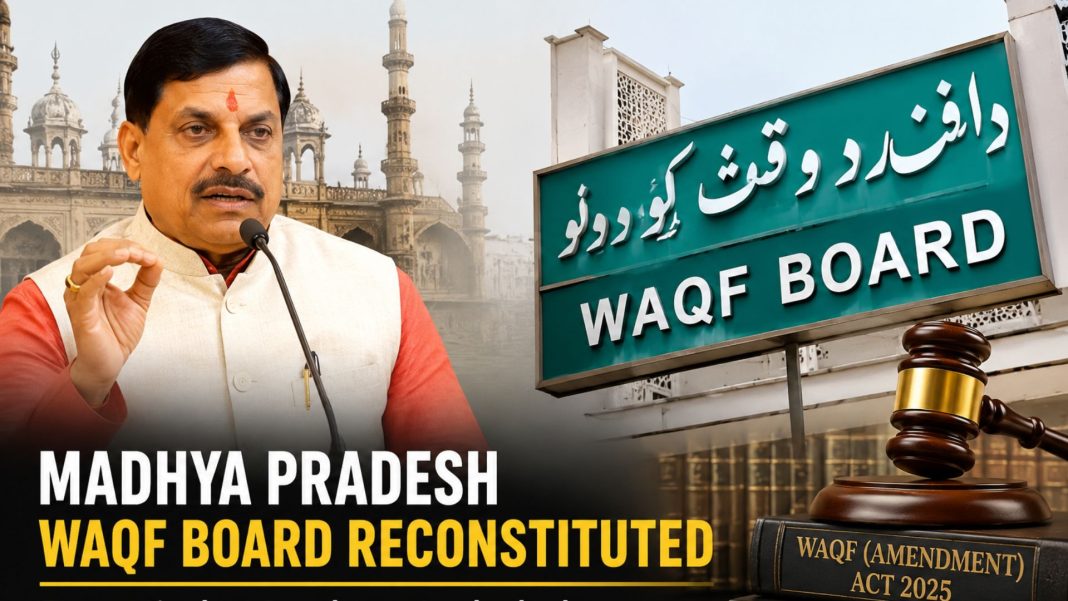

Madhya Pradesh Waqf Board: Madhya Pradesh has become the first state in India to reconstitute its Waqf Board under the provisions of the Waqf (Amendment) Act, 2025.
As part of the newly constituted 10-member board, two Hindu members have been appointed for the first time, reflecting one of the key changes introduced through the amended law.
The Madhya Pradesh government issued the notification constituting the new board on July 5, 2026. According to the official notification and multiple media reports, the board has been formed under Section 13(1) of the Waqf Act, 1995, as amended by the Waqf (Amendment) Act, 2025.
The move marks the first known implementation of this provision by any state after the amendment came into force.
Who Is Part of the New Madhya Pradesh Waqf Board?
Madhya Pradesh Waqf Board: The newly constituted Waqf Board will be headed by Sanwar Patel, who has been appointed as its Chairman.
The other members include:
Manoj Malpani (Hindu member)
Animesh Bhargava (Hindu member)
Najma Heptulla
Atif Aqueel
Faizan Khan
Sister Fatema Choudhary
Shaista Sultan
Shabana Khan
Commissioner, Backward Classes and Minority Welfare Department (Ex-officio Member)
The board also includes two women members, in line with the composition provided under the amended law.
According to the state government’s notification, Najma Heptulla will continue to serve for the remainder of her existing tenure.
Why Is This Development Significant?
Madhya Pradesh Waqf Board: The reconstitution of the Madhya Pradesh Waqf Board is significant because it is the first reported instance of a state implementing the revised composition provisions introduced through the Waqf (Amendment) Act, 2025.
Before the amendment, State Waqf Boards primarily consisted of Muslim members under the framework of the earlier law. The amended legislation allows for the appointment of non-Muslim members to State Waqf Boards, subject to the provisions laid down in the Act.
By constituting the board under the amended law, Madhya Pradesh has become the first state to operationalise this particular provision.
What Is the Role of a State Waqf Board?
A State Waqf Board is a statutory body responsible for managing and supervising Waqf properties, which are assets permanently dedicated for religious, educational or charitable purposes under Islamic law.
Its primary responsibilities include:
Maintaining records of Waqf properties.
Protecting Waqf land from illegal encroachments.
Monitoring the management and income of Waqf assets
Ensuring Waqf properties are used according to their intended religious, educational and charitable purposes.
Taking administrative action wherever required under the Waqf Act.
The board functions under the legal framework established by the Waqf Act, 1995, as amended from time to time.
What Changed Under the Waqf (Amendment) Act, 2025?
The Waqf (Amendment) Act, 2025 introduced several administrative and governance-related changes to the existing law governing Waqf institutions in India.
Among its notable provisions is the revised process for constituting State Waqf Boards, including the eligibility of non-Muslim members to be appointed to these bodies.
The legislation has generated political debate across the country. While the Central Government has stated that the amendments are intended to improve transparency, accountability and administration of Waqf properties, several opposition parties and organisations have raised concerns over certain provisions.
The constitutional validity of some provisions of the Act is currently under consideration before the Supreme Court of India. As of now, no final judgment has been delivered, and the law remains in force.
What Happens Next?
With Madhya Pradesh becoming the first state to constitute its Waqf Board under the amended legal framework, other states may also review and reconstitute their respective Waqf Boards in accordance with the provisions of the Waqf (Amendment) Act, 2025.
However, the timing and composition of such boards will depend on decisions taken by the respective state governments under the applicable legal provisions.
Conclusion
The formation of the new Madhya Pradesh Waqf Board marks an important administrative development following the implementation of the Waqf (Amendment) Act, 2025.
”The appointment of two Hindu members Manoj Malpani and Animesh Bhargava makes Madhya Pradesh the first state reported to have implemented this aspect of the amended law.
While the broader Waqf Amendment Act continues to be debated in political and legal circles, the newly constituted board represents the first practical implementation of the revised provisions relating to the composition of State Waqf Boards.
Disclaimer: This report is based on official notifications and publicly available information from multiple credible news sources. Readers are advised to refer to official government releases for the latest updates.