


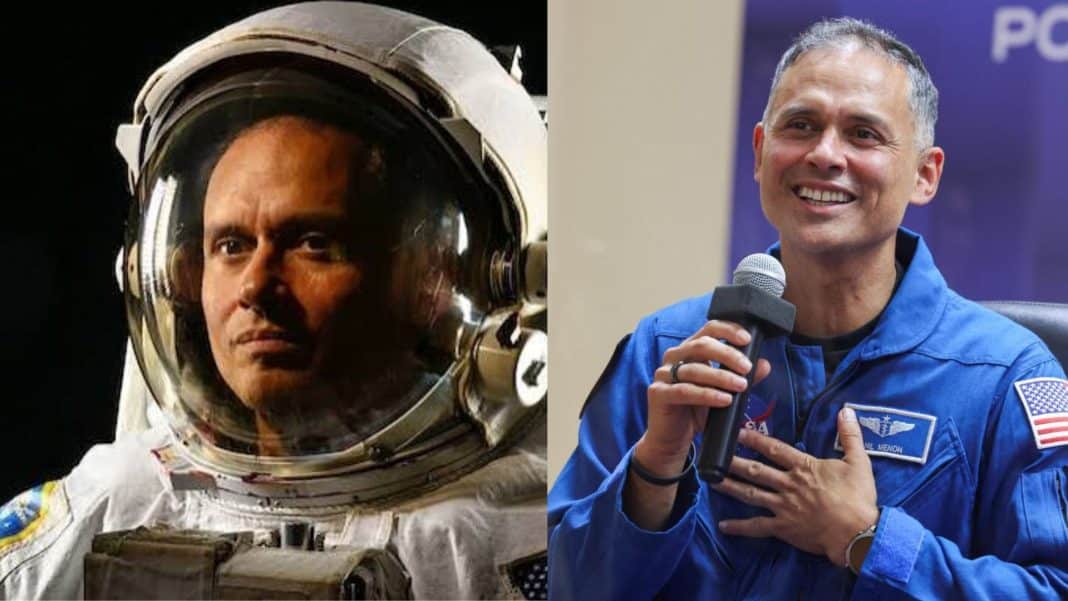

NASA Astronaut Anil Menon Launches to Space: In a historic milestone for international space exploration and the global Indian diaspora, Indian-origin NASA astronaut Anil Menon has officially launched into orbit.
Strapped inside the Roscosmos Soyuz MS-29 spacecraft alongside Russian cosmonauts Pyotr Dubrov and Anna Kikina, Menon lifted off from the legendary Baikonur Cosmodrome in Kazakhstan at precisely 10:47 AM Eastern Standard Time (EST).
The textbook liftoff marks the beginning of a grueling eight-month journey aboard the International Space Station (ISS). The spacecraft is scheduled to complete just two precise orbits around Earth before executing a flawless docking maneuver to connect with the orbiting laboratory.
For Menon, a decorated emergency medicine physician and U.S. Space Force Colonel, this mission represents the culmination of a lifetime dedicated to pushing the boundaries of human endurance, from the treacherous peaks of Mount Everest to the absolute vacuum of space.
The Crew and the Flight Plan: Expedition 74 & 75
NASA Astronaut Anil Menon Launches to Space: The international crew of Soyuz MS-29 is set for an extended stay in low-Earth orbit. Menon, Dubrov, and Kikina will serve as vital flight engineers during Expedition 74 and Expedition 75.
Mission Timeline at a Glance
Launch Date: July 14
Launch Site: Baikonur Cosmodrome, Kazakhstan
Spacecraft: Roscosmos Soyuz MS-29
Mission Duration: 8 Months (Expected return: April 2027)
Destinations: Low-Earth Orbit (ISS) and advanced medical science frontiers
NASA Astronaut Anil Menon Launches to Space: The long-duration mission is designed to bridge the gap between current low-Earth orbit operations and humanity’s upcoming deep-space voyages to the Moon and Mars. By the time Menon returns to Earth in April 2027, he will have spent nearly three-quarters of a year living and working in microgravity.
Who is Anil Menon? The Doctor Who Conquered Extreme Environments
Born and raised in Minneapolis, Minnesota, Anil Menon’s identity is shaped by a rich cultural tapestry, born to Indian and Ukrainian immigrant parents. Long before he wore the NASA meatball insignia, Menon was fascinated by how the human body adapts to extreme stress and hazardous environments.
A Career Forged in Service
Menon’s career reads like a real-life adventure novel. As a physician specializing in emergency medicine, he joined the U.S. Air Force, eventually rising to the rank of Colonel in the newly formed U.S. Space Force. He deployed to Afghanistan in support of Operation Enduring Freedom, treating critical injuries in active combat zones.
Seeking to understand medicine at the roof of the world, Menon also aligned himself with the Himalayan Rescue Association. He spent months stationed at Mount Everest, providing life-saving medical care to mountaineers suffering from high-altitude cerebral edema and extreme frostbite.
The Indian Connection: Despite growing up in the United States, Menon maintained a profound bond with his Indian roots. Early in his career, he spent a year living in India as a Rotary Ambassadorial Scholar.
Instead of working in a pristine lab, Menon traveled across the country to study and support local polio vaccination programs, witnessing firsthand the power of public health infrastructure.
From NASA to SpaceX and Back: The Road to the Astronaut Corps
Menon’s transition from wilderness and military medicine to aerospace medicine was a natural evolution. In 2014, NASA hired him as a Flight Surgeon. In this critical role, he was the medical lifeline for astronauts floating 250 miles above Earth, monitoring their vitals, managing long-term muscle atrophy, and ensuring the health of the crew on the ISS.
Building the Future of Commercial Space
In 2018, Elon Musk’s SpaceX recruited Menon to spearhead their medical division. As the company’s first formal medical lead, Menon was tasked with a monumental challenge: building a medical program from scratch to support commercial human spaceflight.
He designed the medical protocols for SpaceX’s first historic crewed missions (Demo-2 and Crew-1).
He actively contributed to the medical safety parameters of Starship, SpaceX’s next-generation launch system designed to carry humans to Mars.
NASA recognized Menon’s unparalleled dual expertise in emergency medicine and spacecraft engineering. In December 2021, he was selected as part of an elite group of astronaut candidates.
He entered NASA’s grueling two-year astronaut training program the following month, mastering spacewalking, robotics, and T-38 jet operations.
A Cosmic Power Couple: The Astronaut Husband and Wife
Space exploration is truly a family affair in the Menon household. Anil’s wife, Anna Menon (formerly Anna Wilhelm), is an accomplished aerospace engineer and a history-making astronaut in her own right.
In September 2024, Anna launched into orbit as part of SpaceX’s groundbreaking Polaris Dawn mission. A privately funded orbital flight that lasted five days, Polaris Dawn reached the highest Earth orbit since the Apollo program and featured the world’s first commercial spacewalk.
With Anil’s current launch, the Menons join a highly exclusive club of married couples who have both crossed the Kármán line into space.
The Ultimate Orbiting Lab: What Will Menon Do in Space?
While the launch is a spectacular visual event, the real work begins once Menon floats through the hatches of the ISS. As a physician-astronaut, Menon’s research portfolio focuses heavily on solving the biological roadblocks that prevent humans from traveling deeper into the solar system.
Anil Menon’s ISS Science Portfolio
Human Physiology: Blood flow, vein structure, and fluid shifts
Autonomous Medicine: AI & Augmented Reality (AR) guided ultrasounds
Deep Space Logistics: Generating IV fluids from recycled ISS drinking water
Next-Gen Tech: Microgravity manufacturing of semiconductor crystals
- Cracking the Code of the “Fluid Shift”
In microgravity, fluids in the human body shift upward toward the head, causing changes in vision, blood composition, and vein structure. Menon will conduct a series of complex cardiovascular experiments, monitoring how prolonged weightlessness alters blood flow and vascular elasticity. The data collected will help scientists design countermeasures to protect future crews traveling to Mars, who will spend years away from Earth’s gravity.
- Revolutionizing Wilderness Medicine in Space (IV Fluids from Water)
If an astronaut gets severely dehydrated or injured on the way to Mars, they cannot call for a resupply ship. Menon will test a cutting-edge technological innovation that can manufacture medical-grade intravenous (IV) fluids on-demand using the ISS’s existing potable (drinking) water system. This eliminates the need to launch heavy bags of saline into space, creating a self-sustaining medical bay.
- AI and Augmented Reality (AR) Doctors
With a multi-minute communication delay between Earth and deep space, future astronauts must become medically self-reliant. Menon will test medical ultrasound devices integrated with AI and AR headsets.
The software guides non-medical astronauts to perform complex internal scans perfectly, reducing the need for real-time guidance from doctors back on Earth.
- Manufacturing the Brains of Future Computers
Beyond medicine, Menon will oversee experiments involving the growth of semiconductor crystals in zero gravity. On Earth, gravity introduces imperfections (convection currents) during crystal growth.
In the pure weightlessness of the ISS, crystals form with near-perfect atomic structures. This research aims to pave the way for the large-scale production of high-performance components used in supercomputing, advanced artificial intelligence, and specialized medical imagery.
The Next Giant Leap for the Indian Diaspora
Anil Menon’s launch places him in the pantheon of trailblazers of Indian origin who have reached for the stars, following in the footsteps of Rakesh Sharma, Kalpana Chawla, and Sunita Williams.
As the Soyuz MS-29 settles into its orbital rhythm, the world will be watching this unique doctor-colonel. Over the next eight months, the experiments handled by Menon will directly dictate how safely, how far, and how effectively humanity can venture out into the great cosmic ocean.
His journey proves that whether saving lives on the freezing slopes of Everest or conducting pioneering surgery in the weightless void, the human spirit knows no bounds.
Also Read : Jaishankar’s ‘SHANTI’ Formula: Will India’s Bold Move Break the Western Monopoly at the UNSC?