


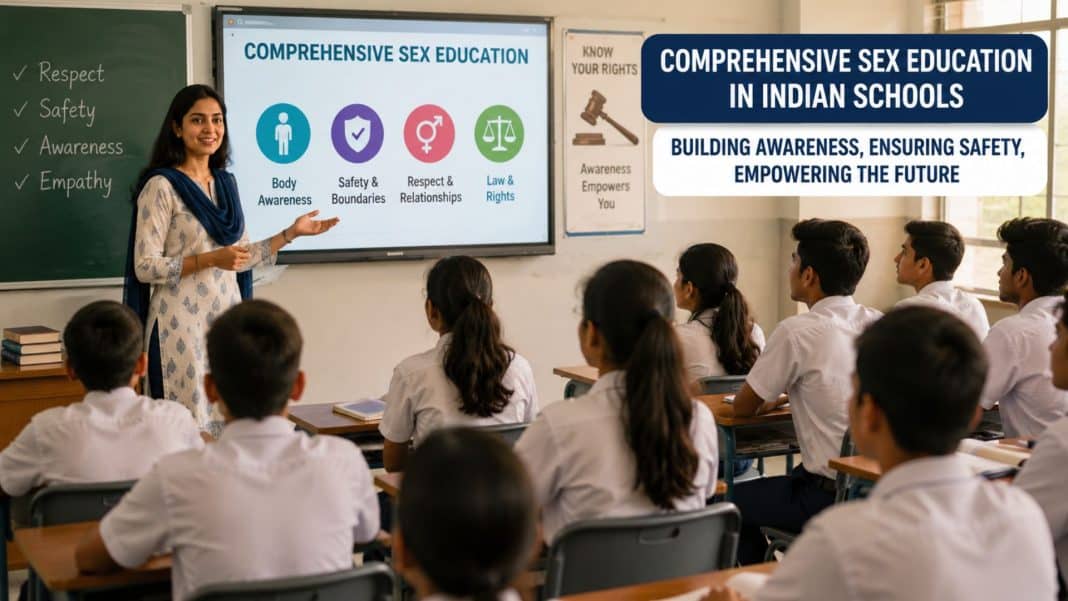

Comprehensive Sex Education in Indian Schools: In a potentially transformative decision for the Indian schooling system, the Central Government has informed the Supreme Court of India that it has agreed to introduce “Comprehensive Sex Education” (CSE) as a formal, integrated part of the curriculum in schools and colleges nationwide.
According to official media reports, the Centre is prepared to roll out this standardized syllabus across the country once the apex court grants its formal approval.
Appearing before a bench of Justices B.V. Nagarathna and R. Mahadevan, Additional Solicitor General Aishwarya Bhati confirmed that the government has accepted the extensive recommendations of a 26-member national expert committee.
This policy shift aims to address critical gaps in adolescent health, safety, and digital literacy while providing young learners with accurate, age-appropriate information.
The Legal Catalyst: Why This Reform is Happening Now
Comprehensive Sex Education in Indian Schools: According to legal and judicial sources, the government’s decision came in direct response to directives from the Supreme Court, which has been examining a worrying trend: the rising criminalization of consensual adolescent relationships under the Protection of Children from Sexual Offences (POCSO) Act.
During ongoing hearings, the apex court expressed serious concern over how the rigid 18-year age of consent framework often traps teenagers in severe criminal cases.
Media reports highlight observations from Justices Nagarathna and Mahadevan, who noted that parents occasionally use the POCSO Act to file complaints against teenage couples out of family “honor” when they elope.
The court emphasized that because adolescence is a naturally vulnerable period of development and experimentation, criminalizing young couples is counterproductive. Instead, the court urged the state to focus on protective education.
To find a solution, the government formed a 26-member committee comprising clinical psychologists, academic experts from the Tata Institute of Social Sciences (TISS), and representatives from the National Legal Services Authority (NALSA) and the National Commission for Protection of Child Rights (NCPCR).
The panel concluded that structured, universal sex education is the most effective preventive measure.
Inside the Proposed Syllabus: Structured and Age-Appropriate Learning
The expert panel’s report explicitly states that sex education should not be treated as an optional, one-off seminar. Instead, it advocates for a mandatory, structured integration into the core school curriculum, fully aligned with the principles of the National Education Policy (NEP) 2020.
According to the recommendations submitted to the court, the proposed educational model will be structured as follows:
Early Childhood & Primary Level: Education will begin at the primary school level, focusing strictly on foundational concepts such as personal hygiene, basic anatomy, and distinguishing between “safe and unsafe touch.”
Adolescent Level: As students transition into higher grades, the curriculum will naturally expand to cover biological changes during puberty, hormonal shifts, personal boundaries, recognizing grooming behaviors, and learning how to seek official help.
Dedicated Time: The committee recommended that dedicated, trained teachers conduct these mandatory classes for 15 to 20 minutes, at least twice a week.
Bridging the Cultural Gap: Engaging Parents and Communities
Acknowledging the deep-seated cultural taboos and historical resistance surrounding sex education in India, the expert committee has proposed a highly collaborative approach.
For decades, similar educational proposals faced political and social opposition, with critics frequently labeling the subject as a “Western concept” incompatible with traditional Indian values.
However, the panel argued that in the modern digital age where adolescents have unmonitored access to the internet and pornography withholding formal instruction leaves them highly vulnerable to online predators, misinformation, and sexual exploitation.
To ease societal concerns and build trust, the report mandates regular dialogues and workshops for parents and guardians.
These sessions will focus on sensitizing families about childhood developmental milestones, the psychological changes of adolescence, and the immense safety value of providing scientifically backed information to children.
Integration of POCSO Awareness
Beyond biological and safety fundamentals, the committee recommended integrating legal awareness, particularly regarding the provisions of the POCSO Act, directly into the adolescent education modules.
By educating senior students on the legal boundaries of consent, personal privacy, and the statutory laws of the land, the program aims to empower teenagers to make informed, legally aware, and safe decisions.
A Highly Anticipated Judicial Verdict
If approved by the Supreme Court, these recommendations will mark one of the most significant structural shifts in India’s modern public and private school systems.
By shifting the focus from post-facto criminalization to proactive, preventative education, the policy hopes to foster a safer, more empathetic environment for India’s youth.
The administrative machinery is currently awaiting the final nod from the apex court to begin coordinating with state education boards and NCERT to design the textbooks and train teachers for the nationwide implementation of Comprehensive Sex Education in Indian schools.
Also Read: Jharkhand Minor Rape Case: How a Panchayat Allegedly Settled a Horrific Crime for a Rs 1 Lakh Fine