


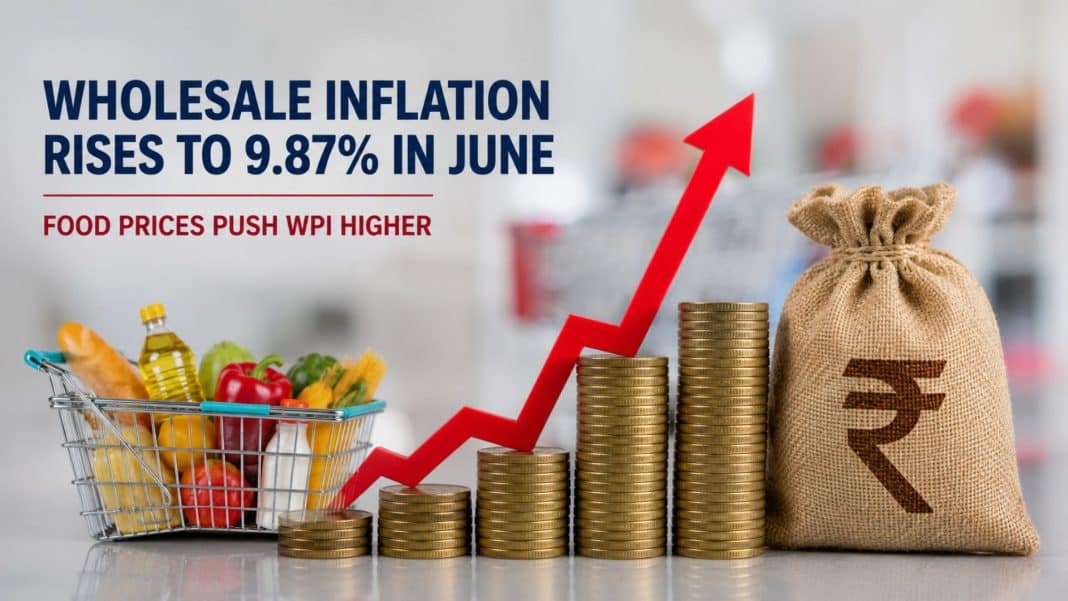

India Wholesale Inflation Rises to 9.87%: India’s wholesale inflation recorded another increase in June 2026, indicating that price pressures at the producer level remain elevated.
According to data released by the Ministry of Commerce and Industry, the Wholesale Price Index (WPI)-based inflation rose to 9.87% in June, compared with 9.68% in May.
The latest figure was also higher than several market estimates, suggesting that inflationary pressures continue to persist despite some moderation in energy prices.
According to the ministry, the rise in wholesale inflation was mainly driven by higher prices of food articles, mineral oils, basic metals, and chemicals & chemical products.
While inflation in the fuel segment eased marginally compared to the previous month, the sharp increase in food prices remained the biggest contributor to the overall rise in WPI.
Food Inflation Emerges as the Biggest Driver
India Wholesale Inflation Rises to 9.87%: Food prices continued to remain the primary reason behind the increase in wholesale inflation during June. Official data showed that the WPI Food Index increased to 6.14%, up from 4.49% recorded in May.
Inflation in primary articles also rose to 7.0%, compared with 4.99% in the previous month. Prices of food articles registered a notable month-on-month increase, while non-food agricultural products also became costlier.
According to official data, the increase reflects continued price pressures in agricultural commodities. While the government has not attributed the rise to any single reason, economists and market observers have linked higher food prices to seasonal factors, supply-side challenges and fluctuations in agricultural output.
Fuel Inflation Moderates but Energy Costs Remain High
India Wholesale Inflation Rises to 9.87%: The fuel and power segment offered some relief during June, although inflation remained significantly elevated on an annual basis.
According to the Commerce Ministry, inflation in the Fuel and Power category eased to 27.41% in June from 30.33% in May.
Official figures showed:
Crude petroleum and natural gas inflation stood at 34.75% year-on-year.
Mineral oils recorded annual inflation of 46.48%.
Electricity prices remained largely stable, with inflation continuing in the negative territory.
Although energy inflation has moderated compared to previous months, petroleum-related products continue to contribute significantly to overall wholesale price pressures.
Manufacturing Sector Continues to Face Input Cost Pressure
Manufactured products, which account for nearly two-thirds of the Wholesale Price Index basket, continued to witness elevated pricing pressure. Inflation in the manufacturing segment remained unchanged at 7.48% in June.
According to the Commerce Ministry, prices increased across most manufacturing industries during the month. Higher inflation was observed in sectors such as:
Basic metals
Chemicals and chemical products
Food products
Electrical equipment
Machinery and equipment
Textiles
Meanwhile, certain categories, including pharmaceutical products and fabricated metal products, recorded comparatively lower prices.
According to economists quoted in various media reports, sustained inflation in manufacturing could increase production costs if raw material prices remain elevated for a prolonged period.
However, the extent to which these costs are passed on to consumers depends on market demand and competitive conditions.
Retail Inflation Also Moved Higher
The latest WPI figures were released a day after the government published June’s Consumer Price Index (CPI) data.
According to official statistics, retail inflation (CPI) increased to 4.38% in June from 3.93% in May. Food inflation under the Consumer Food Price Index (CFPI) also rose to 5.32%, compared with 4.78% recorded in the previous month.
Although WPI and CPI measure different sets of goods and services, both indicators moving upward suggests that inflationary pressures remain visible across different segments of the economy.
Revised WPI Series Reflects Changing Economy
The June inflation figures have been compiled using the government’s revised Wholesale Price Index series, which now uses 2022-23 as the base year, replacing the earlier 2011-12 base year.
According to the Ministry of Commerce and Industry, the revised series expands the commodity basket from 697 items to 957 items, allowing the index to better represent the current structure of India’s economy.
The updated basket also includes several newer products, including electricity generated through solar, wind and nuclear sources, along with other emerging industrial commodities.
The ministry further revised April’s final WPI inflation estimate to 8.36%, slightly higher than the provisional estimate of 8.26%, after incorporating updated responses from reporting units.
What Does Rising Wholesale Inflation Mean?
Wholesale inflation measures price changes at the producer or wholesale level before goods reach consumers. A sustained increase in WPI generally indicates rising input costs for manufacturers, wholesalers and businesses.
According to economists quoted in media reports, wholesale inflation does not automatically result in higher retail prices.
However, if elevated producer costs continue for an extended period, businesses may gradually pass on a portion of these additional costs to consumers depending on demand, competition and overall market conditions.
At the same time, economists note that wholesale and retail inflation often move differently because the two indices track different baskets of goods and follow separate calculation methodologies.
Conclusion
The latest official data indicates that India’s wholesale inflation increased to 9.87% in June 2026, primarily due to higher food prices, along with increases in mineral oils, basic metals and chemical products.
Although fuel inflation moderated compared to May, food inflation remained the biggest contributor to overall wholesale price growth.
Going forward, economists believe factors such as monsoon performance, agricultural output, global commodity prices and supply chain conditions will remain crucial in determining the direction of wholesale inflation.
Any sustained improvement in these areas could help ease price pressures in the coming months, while continued volatility may keep inflation elevated.
For now, the latest WPI data suggests that inflation at the wholesale level remains an important area of focus for policymakers and businesses alike.