


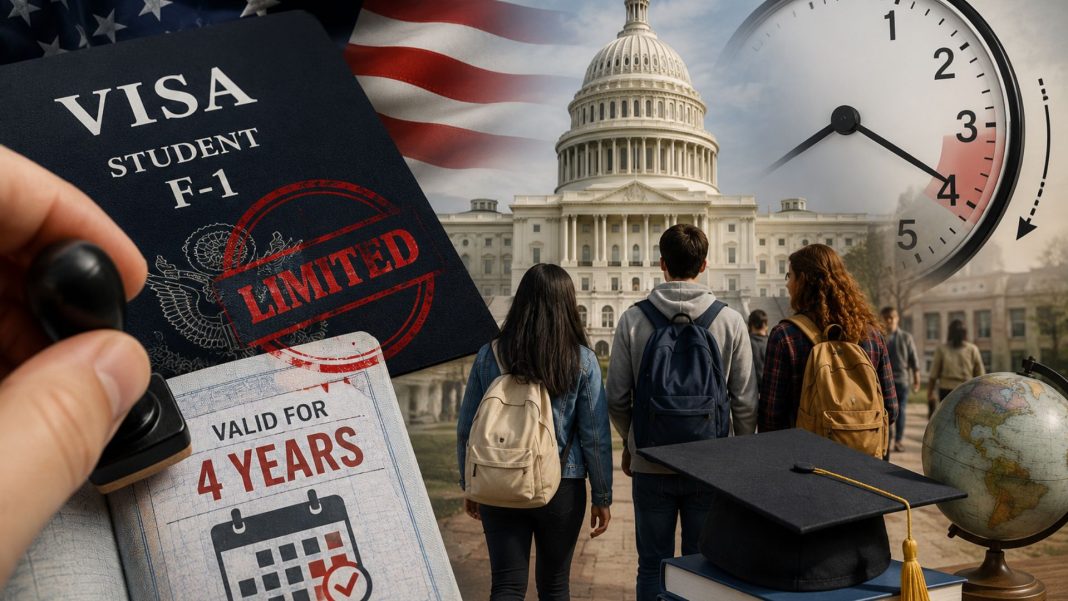

No More ‘Duration of Status’: The landscape of international education in the United States is about to undergo its most significant transformation in decades.
The Trump administration has issued a final notice implementing strict new limits on student visas, effectively dismantling a long-standing policy that allowed international students to live in the US as long as they remained enrolled in school.
Starting this September, the traditional “Duration of Status” (D/S) framework will be officially retired. In its place, the US government is introducing a rigid, fixed-term immigration model that caps most student stays at a maximum of four years.
The Big Shift: Old Rules vs. New Rules
No More ‘Duration of Status’: For decades, the US visa system offered foreign students peace of mind through flexibility. As long as a student was registered full-time, maintained good grades, and followed university rules, they could stay in the country indefinitely to complete their bachelor’s, move on to a master’s or PhD, and complete post-graduation work training.
The new system completely replaces this flexible model. Now, student visas are strictly capped at a maximum of four years.
If a student’s academic course takes longer than four years, they do not get to stay automatically. Instead, they must apply for a formal extension directly with the federal government.
This change shifts the authority of staying in the country from the university’s academic enrollment to direct immigration approval, requiring extra fees, paperwork, and biometrics.
The Crackdown on the 60-Day Grace Period
No More ‘Duration of Status’: Under the previous framework, graduating students enjoyed a comfortable 60-day buffer period. This window allowed them to travel, pack up their lives, or transition onto work visas and Optional Practical Training (OPT) pathways.
The new rule slashes this grace period in half. Students will have just 30 days after their graduation date to either exit the country or successfully transition to a different legal visa category.
Attempting to stay even a day past this window without official government approval will trigger immediate legal consequences.
Why Indian Students are in the Eye of the Storm
This policy shift is poised to hit Indian students harder than any other demographic.
According to the Open Doors 2024 report, over 331,000 Indian students were studying in the US during the 2023–24 academic year. Making up nearly 30% of the entire international student population in America, India stands as the largest source of international scholars in the country.
The major challenges for Indian students under the new rule include:
Lengthy Academic Paths: A massive portion of Indian scholars are enrolled in advanced STEM fields, research-intensive master’s degrees, and doctoral (PhD) programs. Because these tracks routinely take five to seven years to complete, nearly every Indian post-graduate researcher will be forced to apply for formal federal extensions midway through their studies.
Bureaucratic Hurdles: Instead of focusing purely on their research, students will face additional biometrics appointments, costly application fees, and intense immigration scrutiny to prove they deserve to stay.
OPT Work Transitions: The critical transition period from graduation to high-skilled work pathways (like H-1B visas via OPT) will become significantly tighter, leaving very little room for administrative delays.
Security vs. Certainty: The Great Debate
The Department of Homeland Security (DHS) defended the policy update as a vital step toward national security and administrative consistency. Officials argue that student visas should align with other temporary visa categories—such as tourist or guest worker visas—which have always had hard expiration dates.
The government expressed concerns over visa fraud and cases where individuals perpetually enroll in minor courses for decades simply to avoid leaving the country. By implementing a hard four-year limit, they hope to curb these loopholes.
However, the international education community has expressed deep worry. Experts argue that this injects unnecessary fear and bureaucracy into a system that has worked well for decades.
They warn that it may penalize legitimate, hard-working researchers and drive global talent away from the US to competitive destination countries like Canada, the UK, or Australia.
The High Stakes of Overstaying
The most stressful element of the new policy is the immediate consequence of an expired stay.
Under the new guidelines, if a student’s four-year limit passes and their extension application is either delayed in a government backlog or denied, they will immediately begin accumulating unlawful presence.
In US immigration law, accumulating unlawful presence can trigger immediate deportation, lead to three-year or ten-year bans from re-entering the United States, and permanently damage a student’s ability to secure future travel or employment visas.
Action Plan: How Students Can Protect Their Status
With the policy scheduled to take effect this September, international students cannot afford to take a “wait and see” approach. If you are currently studying in the US or planning to arrive soon, immigration experts recommend taking the following proactive steps:
Monitor Your Authorized Stay Date: Do not confuse your visa stamp’s physical expiration date with your authorized period of stay. Keep close track of your electronic I-94 travel record and your I-20 form.
Plan Extensions Well in Advance: If your academic program, doctoral research, or post-grad OPT is expected to run past the four-year mark, coordinate with your university’s Designated School Official (DSO) to file for a federal extension at least six months before your limit.
Maintain Bulletproof Records: Keep flawless documentation of your full-time enrollment, academic progress, and financial support. Under the new rule, the government will highly scrutinize any program extensions or changes in majors.
Watch the Clock Post-Graduation: Mark your graduation date clearly. Keep in mind that your countdown to leave or transition status is now strictly 30 days, not 60.