


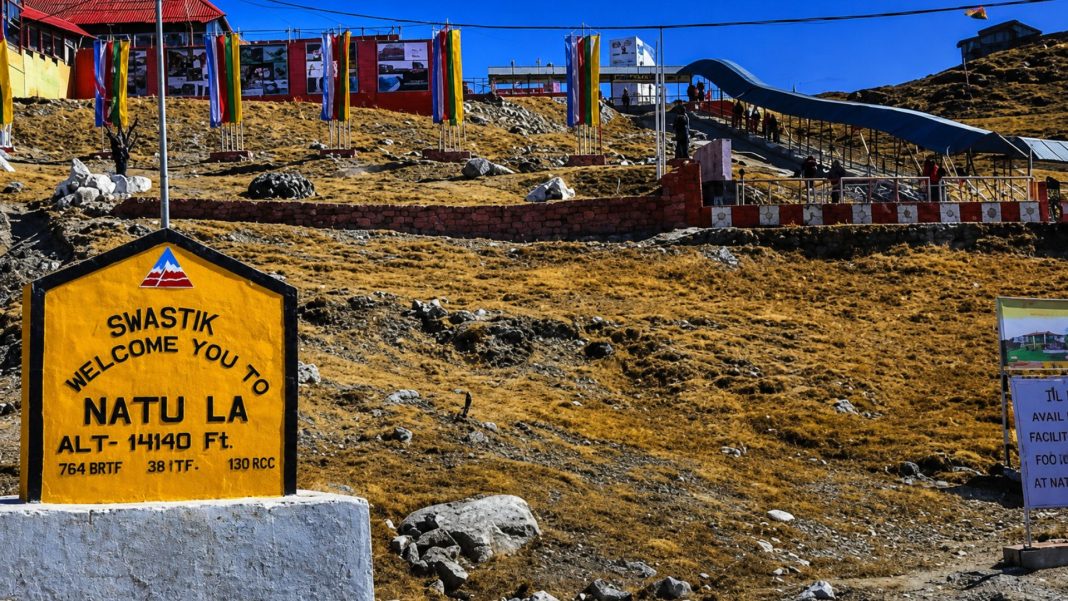

India-China Border Trade: In a major development toward stabilizing bilateral relations, border trade between India and China through the historic Nathu La Pass in East Sikkim is scheduled to resume on August 1, 2026.
This decision marks the end of a six-year hiatus that left local traders, transporters, and border communities in financial uncertainty.
According to media reports, both sides have finalized administrative and logistical arrangements ahead of the reopening.
The high-altitude trading route had remained suspended since 2020 due to the COVID-19 pandemic and heightened military tensions along the Line of Actual Control (LAC).
High-Level Diplomatic Talks Paved the Way for Revival
India-China Border Trade: The breakthrough came following the 24th round of the India-China Special Representatives’ dialogue, co-chaired by National Security Advisor Ajit Doval and Chinese Foreign Minister Wang Yi.
During the discussions, both nations agreed to gradually revive border commerce across three key Himalayan passes:
Nathu La Pass in Sikkim
Shipki La in Himachal Pradesh
Lipulekh Pass in Uttarakhand
According to media reports, this economic restart follows a series of confidence-building initiatives over the past year, including the resumption of the Kailash Mansarovar Yatra pilgrimage through the Nathu La route and ongoing discussions to restore direct passenger flights.
While the primary boundary disputes remain unresolved, the revival of trade reflects a pragmatic approach by both governments to rebuild economic ties in areas of mutual interest.
Significance and History of the Historic Pass
Perched at an altitude of over 14,000 feet (4,310 meters) in the eastern Himalayas, Nathu La is an ancient mountain pass connecting Sikkim with Tibet’s Chumbi Valley.
Situated roughly 54 kilometers from Gangtok, it historically served as a critical branch of the Silk Route, facilitating trade and cultural exchanges between India and Tibet for centuries.
Trade through the pass originally halted following the 1962 India-China war. After more than four decades of closure, diplomatic efforts led to its formal reopening on July 6, 2006.
However, commercial operations came to a sudden stop in 2020 following health protocols and the subsequent military standoff in eastern Ladakh’s Galwan Valley.
Major Relief for Local Sikkim Traders and Border Economy
The reopening is expected to provide immediate financial relief to nearly 600 registered traders in Sikkim, alongside warehouse operators, drivers, hotel owners, and local businesses whose livelihoods depended heavily on seasonal cross-border commerce.
Unlike standard international commerce, trade via Nathu La operates under a bilateral, mutually agreed list of permitted commodities:
Traditional Indian Exports: Garments, blankets, textiles, tea, coffee, agricultural implements, bicycles, edible oil, and handicrafts.
Imports from Tibet Autonomous Region: Raw silk, wool, yak hair, goat skin, medicinal herbs, carpets, and traditional earthenware.
According to media reports, trade is strictly seasonal and conducted exclusively by authorized traders from both nations subject to customs regulations, security checks, and proper quotas.
Infrastructure Upgrades to Support Border Logistics
To support the expected influx of commercial vehicles and improve overall connectivity in East Sikkim, government agencies have accelerated several infrastructure projects across the border belt.
A new highway connecting Rongli to Menla is currently under construction. Officials note that this upgrade will provide a safer, all-weather alternative to older routes prone to severe landslides during the heavy monsoon season.
Beyond strengthening trade corridors and military logistics, the improved infrastructure is expected to bolster domestic tourism in East Sikkim.
Strategic Implications of the Reopening
Beyond its commercial benefits, Nathu La holds immense strategic importance. Located near the Chumbi Valley where the borders of India, China, and Bhutan converge it is one of the few designated trading posts along the contested frontier.
According to media sources, the resumption of trade serves as an important diplomatic signal: demonstrating that economic cooperation and strategic competition can coexist as both nations continue managing complex territorial differences.
Also Read: NEET Aspirant Dies by Suicide in Maharashtra After Falling Short in Re-Exam