


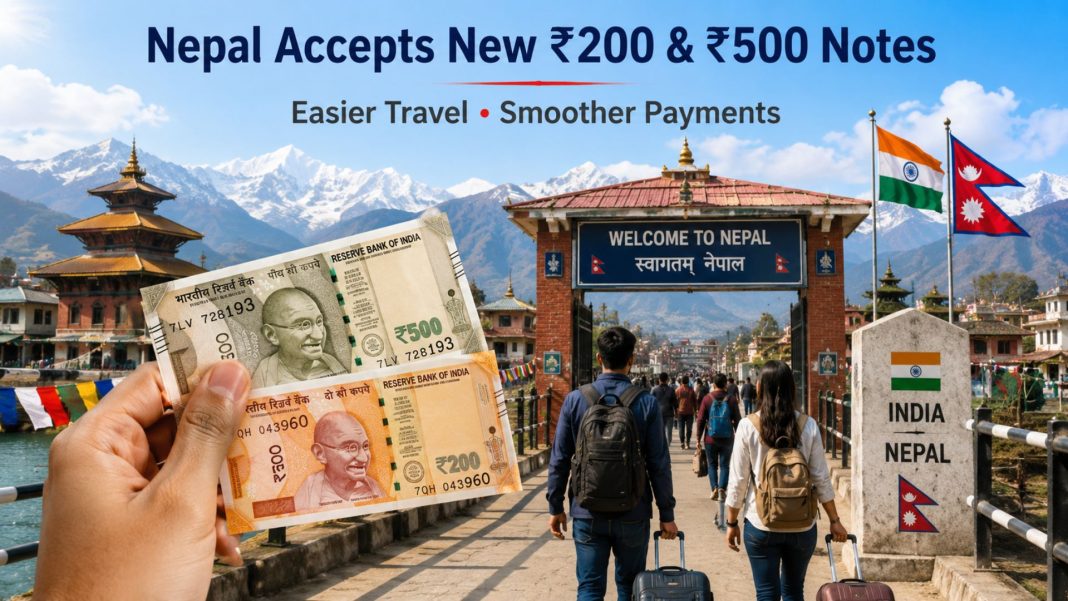

Nepal Allows New ₹200 and ₹500 Indian Notes: In a major development for cross-border mobility and regional commerce, the Nepali government has eased long-standing financial restrictions by officially permitting the use and entry of newly designed Indian currency notes.
According to recent media reports, travelers and merchants can now legally carry post-demonetization Indian currency notes of ₹200 and ₹500 denominations into Nepal under specified conditions.
The policy shift is set to resolve years of transaction hurdles faced by millions of Indian tourists, daily commuters, and local business owners along the porous India-Nepal border.
What Changes Under the New Nepal Currency Rules?
Nepal Allows New ₹200 and ₹500 Indian Notes: According to statements attributed to the Nepal Rastra Bank (NRB), the central banking authority has cleared the circulation and carrying of specified high-value Indian banknotes. However, strict parameters remain in place to prevent misuse:
Eligible Banknotes: Only newly designed ₹200 and ₹500 currency notes issued by the Reserve Bank of India (RBI) after November 9, 2016, are authorized for use and transport.
Prohibited Currency: Pre-demonetization Indian notes of ₹500 and ₹1,000 remain strictly banned. Any attempt to introduce these outdated bills into Nepal remains illegal.
Maximum Carrying Limit: Individual travelers whether Indian or Nepali citizens are legally permitted to carry up to a maximum total value of ₹25,000 in Indian currency per person.
According to media reports, these guidelines aim to streamline genuine personal expenditures while keeping cross-border financial flows within regulated limits.
Guidelines for Third-Country Travel and Foreign Exchange
The regulatory update also lays down explicit instructions regarding international travel and foreign currency limits:
1.Strict Restriction on Third-Country Transit
Nepal Rastra Bank officials have clarified that Indian currency can only be carried directly between India and Nepal.
Nepali nationals and international visitors are prohibited from bringing Indian Rupees into Nepal from a third country, or taking Indian currency from Nepal to any other country besides India.
2.Foreign Currency Customs Thresholds
According to local coverage, travelers entering Nepal with foreign currencies (other than Indian currency or small-denomination Indian notes up to ₹100) do not need to submit a customs declaration if the total amount is under $5,000 USD (or its equivalent in other currencies).
Any amount exceeding this threshold requires a written formal declaration to customs officials upon arrival at airports or border checkpoints.
Why Was the Ban Imposed in 2016?
The background to this policy shift dates back to November 8, 2016, when India announced the demonetization of its original ₹500 and ₹1,000 notes.
Following the announcement, significant reserves of old Indian currency remained uncollected in Nepal.
Due to security concerns, fears over counterfeit currency smuggling, and uncertainties surrounding redemption mechanisms between the RBI and the NRB, Nepal restricted the use of Indian notes above the ₹100 denomination.
According to media reports, nearly a decade of continuous bilateral talks and reviews between central banking representatives was required to establish a secure framework that eventually paved the way for this clearance.
Impact on Tourism, Border Economies, and Bilateral Trade
Industry observers note that India remains Nepal’s largest source of tourism and its primary trade partner. Thousands of students, laborers, and business owners move across the shared border daily.
According to statements from NRB spokesperson Guru Prasad Poudel in press reports, this updated framework was finalized following extensive consultations with the Reserve Bank of India to ease financial friction for travelers.
Key Benefits Include:
Simplified Travel Expenses: Indian tourists visiting popular hubs like Kathmandu, Pokhara, and Lumbini can now pay directly for hotel bookings, dining, and shopping using ₹200 and ₹500 notes, drastically reducing their reliance on currency exchange counters or foreign cards.
Boost for Small Merchants: Border-town traders in regions like Raxaul-Birgunj and Sonauli-Bhairahawa stand to gain from smoother cash transactions, accelerating local commerce.
Reduced Transaction Costs: Daily wage workers and students moving between the two nations can avoid the fees typically associated with unofficial currency exchanges or wire transfers.
Final Takeaway for Travelers
While the acceptance of new ₹200 and ₹500 notes brings significant convenience, travelers are advised to adhere strictly to the ₹25,000 cash cap and ensure all banknotes carried were issued post-November 2016.
Abiding by these official rules ensures a smooth, hassle-free trip across the border.