


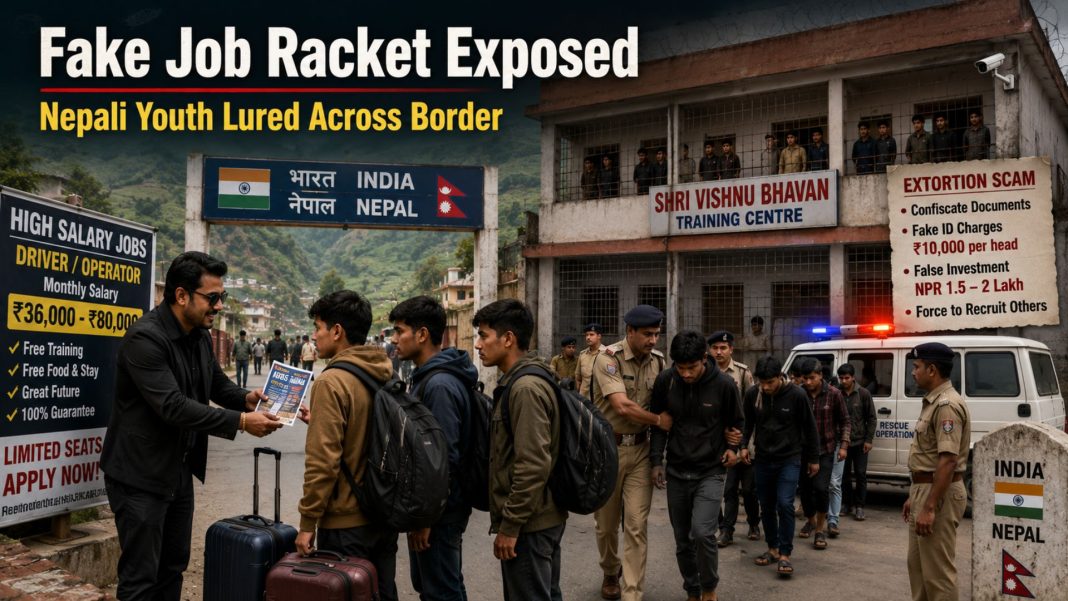

Nepal Job Racket in Bihar Exposed: An international trafficking network operating along the India-Nepal border has come to light following a media investigation.
According to media reports, several organized syndicates in Bihar and Uttar Pradesh are targeting young people from Nepal with lucrative employment offers, only to hold them captive and extortionately exploit them under the guise of training and business opportunities.
Modus Operandi: How the Fake Job Network Functions
Nepal Job Racket in Bihar Exposed: As reported by investigative journalists, the racket lures young Nepali job seekers across the border by promising high-paying positions such as drivers and machine operators in India, with monthly salary offers ranging from ₹36,000 to ₹80,000.
Once the victims arrive in India, the syndicate executes a structured plan to isolate and extort them:
Confiscation of Personal Items: Upon reaching training locations, victims’ mobile phones and personal documents are confiscated to cut off communication with their families.
Initial Identity Fees: Money ranging from ₹10,000 per head is extorted under the pretext of creating Indian documents like Aadhaar cards and driving licenses.
Extortion for ‘Investments’: Promising high returns, shares, and promotions, the operators coerce victims into paying between NPR 1.5 lakh to NPR 2 lakh.
Forced Recruitment: Once a victim’s financial resources are exhausted, they are pressured to trap other Nepali youths into the network often disguised as a multi-level marketing or “network business” scheme.
Victim Accounts: From Promising Careers to Captivity
According to media reports, three victims Birman Tamang, Gam Bahadur, and Kul Bahadur recently escaped the racket and returned to Kathmandu. They recounted being brought to Gayaji in Bihar after being offered driver and operator jobs.
Upon arrival, they were kept under strict surveillance for a week at a hostel setup named ‘Shri Vishnu Bhavan’ in the Kendui locality of Gayaji.
After extorting large sums of money under promises of high earnings, over 60 victims were taken on a trip to Rajgir on the pretense of a local fair.
Shortly after, the operators falsely claimed a virus outbreak had occurred at the hostel and instructed them to return to Nepal.
Many victims who returned to Nepal are reportedly heavily burdened by debt and unable to go back to their family homes due to the financial loss suffered during the ordeal.
Active Rackets Across Bihar and Recent Rescues
According to ground investigative reports, multiple active gangs are operating across various locations in Bihar, including Gayaji, Muzaffarpur, and Punpun.
Journalists investigating the Kendui facility in Gayaji reported finding several Nepali youths hosted in a two-story building above a local post office, though occupants remained tight-lipped when approached.
This is part of a broader trend of cross-border human trafficking operating under the umbrella of fake network marketing businesses. According to media reports citing human rights documentation:
Mass Rescue Operations: In May 2026, law enforcement agencies rescued 453 individuals from Kushinagar in Uttar Pradesh.
Official Complaints: Victims Kul Bahadur and Birman Tamang have formally registered complaints with the Home Ministry in Nepal, naming several key individuals Prem Thami, Man Kumari Lama, Tulesh Ale Magar, Santu Tamang, Pawan Mahtara, and Sunil Dhanuk alleged to be orchestrating the operation.
Human Rights Reports: Reports from the Nepal Human Rights Commission have repeatedly flagged how trafficking operations exploit “network marketing” and fake employment labels to bypass suspicion.
Calls for Bilateral Security Action
According to media reports, while the physical venues and infrastructure are situated within Indian states like Bihar and UP, key organizers running the syndicates are themselves Nepali nationals exploiting their local connections.
With missing persons reports mounting and escaped victims coming forward, human rights advocates and victims are urging stronger coordination between Indian and Nepali law enforcement agencies to dismantle these training centers, track financial trails, and prevent further exploitation of vulnerable job seekers along the border.
Also Read: Nepal Allows New ₹200 and ₹500 Indian Notes: Major Relief for Tourists and Cross-Border Trade