


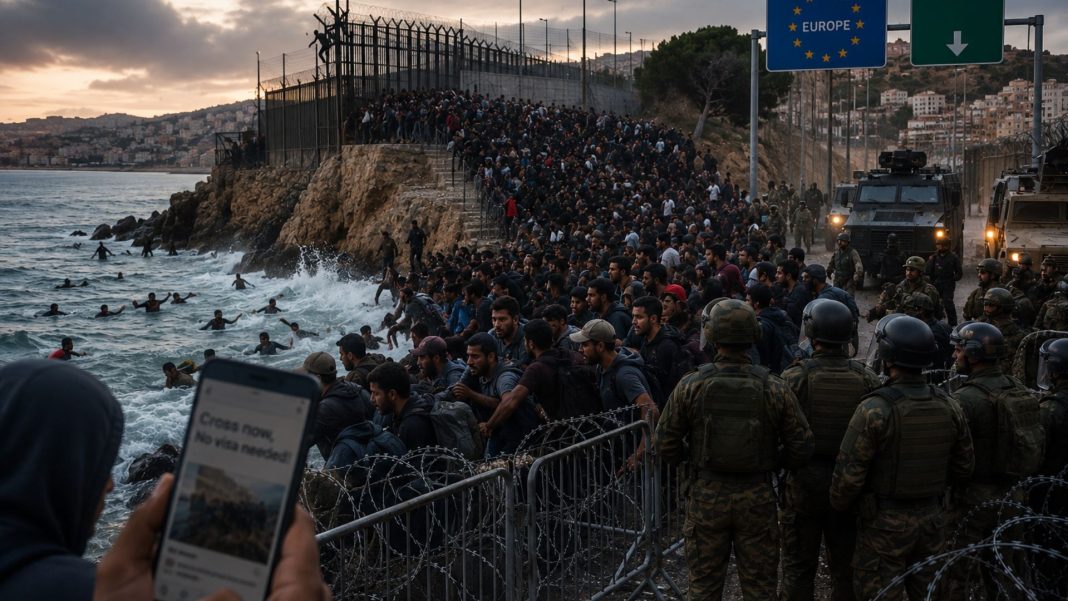

Chaos at the Frontier: A massive humanitarian and security crisis has erupted along Europe’s southern frontier as an estimated 60,000 migrants attempted to cross into Ceuta, a Spanish North African enclave of just 85,000 residents.
The sudden, violent surge over a 48-hour period has left at least 34 people dead in coastal waters, overwhelmed local infrastructure, and prompted the deployment of the Spanish military.
The unprecedented event was fueled by a toxic mix of viral social media campaigns, distorted legal rulings, and deep-seated economic hardship across North Africa, triggering severe political friction across the European Union.
The Digital Spark: How Social Media Algorithms Drove the Influx
Chaos at the Frontier: At the core of the mass migration event was a hyper-targeted digital campaign across TikTok, Instagram, Facebook, and encrypted WhatsApp networks.
For weeks, algorithms flooded young Moroccans’ feeds with short-form videos framing the dangerous sea crossing from Fnideq (Castillejos) into Ceuta as a simple, guaranteed achievement.
Glorified Success Stories: Burner profiles posted slickly edited videos set to upbeat music showing young men celebrating on Ceuta’s beaches or walking freely through its streets.
Tactical Instructions: Content creators explicitly advised followers to ditch heavy belongings, wear only swim trunks, and move in clusters of at least seven people to overload border patrol interception capabilities.
Annotated Maps: Diagrams and satellite imagery shared on Instagram highlighted vulnerable entry points, specifically the Tarajal breakwater and the rocky cliffs of Belyouch.
Despite raids by Moroccan cyber-crime units, digital creators evaded law enforcement by deleting and recreating accounts in rapid succession.
The Legal Catalyst: High Court Ruling Distorted into “Open Border” Meme
Chaos at the Frontier: The online surge gained immense momentum following a pivotal legal development in Madrid. Spain’s Supreme Court ruled that migrants intercepted at sea while attempting to reach Ceuta or Melilla could no longer be subject to summary returns (“pushbacks”).
The court mandated individual processing and full access to international protection procedures once an individual enters Spanish territorial waters.
Within hours, translators and social media influencers distorted the nuanced legal judgment into a viral meme: “The border is legally open.”
This false perception spread rapidly among young Moroccans facing high youth unemployment and limited mobility, creating an intense “now or never” urgency to attempt the crossing.
48 Hours of Chaos: Land and Sea Defense Breakdown
By Thursday morning, thousands of prospective migrants gathered at the Moroccan border town of Fnideq. When crowds surged toward the coastline, Moroccan security forces deployed tear gas, water cannons, and riot gear. However, the sheer volume of people quickly breached defensive lines.
Hundreds poured into the cold ocean simultaneously to swim around the 10-kilometer coastal breakwaters.
Tragedy at Sea: Strong currents, exhaustion, and freezing temperatures caused widespread chaos. Maritime rescue teams confirmed at least 34 drownings, with hundreds more treated for severe hypothermia.
Infrastructure Collapse: Inside Ceuta, primary reception centers, already operating at 400% capacity before the influx, collapsed. Hundreds of migrants were forced to sleep in public parks, beaches, and makeshift encampments.
Juan Jesús Vivas, leader of Ceuta’s regional government, described the situation as “absolute chaos” and urgently demanded a national emergency declaration.
Military Deployment and Political Fallout Across Europe
In response to the escalating emergency, Spanish Prime Minister Pedro Sánchez deployed the Spanish Armed Forces, including armored units, to reinforce the Civil Guard and National Police along Tarajal beach.
Sánchez and Interior Minister Fernando Grande-Marlaska flew directly to Ceuta to oversee border operations, emphasizing that Spain would defend its territorial integrity while managing humanitarian needs.
High-level diplomatic talks were immediately opened between Madrid and Rabat to coordinate expedited returns of individuals entering through non-legal channels.
Schengen Under Threat
The crisis has ignited sharp political conflict within the European Union. Italian Prime Minister Giorgia Meloni publicly criticized Madrid’s border management, demanding that Spain be temporarily suspended from the Schengen open-border agreement until full control over its external perimeter is restored. Meloni warned that unmonitored entry into Spanish enclaves poses an immediate risk to collective European security.
Key Crisis Metrics at a Glance
| Metric | Details |
|---|
| Total Influx / Attempts | Up to 60,000 migrants in a 24–48 hour period |
| Ceuta Resident Population | Approximately 85,000 residents |
| Confirmed Fatalities | At least 34 drownings reported |
| Key Entry Points | Tarajal Breakwater and Belyounech (Belyouch) Cliffs |
| Security & Military Deployment | Spanish Armed Forces, Armored Vehicles, and the Spanish Civil Guard |
Also Read : CEUTA BORDER COLLAPSE: 49,000 Migrants Surge Into Spanish Enclave in 24 Hours