


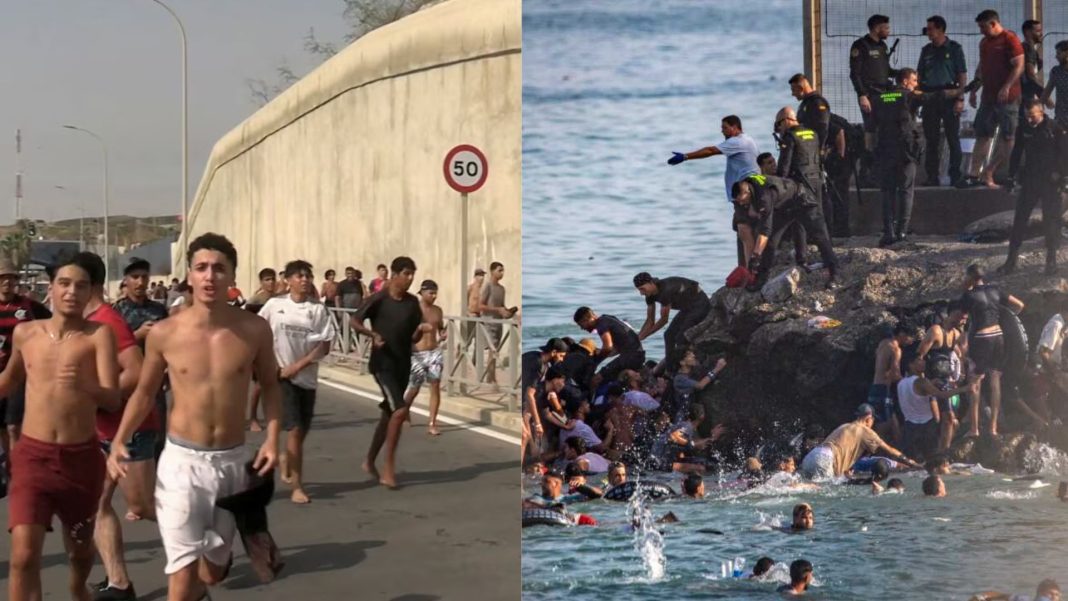

CEUTA BORDER COLLAPSE : Spain’s North African exclave of Ceuta has been plunged into “absolute chaos” after an estimated 49,000 migrants crossed the border in a single 24-hour window, completely overwhelming local security forces and reception facilities.
The unprecedented influx, representing more than half of the combined population of Spain’s North African enclaves, has left thousands sleeping on streets, triggered deadly clashes at the frontier, and ignited a major diplomatic crisis within the European Union.
Unprecedented Surge Overwhelms Frontier
CEUTA BORDER COLLAPSE : Migrants arrived in continuous waves, bypassing border controls by scaling six-meter-high wire fences or swimming around the Tarajal breakwater using inner tubes, makeshift flotation devices, and flippers. Video footage showed streams of people entering the enclave unchallenged and moving inland as border control mechanisms effectively collapsed.
“It is absolute chaos,” said Rachid Sbihi, chief of the local Spanish Civil Guard Association. “The border control has totally collapsed. Arrival centers are beyond capacity, and thousands of people, including women and unaccompanied children, are left sleeping in parks and on sidewalks.”
To put the scale in perspective:
85,000: Combined population of Spain’s two African exclaves, Ceuta and Melilla.
49,000: Migrants entering Ceuta in just 24 hours.
18+: Confirmed deaths during crossing attempts and border clashes.
Deadly Crossings and Violent Clashes
CEUTA BORDER COLLAPSE : The rushing tide of crossings quickly turned tragic. At least 18 people have died, mostly from drowning in rough sea currents or being crushed against border breakwaters.
On the Moroccan side of the frontier, violence erupted as security forces attempted to push back crowds. Authorities utilized water cannons to dislodge hundreds gathered near the fence, while rioters torched at least one bus and seven cars during the unrest.
Key Crisis Metrics
Total Arrivals (24 Hours): ~49,000 migrants
Fatalities Reported: 18 confirmed (drowning/crush)
Key Origin Countries: Morocco & Sub-Saharan Africa
Local Enclave Population: ~85,000 residents
Madrid Deploys Troops but Denies Emergency Status
Responding to desperate pleas from local authorities, the Spanish government dispatched army units, specialized diving teams, and police reinforcements to secure the border perimeter.
However, despite Ceuta’s administration requesting a formal national emergency declaration on national security grounds, Madrid has stopped short of issuing one, arguing that the situation can be handled through standard administrative procedures and security deployments.
Spain’s Interior Ministry confirmed that joint operations with Moroccan authorities have succeeded in halting new crossings, though managing the tens of thousands already inside the enclave remains a daunting logistical nightmare.
What Sparked the Mass Crossing?
While human trafficking rings clearly exploited the border breach, legal experts and critics point to two major catalyst events:
Spanish Supreme Court Ruling: A recent legal decision restricted the use of summary returns (immediate pushbacks) for migrants intercepted at sea, requiring standard, longer processing procedures instead. Smugglers reportedly weaponized this ruling to convince migrants that entering Spain by sea guaranteed legal entry.
Legal Regularization Plan: Rumors surrounding a proposed Spanish government initiative to grant legal status to nearly 500,000 undocumented migrants already in the country created an intense “pull factor” across North and Sub-Saharan Africa.
Moroccan official sources maintained that criminal smuggling networks organized the breach, reiterating that bilateral security cooperation with Spain remains active.
European Fallout: Schengen System Under Threat
The crisis in Ceuta has sent shockwaves through European capitals. Because Ceuta represents the European Union’s only land border on the African continent (along with Melilla), an influx of this magnitude threatens free movement across Europe.
Italian Prime Minister Giorgia Meloni issued a sharp warning, threatening to suspend Schengen free-travel arrangements with Spain if Madrid fails to secure its outer frontier. The threat has ignited diplomatic friction, with Spanish officials calling on EU partners to show solidarity rather than issue ultimatums.
Border Sealed, Expulsions Begin
As of Friday afternoon, border crossings have come to a standstill following heavy deployments by Spanish and Moroccan forces.
Spain has reaffirmed its intention to push back and deport those who entered illegally. However, with reception infrastructure completely paralyzed and 49,000 individuals scattered across the tiny 18-square-kilometer enclave, humanitarian groups warn that tracing, processing, and repatriating such a massive group could take months.