


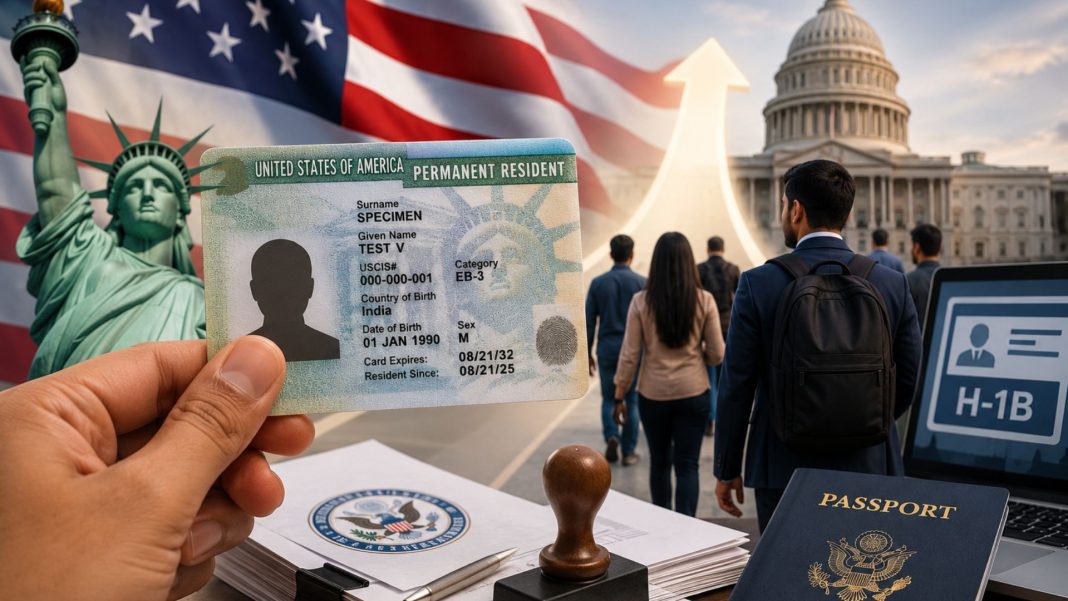

U.S. Green Card Big Update: In a landmark legislative move that could reshape the American immigration landscape, U.S. Senator Alex Padilla has renewed a powerful push for a bill designed to grant Green Cards to individuals who have continuously resided in the United States for at least seven years.
If signed into law, the “Renewing Immigration Provisions of the Immigration Act of 1929” would replace outdated cutoff dates and create a rolling eligibility system. This means anyone meeting the seven-year continuous stay requirement, and maintaining a clean criminal record, could qualify to apply for lawful permanent resident status.
The proposed law offers a potential lifeline to over 8 million long-term residents, including Indian tech professionals stuck in decades-long H-1B visa backlogs, “Dreamers,” TPS holders, and families facing legal separation due to age-out rules.
WHY THIS IS A GAME-CHANGER FOR INDIAN H-1B WORKERS
U.S. Green Card Big Update: For hundreds of thousands of Indian technology professionals, the American Dream has long been stalled by systemic delays.
The Per-Country Barrier: Under current rules, employment-based Green Cards impose a strict 7% per-country cap. Because Indians represent the largest pool of high-skilled H-1B workers, this cap has created backlogs stretching into decades.
Freedom From Work Visas: Obtaining a Green Card allows noncitizens to live and work in the U.S. permanently without tied employer sponsorships or continuous visa renewals. Changing jobs or switching industries no longer requires tedious visa transfers.
Saving “Aging Out” Children: Thousands of children of long-term visa holders risk losing their legal status and face deportation once they turn 21. A rolling 7-year Green Card option provides a safety net for these families before youth age out of dependent status.
MODERNIZING AN OUTDATED SYSTEM: HOW THE LAW WOULD CHANGE
U.S. Green Card Big Update: The crux of Senator Padilla’s proposal relies on updating Section 249 of the Immigration and Nationality Act, commonly known as the “Registry”.
Currently, the Registry rule only protects individuals who arrived in the U.S. before January 1, 1972, a 50-year-old benchmark that leaves modern immigrants behind.
By shifting the standard to a rolling 7-year continuous residence model, the legislation creates a dynamic, future-proof mechanism for lawful integration.
STRICT ELIGIBILITY: WHO QUALIFIES AND WHO GETS EXCLUDED?
While the bill opens an expansive door, it does not offer unconditional entry. Applicants must satisfy rigorous Department of Homeland Security (DHS) vetting standards.
Who Qualifies?
Long-Term H-1B Holders: High-skilled professionals with 7+ years of continuous U.S. residence.
Dreamers: Immigrants who arrived in the United States as young children.
TPS Holders & Essential Workers: Individuals with Temporary Protected Status and frontline service personnel.
Documented Dependents: Youth at risk of aging out of family-based applications.
Who Gets Excluded?
Individuals with Criminal Records: Any serious criminal history, felony convictions, or severe public safety violations trigger instant disqualification.
Incomplete Stays: Applicants who cannot produce verifiable documentation showing unbroken 7-year residency.
POLITICAL HEADWINDS: THE ROAD AHEAD IN CONGRESS
Despite growing support among immigrant advocacy groups and Democratic lawmakers, the legislative battle ahead is steep.
Bipartisan Friction: Republican lawmakers predominantly oppose sweeping registry updates, labeling them broader amnesties and pushing for stricter enforcement-first border policies.
Timeline for Enactment: If passed by Congress and signed into law, the new rules are set to take effect 60 days after enactment.
Strategic Push: Sponsors argue the bill provides a pragmatic economic boost by legalizing millions of taxpayers who are already fully integrated into the American workforce.
SENATE PUSH RENEWED AMID RISING IMMIGRATION DEBATE
In the latest updates from Capitol Hill, Senator Alex Padilla has formally reiterated his push for the Registry bill to counter shifting federal immigration enforcement strategies and expanding administrative hurdles facing long-term noncitizens.
Immigration attorneys advise prospective applicants to begin organizing records, such as historical tax filings, lease agreements, employment records, and travel logs, to establish proof of continuous presence should the legislative landscape shift in favor of passage.
Also Read : Pakistan Coal Mine Explosion: 32 Dead, 10 Trapped in Quetta Methane Blast