


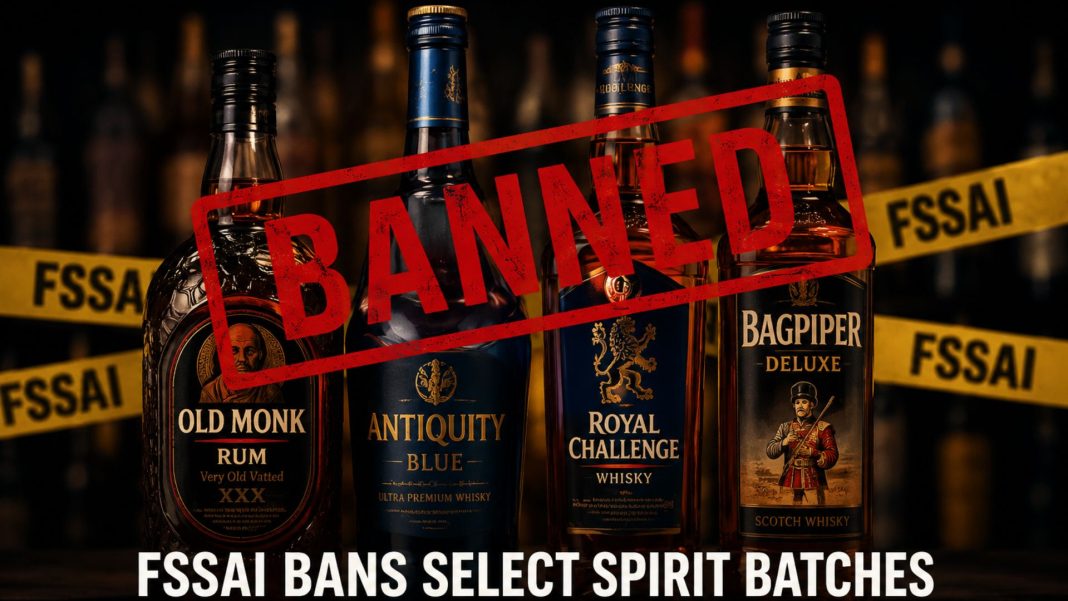

FSSAI Bans Select Old Monk: The Food Safety and Standards Authority of India (FSSAI) has barred the sale of specific variants of major popular spirits brands including Old Monk, Antiquity Blue, Royal Challenge, and Bagpiper Deluxe after laboratory evaluations uncovered non-compliant manufacturing practices.
According to media reports, testing conducted by the apex food safety regulator revealed the presence of artificial or nature-identical flavourings that violate established national standards for alcoholic beverages.
The enforcement action targets products manufactured by prominent industry leaders, including Diageo India’s United Spirits, Inbrew Beverages, and Mohan Rocky Springwater, signaling an intensifying regulatory push across India’s fast-growing beverage market.
Affected Brands and Manufacturing Facilities
Has FSSAI banned Old Monk? According to reports citing news agency Reuters, the regulatory order specifically restricts the distribution and sale of several specific spirit batches produced across designated state units:
United Spirits (Diageo India): Antiquity Blue Whisky and Royal Challenge Whisky manufactured at facilities located in Madhya Pradesh.
Inbrew Beverages: Bagpiper Deluxe Whisky and Old Cask Deluxe XXX Rum produced at bottling plants in Madhya Pradesh.
Mohan Rocky Springwater: Three distinct variants of Old Monk Rum manufactured at facilities in Maharashtra.
According to media reports, official communications have not yet clarified whether the prohibition applies solely to batches produced at these specific regional plants or if the directive will extend to identical brand lines manufactured across other state facilities nationwide.
Why FSSAI Intervened: Artificial Flavouring vs. Natural Aging
FSSAI Bans Select Old Monk: Indian food safety regulations permit the addition of approved natural flavouring substances in select spirit categories.
However, the regulatory intervention centers on how external synthetic compounds were applied to imitate the intrinsic taste and aroma profile of the spirits themselves.
According to media reports citing official FSSAI statements, laboratory tests established that manufacturers were adding synthetic “rum flavour” into rum products and synthetic “whisky flavour” into whisky formulations.
The regulator pointed out that adding an artificial flavour of the beverage itself is not an internationally recognized manufacturing practice.
Standard industry protocols mandate that authentic spirits derive their character, flavor notes, and color through natural ingredients such as molasses, malted barley, or grain mash alongside proper maturation and barrel aging.
FSSAI concluded that substituting natural maturation and raw ingredient processing with artificial or nature-identical flavour enhancers renders the affected batches sub-standard under the Food Safety and Standards Act.
Industry Response and Commercial Implications
FSSAI Bans Select Old Monk: India represents one of the world’s largest alcoholic beverage markets, with overall annual revenue estimated at approximately $40 billion.
Domestically produced spirits such as the affected variants of Old Monk, Bagpiper, and Royal Challenge serve as mass-market staples positioned at accessible price points compared to premium imported Scotch or aged rums.
According to media reports citing senior industry executives, liquor manufacturers have expressed concern over the scope of the order.
Company representatives reportedly maintained that their manufacturing processes complied with existing statutory provisions regarding permitted additives.
As of reporting time, official media queries submitted to Diageo India, United Spirits, Inbrew Beverages, and Mohan Rocky Springwater seeking further operational clarity remain unanswered.
Broader Regulatory Crackdown Across the Beverage Sector
This regulatory action against major liquor manufacturers forms part of a wider enforcement campaign by FSSAI targeting mislabeling, synthetic additives, and unauthorized product claims across the broader food and consumer goods sector.
According to media reports, the food authority recently issued directives to manufacturers of high-caffeine functional drinks to cease marketing their products under the term “energy drinks,” despite challenges raised by major multinational brands.
Coupled with recent enforcement drives against misleading front-of-pack consumer claims, FSSAI’s latest action underscores a sharp tightening of regulatory oversight across India’s consumer markets.
Disclaimer: The information provided in this article is compiled from public media reports, official regulatory announcements, and news agency disclosures for informational and educational purposes only. It does not constitute financial, legal, or commercial advice.