


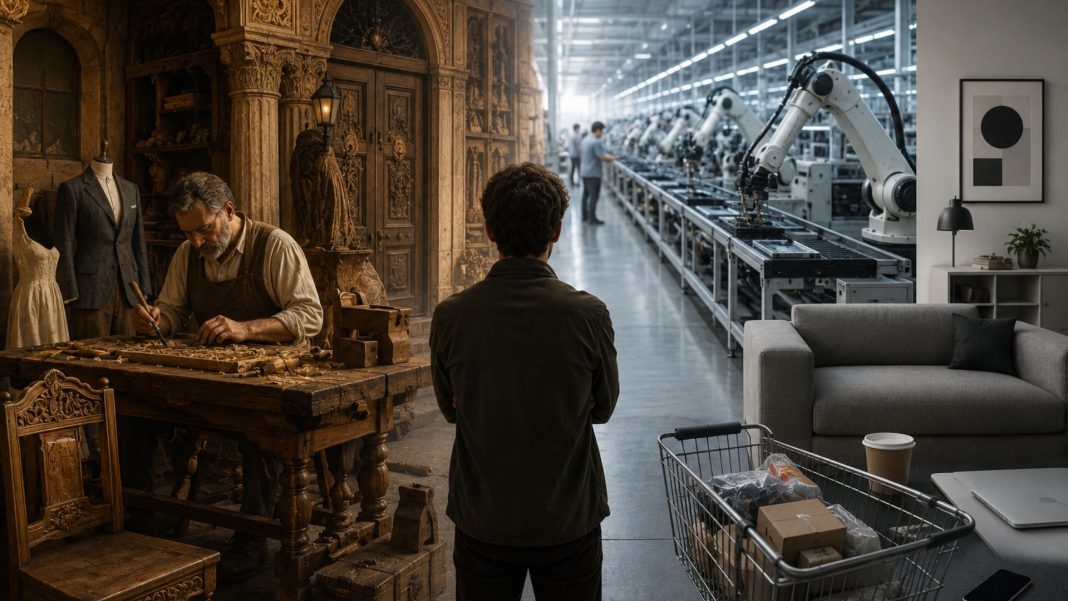

The Death of Craftsmanship: For decades, the world quietly underwent a radical transformation. Without a single vote being cast or a formal announcement made, cities exchanged hand-carved stone for flat glass, tailored garments for fast fashion, and handcrafted wooden heirlooms for flat-pack furniture assembled with an Allen wrench.
The transition did not happen overnight. It was a slow, seductive trade-off: beauty gave way to convenience, and ornament was sacrificed for efficiency.
Today, as society reaches a tipping point in 2026, a growing global debate is forcing us to confront a fundamental question: Did we gain simplicity at the cost of our soul, or is modern life superior to the past?
“We stopped building things that were meant to last for generations and started manufacturing things that were meant to be thrown away when the lease expires.”
— Architectural historian & urban theorist
The Great Trade-Off: Efficiency vs. Elegance
The Death of Craftsmanship: To understand how the world lost its visual richness, experts point to the mid-20th century, when industrial manufacturing and global supply chains changed the rules of production.
The Shift in Production
Traditional Era: Local materials (stone, timber), artisanal labor & hand detail, built to endure for centuries, high emotional & aesthetic value.
Modern Era: Synthetic composites & steel, mass production & pre-fab, designed for fast replacement, high functional efficiency.
The motivation was not malicious, it was practical. Standardized, mass-produced materials made housing affordable, goods accessible, and life dramatically more convenient. However, the side effect was a pervasive visual monotony across global cities.
Why Cities All Look the Same Now
The Rise of Modernist Minimalism: Post-war architecture stripped away arches, columns, and ornate facades in favor of clean lines and budget-friendly concrete panels.
The Fast-Culture Boom: From clothing to interior decor, items are engineered for cheap shipping and quick disposal rather than artistic permanence.
Digital Flatness: Screen-centric living shifted public appetite toward smooth, textureless surfaces—both online and in real-life design.
The “Human-Centered” Counter-Revolution
The story of lost beauty does not end in decline. In 2026, design forecasts, urban planning initiatives, and consumer trends reveal a powerful counter-movement across Europe, North America, and Asia:
- The Arts & Crafts Revival
Design institutes and home trends report a major resurgence in artisan aesthetics. Consumers are rejecting mass-printed, hyper-smooth home goods in favor of hand-decorated tiles, exposed timberwork, and visible handcrafting.
- Classical Architecture Comes Back in Style
Top architectural firms are re-integrating classical principles, symmetry, natural stone (limestone, marble), and human-scaled entryways, to combat the “soulless concrete box” phenomenon.
- “Tactile Resistance” in Art & Culture
Contemporary art in 2026 is seeing a wave of raw textures, visible grain, and unpolished craft as a direct revolt against ultra-clean, AI-generated digital art.
The Ultimate Dilemma: Past Elegance or Modern Simplicity?
If given the choice to live in one era forever, society remains divided into two distinct camps:
| The Case for Past Elegance | The Case for Modern Simplicity |
|---|---|
| Craftsmanship | Every building, garment, and tool reflected unique artistry, skilled craftsmanship, and individual character. |
| Durability | Structures and objects were built using high-quality natural materials, designed to withstand the test of time and age gracefully over centuries. |
| Visual Harmony | Human-scaled architecture and thoughtful urban design fostered a sense of beauty, balance, and community in public spaces. |
The Verdict: Can We Have Both?
The world did not lose its beauty because people stopped loving beautiful things, it lost it because society prioritized speed and cost above all else.
However, the latest trends in 2026 suggest we do not need to choose between living in a drafty 19th-century castle or a sterile 21st-century glass cubicle. The emerging consensus among modern designers is “Biophilic Modernism”: using advanced technology and sustainable engineering to bring back natural materials, rich textures, and timeless craftsmanship, without sacrificing modern comfort
Also Read : 7 Forbidden Places in India: Where Human Entry is Strictly Banned