


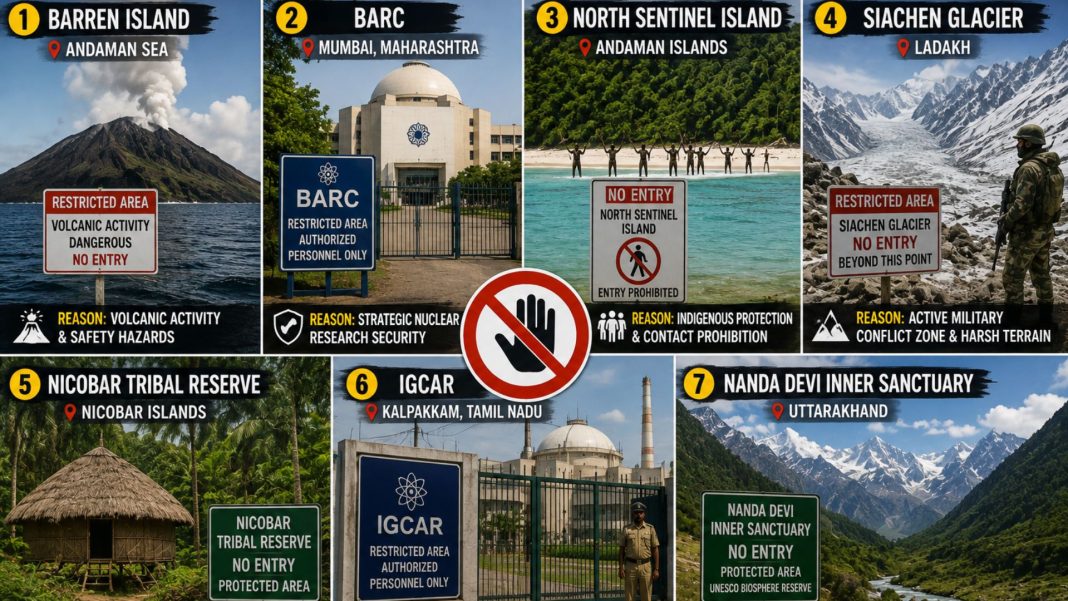

7 Forbidden Places in India: While India is globally celebrated for its bustling cities, ancient temples, and sun-soaked beaches, a handful of enigmatic locations across the sub-continent remain completely shut off from the public.
Guarded by armed military forces, protected by indigenous heritage laws, or shielded to preserve delicate ecological balances, these spots are off-limits to casual travelers and adventurers alike.
From roaring active volcanoes to deep-sea atomic research centers, these seven high-security places in India strictly ban public entry.
1. Barren Island: India’s Solitary Active Volcano
7 Forbidden Places in India: Location: Andaman Sea, Andaman & Nicobar Islands
Restriction Level: Strictly No Foot Traffic (Viewable Only from Ships/Aircraft)
Located around 138 kilometers northeast of Port Blair, Barren Island houses the only confirmed active volcano in South Asia. The island features a stark, scorched terrain where active vents regularly belch smoke, ash, and glowing lava.
Because of unpredictable volcanic surges and extreme safety hazards, setting foot on the island is strictly illegal. The surrounding waters are constantly monitored by the Indian Coast Guard.
Tourists are permitted to view the fiery island only from a safe distance aboard chartered vessels or authorized flying tours, making it an awe-inspiring sight that remains strictly untouchable.
2. Bhabha Atomic Research Centre (BARC), Mumbai: The High-Security Nuclear Hub
7 Forbidden Places in India: Location: Trombay, Mumbai, Maharashtra
Restriction Level: Top-Secret Government Defense Installation
Overlooking the Mumbai harbor in Trombay, the Bhabha Atomic Research Centre (BARC) stands as India’s premier nuclear research facility. Spanning hundreds of acres, the high-security complex houses advanced nuclear reactors, isotopic research laboratories, and classified defense technology projects.
Given the immense strategic and national security importance of the installation, entry into BARC is restricted exclusively to authorized scientists, military personnel, and high-level government clearance holders.
Armed security forces maintain round-the-clock perimeter monitoring, and photography or unauthorized flyovers in the airspace above are treated as serious national security violations.
3. North Sentinel Island: Home of the World’s Most Isolated Tribe
Location: Bay of Bengal, Andaman Islands
Restriction Level: 5-Nautical-Mile Absolute Exclusion Zone
Perhaps the most famous forbidden island on Earth, North Sentinel Island is home to the Sentinelese, a hunter-gatherer tribe that has lived in total isolation from modern civilization for thousands of years. The inhabitants are known to fiercely reject outside contact, often defending their shores with arrows and spears.
To honor the tribe’s autonomy and shield them from modern infectious diseases to which they have zero immunity, the Indian Government enforces a strict 5-nautical-mile exclusion zone around the island.
The Indian Navy and Coast Guard patrol the maritime perimeter continuously to deter intruders and protect both outsiders and the indigenous community.
4. Siachen Glacier: The World’s Highest and Coldest Battlefield
Location: Karakoram Range, Ladakh
Restriction Level: Active Military Defense Zone
Perched high in the eastern Karakoram range of the Himalayas at altitudes exceeding 20,000 feet, the Siachen Glacier is renowned as the highest battlefield on planet Earth.
Operating under extreme climate conditions where temperatures regularly plunge below -50°C, the Indian Army maintains a permanent operational outpost here.
Due to intense geopolitical sensitivities, active military operations, and extreme terrain perils, including frequent avalanches and crevasses, the glacier is strictly off-limits to civilian travelers. Only specialized military supply teams and authorized defense personnel are permitted near the battleground.
5. Nicobar Tribal Reserve: Protected Indigenous Heartland
Location: Nicobar District, Andaman & Nicobar Archipelago
Restriction Level: Strictly Restricted Special Reserve
While parts of the Andaman archipelago have developed into popular beach destinations, the neighboring Nicobar Islands remain completely closed to commercial tourism.
Designated as a protected tribal reserve under the Andaman and Nicobar Islands Protection of Aboriginal Tribes Act, the region is inhabited by vulnerable indigenous communities, including the Nicobarese and Shompen tribes.
Entry into the Nicobar Tribal Reserve requires extraordinary permissions issued only by top government authorities for scientific research or emergency defense operations.
Casual tourists, media teams, and commercial operators are prohibited from visiting to ensure the preservation of the local culture and delicate tropical biodiversity.
6. Indira Gandhi Centre for Atomic Research (IGCAR): India’s Breeder Reactor Citadel
Location: Kalpakkam, Tamil Nadu
Restriction Level: High-Security Nuclear Defense Zone
Situated along the Coromandel Coast near Chennai, the Indira Gandhi Centre for Atomic Research (IGCAR) is a critical facility focused on advanced fast breeder reactor technology and nuclear fuel reprocessing.
As a strategic node in India’s three-stage nuclear power program, IGCAR operates under stringent physical and electronic security grids. The entire complex is classified as a sensitive zone protected by specialized central security agencies. Unauthorized visitors, tourists, or drone operators attempting to approach the complex face immediate military detention and legal prosecution.
7. Nanda Devi Inner Sanctuary: Nature’s Untouched Himalayan Fortress
Location: Chamoli District, Uttarakhand
Restriction Level: Ecological Biosphere Core Reserve
Nestled inside a ring of towering Himalayan peaks exceeding 20,000 feet lies the Nanda Devi Inner Sanctuary. Historically prized by mountaineers, the inner basin suffered severe ecological degradation, littering, and flora damage during mountain expeditions in the mid-20th century.
In 1982, the Indian government banned all human entry, including trekkers and foreign climbing expeditions, to allow the fragile alpine ecosystem to heal. Recognized as a UNESCO World Heritage Site, the inner core remains strictly protected today. Only rare, heavily regulated scientific monitoring teams receive restricted access, preserving one of the world’s last pristine natural wildernesses.
Summary Table: Banned Destinations at a Glance
| Location | Region | Primary Reason for Restriction |
|---|---|---|
| Barren Island | Andaman Sea | Restricted due to active volcanic activity and associated public safety hazards. |
| BARC (Bhabha Atomic Research Centre) | Mumbai, Maharashtra | Access limited for strategic nuclear research and national security reasons. |
| North Sentinel Island | Andaman Islands | Entry prohibited to protect the indigenous Sentinelese tribe and prevent outside contact. |
| Siachen Glacier | Ladakh | Restricted because of the active military conflict zone, extreme weather, and hazardous terrain. |
| Nicobar Tribal Reserve | Nicobar Islands | Protected to preserve indigenous tribal communities and their traditional way of life. |
| IGCAR (Indira Gandhi Centre for Atomic Research) | Kalpakkam, Tamil Nadu | Highly restricted due to nuclear facility security and defense-related operations. |
| Nanda Devi Inner Sanctuary | Uttarakhand | Access controlled to safeguard the fragile UNESCO-designated biosphere reserve and its sensitive ecosystem. |
Also Read : ‘No Standard System Exists’: MEA Slams ‘Arbitrary’ Global Passport Rankings in Parliament