


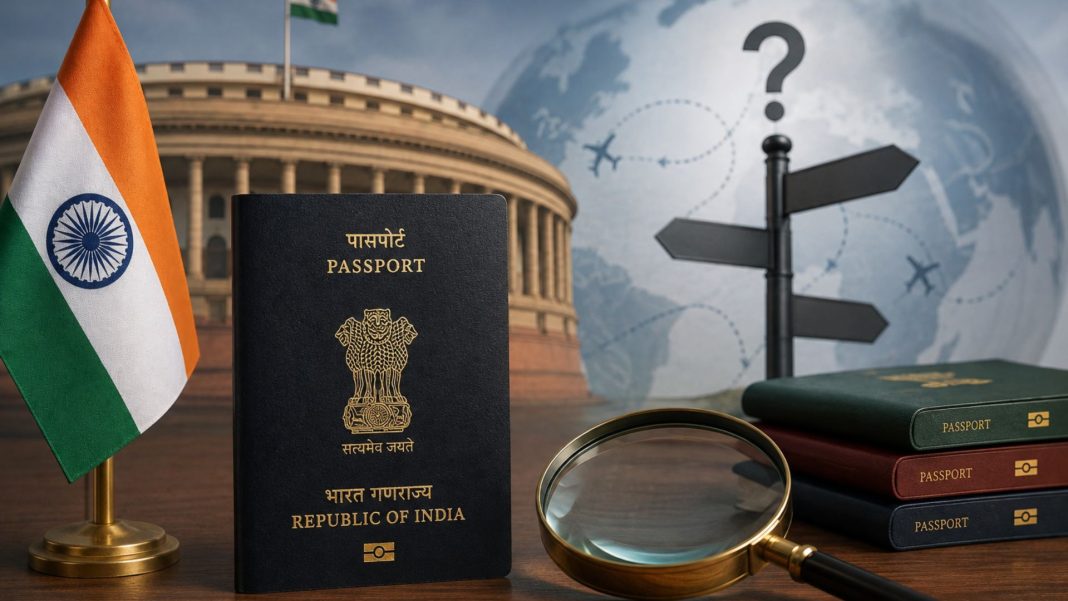

No Standard System Exists’: Responding to questions regarding reported declines in the global standing of the Indian passport, the Ministry of External Affairs (MEA) informed Parliament that widely cited global passport rankings are compiled by private organizations using their own criteria, rather than universally recognized international standards.
Addressing a query in the Lok Sabha, Minister of State for External Affairs Kirti Vardhan Singh clarified that there is no official or standardized global authority that measures or ranks passport power.
‘Arbitrary & Unilateral’: The MEA’s Official Stance
No Standard System Exists’: The clarification came in response to questions raised by MPs regarding India’s position on commercial mobility charts, such as the Henley Passport Index and the Arton Capital Passport Index, which frequently rank national travel documents based on visa-free access.
The government stated that private institutions publish these ratings based on parameters unilaterally decided by them. In the absence of universally acceptable criteria to rank passports, the MEA maintained that no ranking system exists at a global level that can be taken as an official standard.
The government emphasized that index fluctuations do not necessarily represent a downgrade in diplomatic standing or a reduction in access, but often reflect changes in scoring methodologies or visa adjustments made by other nations independently.
How Passport Rankings Work , And Why New Delhi Disagrees
No Standard System Exists’: Popular passport indices evaluate travel documents primarily by counting how many destinations a passport holder can enter without securing a visa in advance. However, the government points out major gaps between how private firms measure passport power and how diplomatic mobility actually works:
Primary Metric vs diplomatic treaties: Private rankings focus strictly on the raw number of visa-free or visa-on-arrival spots. In contrast, foreign ministries evaluate travel access based on bilateral treaties, mutual trust, and security agreements.
Methodology and standards: Commercial rankings rely on standardized point systems created internally by private firms. The government views these as unilateral metrics that lack any international or multilateral consensus.
Key factors ignored: Private charts exclude critical real-world factors such as economic partnerships, trade ties, fast-track processing, e-visa facilities, and security cooperation between nations.
The ministry highlighted that private firms weigh access purely on total numbers, completely ignoring the complex geopolitical nuances and security considerations that govern international border control.
Sovereign Decisions vs Commercial Ratings
The MEA reiterated that granting visa-free entry, visa-on-arrival, or electronic visas (e-Visas) is a sovereign right of every receiving nation. These decisions depend heavily on three core principles:
Reciprocal Agreements: Whether the partner country receives equal and mutual travel ease for its own citizens.
National Security Concerns: Rigorous background vetting, border control protocols, and safeguards against illegal immigration.
Bilateral Economic & Diplomatic Ties: Strategic relations, bilateral trade volumes, and historical tourism flows.
Because these decisions are negotiated directly between governments, the MEA argues that compressing complex foreign policy into a simple numeric rank drastically oversimplifies global mobility realities.
Expanding Travel Access on the Ground
Despite dismissing commercial rankings as non-binding, the ministry affirmed that continuous diplomatic efforts are underway to expand hassle-free international travel for Indian citizens.
Through ongoing diplomatic negotiations, India continues to secure formal bilateral agreements that directly expand real-world mobility:
Visa-Free Access: Direct entry without prior visa requirements across designated partner nations.
Visa-on-Arrival Facilities: Simplified border entry processes for travellers upon landing.
e-Visa Expansion: Streamlined digital visa clearance with faster turnaround times.
Additionally, the government highlighted ongoing efforts to roll out chip-enabled e-passports, which will enhance document security and speed up automated immigration clearance worldwide.
Also Read : Meta Bows to Govt: Zuckerberg Apologizes for PM Modi Post Takedown & Deepfakes