


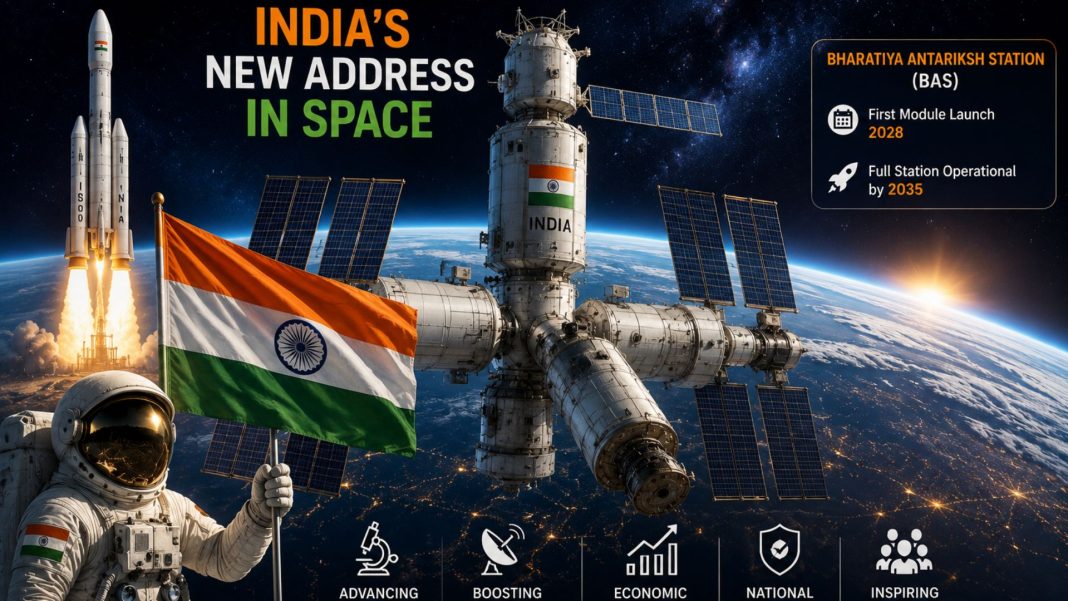

India’s New Address in Space: India is officially preparing to take residence in the stars. The Indian Space Research Organisation (ISRO) is actively advancing from earthbound satellite launches to building a permanent human home in Low Earth Orbit: the Bharatiya Antariksh Station (BAS).
ISRO Crosses Major Milestone for BAS-01
India’s New Address in Space: The Union Government recently confirmed in Parliament that ISRO has completed the Baseline Design Review and System Engineering for BAS-01, the space station’s foundational module. With 31 core design documents reviewed and approved by expert committees, ISRO has officially kicked off subsystem engineering.
Furthermore, ISRO has successfully demonstrated crucial building blocks in orbit, including automated docking technology, space refueling concepts, and robotic arms tested on recent orbital platform missions.
WHAT IS BHARATIYA ANTARIKSH STATION (BAS)?
India’s New Address in Space: The Bharatiya Antariksh Station (BAS) is India’s planned 52-tonne, modular space station. Floating in Low Earth Orbit at an altitude of approximately 400 km to 450 km, it will serve as an orbital laboratory where 3 to 4 Indian astronauts can live and conduct cutting-edge scientific research for 3 to 6 months at a time.
Key Specifications of BAS:
Configuration: 5 interconnected modules (Base, Core-Docking, Science Research, Laboratory, and Common Berthing).
First Module (BAS-01): Targeted for launch by December 2028.
Full Completion: Target set for 2035.
Crew Capacity: 3–4 astronauts.
Launch Vehicle: Heavy-lift HLVM3 (Human-Rated LVM3) and Next Generation Launch Vehicles (NGLV).
FROM GAGANYAAN TO BAS: THE STEPPING STONES
India’s human spaceflight capability is not happening overnight; it follows a well-calculated roadmap under the Gaganyaan umbrella:
Uncrewed Test Flights & Abort Tests
Gaganyaan Crewed Mission (Astronauts to Low Earth Orbit)
BAS-01 Base Module Launch (2028)
Assembly of 4 Additional Modules (2028 – 2035)
Fully Operational Space Station (2035)
Crewed Lunar Mission Target (2040)
The Union Cabinet expanded the Gaganyaan mandate, approving funds to cover human spaceflight and the immediate development of the BAS-01 base module.
Technologies perfected for Gaganyaan, such as Environmental Control and Life Support Systems (ECLSS), crew escape towers, and heavy recovery operations, serve directly as the building blocks for BAS.
WHY IS BAS IMPORTANT FOR INDIA?
Building a space station is one of the most complex engineering challenges in human history. Why is India investing in it?
Microgravity Research Hub: Testing new pharmaceuticals, advanced material alloys, biological growth, and human cell behavior in zero gravity leads to medical and industrial breakthroughs back on Earth.
Space Economy Expansion: India currently holds roughly 2% of the global space economy. BAS will catalyze private Indian aerospace supply chains, aiming to boost India’s share significantly.
Strategic Autonomy: Having its own station means India will not depend on foreign space agencies for microgravity research or human spaceflight operations.
Gateway to Deep Space: BAS will act as an orbital staging ground to train astronauts and test long-duration survival systems required for India’s planned Crewed Moon Mission in 2040.
WHO ELSE HAS A SPACE STATION TODAY?
| Space Station | Operator(s) | Current Status | Key Details |
|---|---|---|---|
| International Space Station (ISS) | USA (NASA), Russia (Roscosmos), Europe (ESA), Japan (JAXA), Canada (CSA) | Operational (planned retirement around 2030) | The world’s first permanently inhabited multinational space station, continuously occupied since November 2000, serving as a major hub for scientific research and international cooperation. |
| Tiangong Space Station | China (CNSA) | Operational | China’s fully indigenous modular space station, completed in 2022, supporting long-duration astronaut missions and advanced space science experiments. |
| Bharatiya Antariksh Station (BAS) | India (ISRO) | In Active Development | India’s planned five-module space station. The first module is scheduled for launch in 2028, with the complete station expected to become fully operational by 2035. |
ISRO’S LEGENDARY TRACK RECORD OF SUCCESS
Doubters once questioned whether ISRO could pull off ambitious missions on frugal budgets. ISRO’s modern resume proves otherwise:
Chandrayaan-3: India became the first nation in history to soft-land near the Moon’s unexplored South Pole.
Mangalyaan (MOM): India became the first Asian nation to reach Martian orbit—and the first in the world to succeed on its very first attempt.
Aditya-L1: India’s first dedicated solar observatory, positioned at Lagrange Point 1 to monitor the Sun.
Commercial Reliability: ISRO’s workhorse rockets (PSLV & LVM3) have safely launched hundreds of foreign satellites for over 30 countries.
THE ROAD AHEAD: AN “ATMANIRBHAR” SKY
The Bharatiya Antariksh Station is a bold statement of self-reliance (Atmanirbhar Bharat). From developing indigenous space suits, viewports, and docking hatches to training its own Gaganyatris (astronauts), ISRO is transforming India into a premier spacefaring superpower.
When BAS-01 reaches orbit in 2028, it won’t just carry science experiments, it will carry the aspirations of 1.4 billion people into the frontier of human exploration.
Also Read : 7 Forbidden Places in India: Where Human Entry is Strictly Banned