


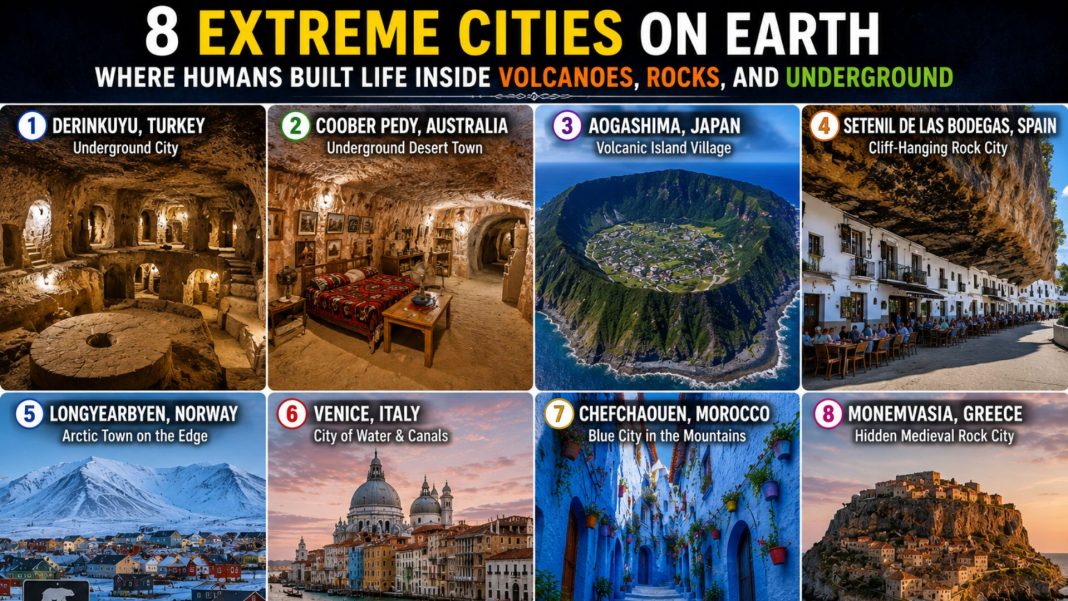

Underground cities: From living inside active volcanoes to carving entire homes beneath giant rocks or underground caverns, human beings have proven that no climate or terrain is off-limits. Around the globe, thousands of people call some of the most geography-defying locations home.
1. La Rinconada, Peru: The Frozen Town Above the Clouds
Underground cities: Location: Andean Mountains, Peru
The Extreme Factor: Sitting at 5,100 meters (16,700 feet) above sea level, La Rinconada holds the official title as the highest permanent human settlement on Earth.
Life on the Edge: The air contains roughly 40% less oxygen than sea level. There is no indoor plumbing, sewage system, or municipal trash collection, yet over 30,000 people reside here.
Why People Stay: Gold. Thousands of miners endure freezing daily temperatures to work under an unwritten labor system where they work 30 days unpaid and keep whatever gold ore they can carry on the 31st day.
Researchers continue studying local residents, who have developed higher red blood cell counts and unique biological adaptations to survive the chronic hypoxia at this extreme altitude.
2. Coober Pedy, Australia: The Underground Desert Sanctuary
Underground cities: Location: South Australian Outback
The Extreme Factor: Ground surface temperatures routinely soar past 50°C (122°F), making surface life unlivable for most of the year.
Life on the Edge: Instead of living above ground, around 60% of the town’s 2,500 residents live in “dugouts”, custom homes carved directly into the sandstone rock. The underground homes maintain a comfortable year-round temperature of 23°C (73°F) without air conditioning.
Underground Amenities: The town features subterranean churches, jewelry shops, bars, and hotels.
As heatwaves intensify globally, international architects and urban planners regularly visit Coober Pedy to study its zero-energy underground construction models.
3. Aogashima, Japan: The Village Inside an Active Volcano
Location: Philippine Sea (358 km south of Tokyo)
The Extreme Factor: Aogashima is a tropical island formed inside a massive double volcanic crater.
Life on the Edge: Around 160 residents live in a small village inside the outer crater rim. The volcano is still active—its last major eruption in 1785 wiped out half the population before survivors eventually returned.
Daily Survival: Islanders use natural geothermal steam vents to cook meals and heat communal saunas. The island is accessible only by a small ferry or a 9-seat helicopter when weather allows.
4. Setenil de las Bodegas, Spain: Life Beneath a Cliff
Location: Andalusia, Southern Spain
The Extreme Factor: Rather than building on top of the hills, residents built their houses directly beneath huge hanging basalt cliffs.
Life on the Edge: Whole streets are covered by massive overhangs of natural rock. The rocks serve as natural roofs and walls, keeping homes cool during scorching southern Spanish summers and warm during winter.
Historical Genius: Modern residents simply added front walls and doors to natural caves created by the Trejo River over thousands of years.
Setenil has become one of Spain’s top sustainable travel destinations, praised for preserving historic architecture that requires minimal modern insulation.
5. Longyearbyen, Norway: The Arctic Outpost Where “Dying is Forbidden”
Location: Svalbard Archipelago, High Arctic
The Extreme Factor: The world’s northernmost town experiences four months of total darkness in winter and four months of continuous sunshine in summer.
Life on the Edge: Temperatures drop far below freezing, and polar bears outnumber the human population of ~2,400. Residents must carry rifles for protection when venturing outside town boundaries.
The Permafrost Rule: Dying here is practically illegal, because the ground is permanently frozen (permafrost), bodies buried in the local cemetery do not decompose. Terminally ill residents are flown to mainland Norway.
Svalbard is warming faster than almost anywhere else on Earth, prompting local authorities to reinforce building foundations built on melting permafrost.
6.Venice, Italy: The Floating City Facing the Tide
Location: Venetian Lagoon, Italy
The Extreme Factor: Built across 118 small islands connected by 400 bridges, Venice has no roads or cars, only canals and boats.
Life on the Edge: Buildings rest on millions of wooden pilings driven into mud centuries ago. The city faces constant threats from seasonal flooding (“Acqua Alta”) and sea-level rise.
Human Engineering: The city relies on the giant MOSE barrier project, a system of 78 mobile gates at lagoon inlets that raise during high tides to prevent devastating floods.
To combat extreme overtourism and preserve its fragile infrastructure, Venice introduced daily entrance fees (€5–€10) for day-trippers visiting on high-density peak days.
7. Chefchaouen, Morocco: The Sky-High Blue Fortress
Location: Rif Mountains, Northwest Morocco
The Extreme Factor: Perched on steep mountain slopes, this historic city is famous for its vibrant blue-washed buildings.
Life on the Edge: Built into steep terrain, narrow cobblestone alleys require residents to navigate thousands of stairs daily. Cars cannot enter the central blue medina.
The Origin of Blue: Founded in 1471 as a fortress, Jewish refugees painting their homes blue in the 1930s established a tradition that remains today to ward off mosquitoes and reflect heat.
Chefchaouen has implemented eco-friendly waste management and pedestrian-first initiatives to protect its mountain watershed from pollution.
8. Monemvasia, Greece: The Fortress Hidden in the Sea
Location: Peloponnese Coast, Southern Greece
The Extreme Factor: A medieval walled town built entirely behind a massive, towering sea rock that is invisible from the mainland.
Life on the Edge: Carved into the back slope of a rock plateau, Monemvasia was designed during Byzantine times so invaders from land or sea could not spot the town.
Modern Adaptation: Today, residents live in restored stone houses accessed via a single narrow causeway bridge connecting the rock to the mainland.
Preservation laws strictly prohibit vehicle traffic inside the castle walls, preserving an ancient lifestyle reliant on foot transport and pack animals.
Summary Matrix: Extreme Settlements at a Glance
| City / Location | Primary Geographic Challenge | Primary Human Adaptation |
|---|---|---|
| La Rinconada, Peru | Extreme altitude (5,100 m) and low oxygen levels | Residents have adapted biologically to high elevation, while the local economy is driven largely by gold mining. |
| Coober Pedy, Australia | Extreme desert heat (often exceeding 50°C) | People live and work in underground “dugout” homes and businesses to stay cool year-round. |
| Aogashima, Japan | Located inside an active volcanic caldera | Residents utilize geothermal energy, steam-powered cooking, and rely on helipad access when sea travel is disrupted. |
| Setenil de las Bodegas, Spain | Massive hanging basalt rock overhangs | Homes, cafés, and shops are built directly beneath natural rock formations, using them as protective roofs. |
| Longyearbyen, Norway | Extreme Arctic cold and permanent permafrost | Strict polar bear safety measures (including carrying rifles outside town) and unique burial policies due to frozen ground. |
| Venice, Italy | Rising sea levels and an extensive canal network | The city depends on the MOSE flood barrier system and water-based transportation for daily life. |
| Chefchaouen, Morocco | Steep mountain terrain | A network of step-based pedestrian streets and blue-painted buildings helps with navigation and reflects heat. |
| Monemvasia, Greece | Isolated sea rock plateau | A hidden fortified settlement connected to the mainland by a narrow causeway provided natural coastal defense. |
Also Read : 7 Forbidden Places in India: Where Human Entry is Strictly Banned