


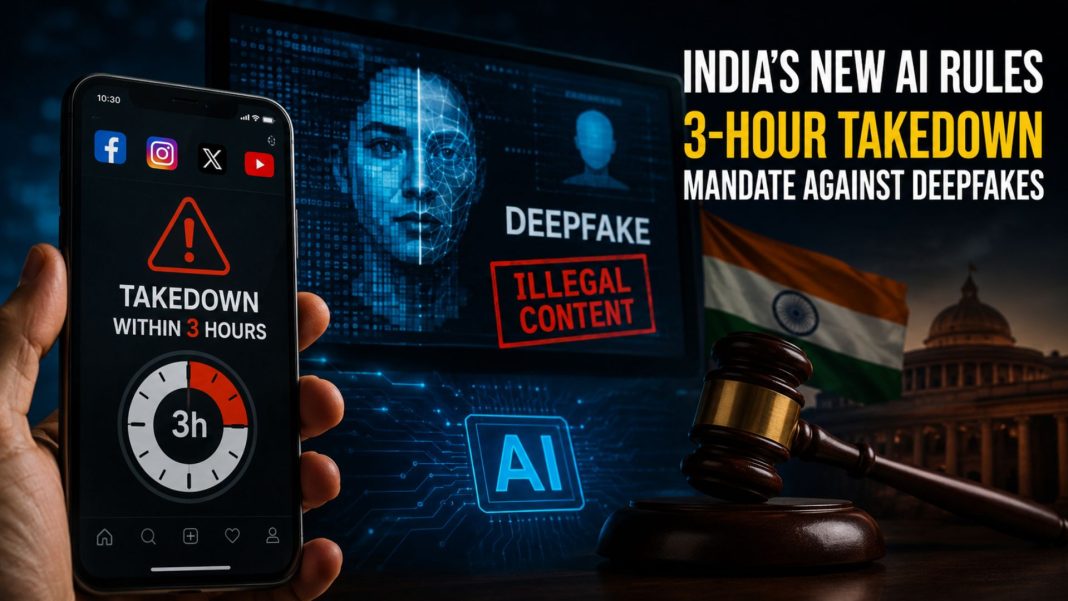

India’s New AI Rules: In a decisive move to curb the proliferation of digital deceptions, synthetic manipulation, and malicious deepfakes, the Indian government has significantly tightened the regulatory framework governing digital intermediaries.
Through key amendments to the Information Technology (Intermediary Guidelines and Digital Media Ethics Code) Rules, 2021, authorities have established rigorous operational mandates for social media platforms operating across the nation.
According to official disclosures made by Minister of State for Electronics and Information Technology Jitin Prasada in a written reply to the Lok Sabha, these revised directives enforce strict content-labelling requirements, drastically shorten takedown windows, and hold platforms accountable under statutory law if non-compliance occurs.
1.Mandatory Labelling and Embedded Metadata for AI Content
What is the new AI policy? Under the newly amended regulatory framework, social media companies and digital intermediaries are legally required to ensure that all permissible AI-generated or synthetically modified content carries prominent visual labels alongside embedded, traceable metadata.
As reported by official sources, this mandate ensures that end-users can easily distinguish between genuine media and synthetically created text, audio, images, or video clips.
By embedding traceable metadata into synthetic outputs, regulators aim to track the origin of manipulated media, curbing systemic misinformation before it goes viral.
2.Unlawful AI Content Removal Timeframe Slashed to 3 Hours
AI content banned in India: Perhaps the most significant shift under India’s new AI rules is the radical reduction in compliance turnaround times for taking down illegal content.
According to official policy details:
Government and Court Orders: Platforms must remove unlawful AI-generated content within three hours of receiving a valid judicial order or reasoned intimation from designated government agencies. Previously, platforms operated under a 36-hour grace period.
Sensitive Personal Grievances: Complaints regarding AI-generated nudity, artificially morphed private images, non-consensual intimate imagery, and impersonation must be addressed within two hours of being reported.
General Grievances: Standard user grievances and policy violations must now be resolved within 36 hours, cutting down the earlier 72-hour timeline.
3.Automated Prevention and Technical Safeguards
India’s New AI Rules: To prevent unlawful synthetic media from spreading unchecked, the Centre has mandated that social media platforms deploy “reasonable and appropriate” technical systems, including automated detection tools.
According to media reports detailing the parliamentary disclosures, Significant Social Media Intermediaries (SSMIs) defined as platforms with over 50 lakh registered users in India must actively intercept and block the generation or sharing of prohibited content.
The regulations explicitly target:
Child Sexual Abuse Material (CSAM) and explicit exploitation images.
Non-consensual intimate images and deepfake nudity.
Artificial identity impersonation and deceptive financial frauds.
Content explicitly designed to incite public mischief or breach public order.
4.Threat to Safe Harbour Protections Under Section 79
India’s New AI Rules: The updated rules carry severe consequences for non-compliant tech giants.
According to government statements shared in Parliament, any digital platform that fails to adhere to the revised due diligence standards risks forfeiting its immunity under Section 79 of the Information Technology Act, 2000.
Loss of this “safe harbour” legal shield means platform executives and parent companies can be held directly liable as publishers.
Consequently, they could face direct criminal prosecution under the Information Technology Act as well as relevant provisions of the Bharatiya Nyaya Sanhita (BNS), 2023, covering forgery, impersonation, and public mischief.
Platforms are also now obligated to explicitly notify users during onboarding about the legal consequences and prosecution risks associated with creating or disseminating illegal synthetic content.
5.R&D Investment and Ramped-Up Awareness Campaigns
Beyond legislative measures, the Indian government is investing in domestic technological infrastructure to detect deepfakes at scale.
As highlighted in the official written response in the Lok Sabha:
Responsible AI Projects: Under the IndiaAI Mission, the Centre has approved 13 specialized Responsible AI projects dedicated to developing indigenous deepfake detection tools.
Leading institutions including IIT Jodhpur, IIT Madras, and IIT Kharagpur are leading research into audio-visual forgery identification.
Cybersecurity Outreach: To build public awareness, government agencies have conducted over 6,650 awareness workshops across the country, directly reaching over 11.37 lakh citizens.
Reporting Portals: Citizens are encouraged to flag deepfake abuses and cybercrimes via the National Cyber Crime Reporting Portal or by dialing the national helpline at 1930.
With these stringent amendments, India establishes one of the world’s most aggressive regulatory stances on synthetic media, forcing global social media entities to instantly overhaul their moderation mechanisms.
Also Read: Airtel Q1 Results: Net Profit Surges 37% Driven by Premium Tariff Plans, ARPU Reaches ₹264