


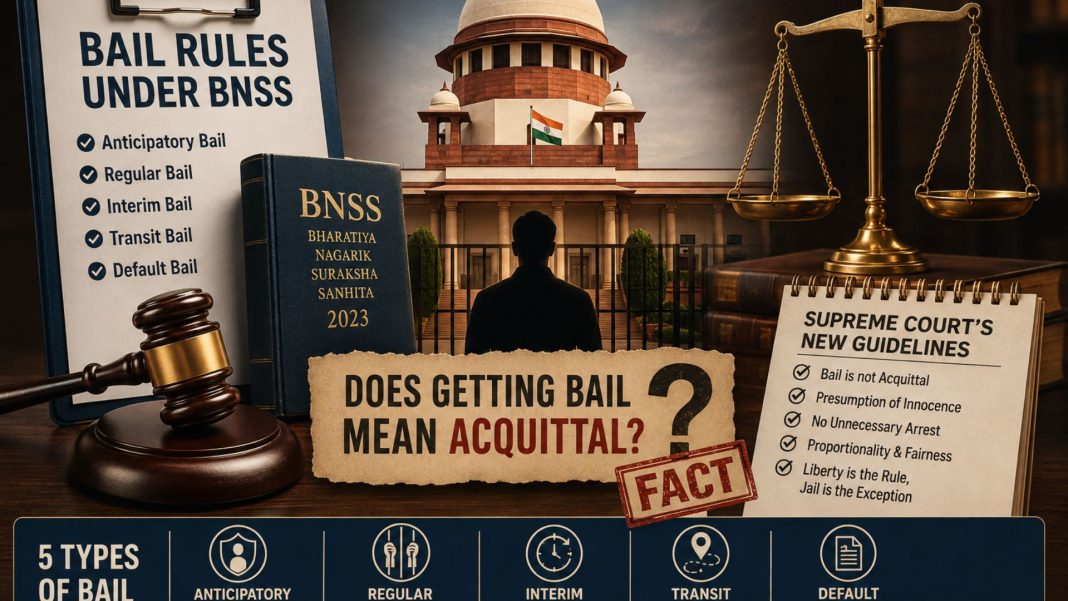

Bail Rules Under BNSS: In a landmark legal posture, the Supreme Court of India has repeatedly reminded trial courts that prolonged detention without trial is a violation of fundamental rights.
With the Bharatiya Nagarik Suraksha Sanhita (BNSS), replacing the old Code of Criminal Procedure (CrPC), clarity around bail laws has become crucial for every citizen.
Despite common misconceptions, bail does not mean an accused person has been declared innocent or acquitted. Rather, it is a legal mechanism to preserve individual liberty while ensuring the accused presents themselves for trial.
What Exactly Is Bail?
Bail Rules Under BNSS: Bail is the temporary release of an accused person awaiting trial or a court verdict, usually on the condition that a sum of money or personal bond is lodged to guarantee their appearance in court.
Acquittal vs. Bail: Know the Difference
Acquittal (बरी होना): The court finds the accused not guilty after evaluating all evidence. The case against them is closed.
Bail (ज़मानत): The trial is still ongoing. The accused is released from prison subject to strict conditions (e.g., surrendering passport, reporting to police stations, not contacting witnesses).
Bail Is the Rule, Jail Is the Exception”: What Does It Really Mean?
Bail Rules Under BNSS: Coined by legendary jurist Justice V.R. Krishna Iyer in 1977 (State of Rajasthan v. Balchand), this doctrine stems directly from Article 21 of the Indian Constitution, the Right to Life and Personal Liberty.
The Core Logic: In Indian jurisprudence, an accused person is presumed innocent until proven guilty. Incarcerating an undertrial before conviction acts as punitive detention without trial. Therefore, detention should only be imposed when strictly necessary.
In recent landmark verdicts (such as Prem Prakash v. Union of India and Jalaluddin Khan v. Union of India), the Supreme Court reiterated that even in stringent statutes, long delays in trial cannot justify indefinite incarceration.
The 5 Major Types of Bail Under BNSS
The Bharatiya Nagarik Suraksha Sanhita (BNSS) outlines key provisions governing relief for undertrials and accused individuals:
Anticipatory Bail (Pre-Arrest Bail), Section 482 BNSS: Applied for when a person apprehends arrest in a non-bailable offense. Prevents harassment and malicious prosecution before police make an arrest.
Regular Bail, Section 480 & 483 BNSS: Applied for by a person who has already been arrested and is in police or judicial custody.
Interim Bail: A short-term, temporary bail granted while the main bail application is pending for emergencies like medical treatment or family events.
Transit Bail: Granted when a person faces arrest by police from another state or jurisdiction, providing time to reach the competent court without being arrested en route.
Default Bail (Statutory Bail) ,Section 187 BNSS: An automatic right to bail if police fail to file the chargesheet within the stipulated timeframe (60 or 90 days).
Major Reform Update: Relief for Undertrials Under Section 479 BNSS
In a major relief to thousands of undertrial prisoners, the Supreme Court ruled that Section 479 of BNSS applies retrospectively.
First-Time Offenders: First-time undertrials (those with no prior criminal convictions) must be released on bail if they have served one-third (1/3rd) of the maximum sentence prescribed for the offense.
General Undertrials: Non-first-time offenders are eligible for bail after completing one-half (1/2) of the maximum sentence.
Quick Comparison: Types of Bail at a Glance
| Bail Type | Primary Stage | Primary Requirement / Trigger |
|---|
| Anticipatory Bail | Before arrest | Apprehension of arrest in a non-bailable case |
| Regular Bail | After arrest / In custody | Normal court evaluation of the case and merits |
| Interim Bail | While the bail application is pending | Emergency or short-term relief until the main application is decided |
| Transit Bail | Inter-state jurisdiction | Temporary protection to provide time to approach the appropriate court in another jurisdiction |
| Default Bail | Investigative stage | Police failure to file the charge sheet within the prescribed 60/90-day period |
How Courts Decide: Factors Influencing Bail
Bail is not an absolute right in non-bailable offenses; it is at the discretion of the judge. Courts weigh specific factors before granting or rejecting bail:
Factors Favoring Grant of Bail
Absence of prior criminal antecedents.
Lack of flight risk (deep roots in society).
Long duration already spent in custody.
Cooperating fully with law enforcement agencies.
Factors Leading to Bail Rejection
Severity and gravity of the crime (e.g., murder, treason).
High risk of tampering with evidence or intimidating witnesses.
High probability of re-offending while out on bail.
The Exception Clause: Special Laws (PMLA, UAPA, NDPS)
Why is getting bail so difficult in money laundering, terrorism, or drug cases? Special statutes contain “Twin Conditions” that invert the standard burden of proof:
The Public Prosecutor must be given an opportunity to oppose the bail plea.
The Court must be satisfied that there are reasonable grounds to believe the accused is innocent and not likely to commit any crime while on bail.
Supreme Court Stance
Even in strict laws like PMLA and UAPA, the Supreme Court has clarified that “Twin Conditions” cannot override Article 21. If a trial is delayed indefinitely and the accused has spent prolonged time behind bars, courts can grant bail to uphold fundamental rights.
Also Read : Assam Minor Rape Murder Case: Five Arrested as SIT Probes Horrific Crime