


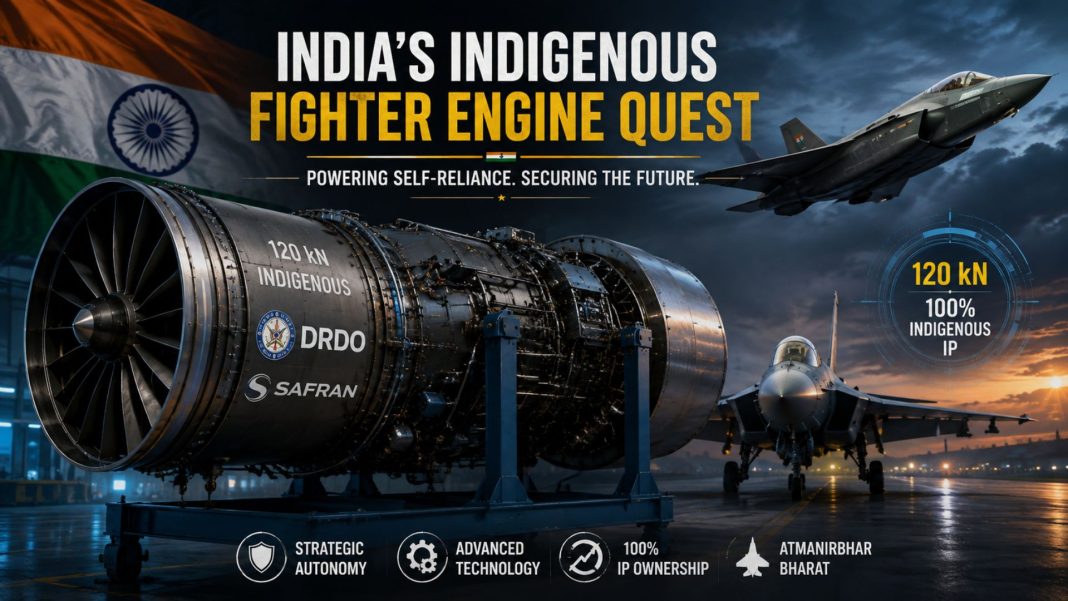

India’s Indigenous Fighter Engine Quest: For over seven decades, India possessed the capability to design and assemble sophisticated airframes, yet remained dependent on foreign nations for the core powerplants that propelled them.
That historical vulnerability is now reaching a turning point. Driven by high-level national mandates and shifting geopolitical realities, India’s push for an indigenous 120 kN fighter engine with 100 percent domestic Intellectual Property (IP) ownership is moving from strategic intent to concrete timelines.
According to recent media reports, the proposed joint venture between France’s Safran Aircraft Engines and DRDO’s Gas Turbine Research Establishment (GTRE) represents a significant shift in India’s pursuit of strategic autonomy in aerospace technology.
The Safran–GTRE Deal: Achieving 100% IP Ownership
India’s Indigenous Fighter Engine Quest: Historically, transfer-of-technology (ToT) agreements with foreign suppliers whether Russian, French, or American came with built-in limitations.
Critical elements such as “hot section” metallurgy, single-crystal turbine blade designs, and control source codes were never fully shared.
According to defence analysis, the Safran–GTRE partnership changes this paradigm:
Cabinet Clearance: The joint venture proposal for a 120 kN turbofan engine is currently awaiting final approval from the Cabinet Committee on Security (CCS).
Full IP Ownership: Unlike past imports, India will retain 100 percent of the intellectual property rights, ensuring immunity from external sanctions, foreign red-flags, or supply chain disruptions during regional crises.
Scalable Roadmap: The project targets the production and certification of nine initial prototypes, laying the groundwork for an uprated 140 kN variant intended to power future fifth- and sixth-generation fighter platforms.
If successfully executed, India will join an exclusive group of nations currently comprising the US, UK, France, and China capable of independently designing and manufacturing modern military jet engines.
Private Sector Entry Acceleration: AMCA Takes Off
Parallel to engine developments, the airframe development model for India’s 5th-generation stealth platform the Advanced Medium Combat Aircraft (AMCA) has undergone a structural transformation.
According to industry reports, the Ministry of Defence issued a Request for Proposal (RFP) bringing private industrial consortia into the lead development phase alongside the Aeronautical Development Agency (ADA):
Leading Consortia: Bids have shortlisted major private entities, including Tata Advanced Systems Limited, a consortium led by Larsen & Toubro (L&T) with BEL, and a Bharat Forge-BEML partnership.
Development Targets: The project calls for building five AMCA prototypes, aiming for a roll-out toward the end of the decade, followed by an extensive flight-testing schedule before serial production begins.
Regional Dynamics: The Strategic Imperative
India’s Indigenous Fighter Engine Quest: The urgency behind India’s propulsion timeline is directly connected to rapid military modernization across its borders.
According to military analysts:
China’s Engine Progress: China has transitioned from reverse-engineering foreign designs to deploying indigenous powerplants, such as the 180 kN class WS-15 engine powering its stealth J-20 fighters.
Border Deployments: Chinese stealth aircraft equipped with domestic engines are operational across key high-altitude airbases facing the Line of Actual Control (LAC).
Operational Autonomy: For India, developing a native engine capability is no longer merely a domestic manufacturing milestone, but a vital requirement to preserve regional aerial deterrence.
Bridging the Gap: GE F414 and Kaveri Realities
While the 120 kN Safran–GTRE engine represents the long-term solution, India is utilizing a multi-tiered strategy to maintain operational readiness in the interim:
GE F404 & F414 Engines: American GE F404 engines continue to power the Tejas Mk1A fleet. Meanwhile, the GE F414 engine under a co-production arrangement with Hindustan Aeronautics Limited (HAL) will power early production batches of the Tejas Mk2 and initial AMCA squadrons until the native 120 kN engine matures.
Kaveri Engine Revival: The indigenous Kaveri engine project, which previously struggled to meet high-thrust requirements, is being repurposed into an 80 kN thrust demonstrator to validate core thermal and material technologies.
Warfare Evolution: Stealth, Drones, and Missiles
Modern aerial warfare is shifting rapidly. Recent global conflicts demonstrate that expensive stealth jets face evolving threats from long-range precision missiles, integrated air defence networks, and uncrewed combat aerial systems (UCAS).
For Indian defence planners, the strategy involves a balanced force structure. While fifth-generation manned platforms like the AMCA remain central, they are being developed alongside deep inventories of standoff munitions, hypersonic missiles, and autonomous drone swarms.
By securing 100 percent IP ownership over core propulsion technologies, India is taking a foundational step toward establishing complete strategic independence across its future air combat ecosystem.