

Rajasthan Local Body Elections: In a major development ahead of the impending municipal and panchayat elections in Rajasthan, the state Other Backward Classes (OBC) Commission has finalized its report on political representation.
The recommendations, which are set to be presented before the State Cabinet for official approval, establish a capped reservation framework tailored to local demographic realities.
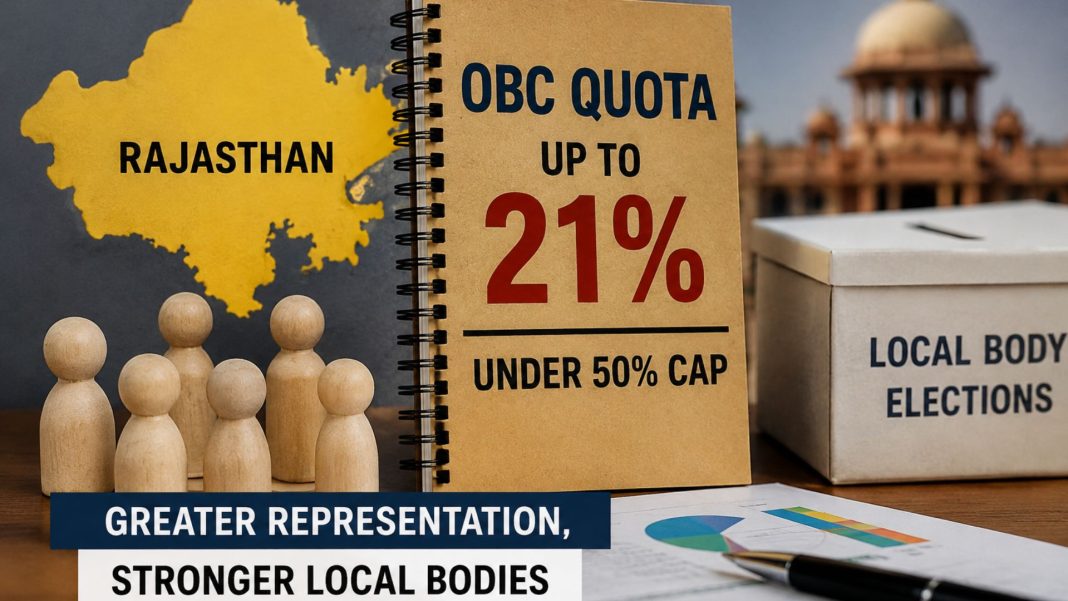
According to media reports, the key proposal sets a maximum ceiling of 21% for OBC reservation in local self-governance bodies, ensuring that the total cumulative quota across all categories remains strictly under the legally mandated 50% ceiling.
In regions where Scheduled Caste (SC) and Scheduled Tribe (ST) populations are dominant, the OBC reservation percentage will be scaled down accordingly, reaching as low as 5% in specific local jurisdictions to prevent exceeding constitutional limits.
The Core Recommendation: Balancing Demographics and Legal Limits
The commission’s findings indicate that Other Backward Classes constitute approximately 44% to 45% of the total population in Rajasthan.
Despite representing nearly half of the state’s residents, the political quota in civic and rural local bodies must be carefully calibrated to comply with Supreme Court guidelines regarding reservation caps.
As reported by media sources, the proposed framework does not apply a uniform percentage across every municipality or panchayat. Instead, it utilizes a flexible sliding scale:
Maximum Limit: A maximum cap of 21% reservation is earmarked for areas where combined SC and ST quotas leave sufficient margin under the 50% limit.
Scaled Down Quotas: In local bodies with high concentrations of SC and ST communities, the OBC quota will be systematically reduced.
Minimum Provisions: In regions with exceptionally high SC/ST population figures, OBC reservation may be set as low as 5%.
This nuanced formula aims to ensure equitable representation without breaching overall legal caps or altering existing statutory protections guaranteed to other marginalized groups.
Comparative Study: How Other States Informed the Formula
Rajasthan Local Body Elections: To devise a legally robust framework, the Rajasthan OBC Commission conducted an extensive comparative analysis of empirical survey models, legal reports, and quota implementations adopted by several other states. As highlighted in recent news reports, key reference points included:
1.Uttarakhand
The retired Justice B.S. Verma Commission in Uttarakhand evaluated urban local body demographics and observed an OBC voter presence of around 27%.
Based on these metrics, the panel recommended elevating local body reservation from the earlier 14% limit, extending proportional representation across mayoral posts, municipal chairmanships, and ward councillor seats.
2.Maharashtra
The dedicated Banthia Commission in Maharashtra evaluated local population metrics across municipal corporations, municipal councils, and nagar panchayats.
It recommended up to a 27% quota for OBC candidates in local bodies, contingent upon the condition that the aggregated quota (SC, ST, and OBC combined) never crosses the 50% threshold.
3.Chhattisgarh
Data from Chhattisgarh indicated an OBC population share between 41% and 42.41%, alongside an Economically Weaker Section (EWS) presence of approximately 3.48%.
State recommendations suggested expanding OBC seats up to 50% in local body elections, provided that existing SC and ST reservations in those specific areas had not already reached or surpassed 50%.
4.Madhya Pradesh
The MP OBC Welfare Commission reported that Other Backward Classes account for over 51% of the state’s total population.
However, empirical findings revealed significant underrepresentation in higher academic spheres (such as PhD enrollments dropping to 21%) and top administrative roles, emphasizing the necessity of targeted political quotas at the grassroots level.
While states like Gujarat have compiled dedicated reports that remain undisclosed, Rajasthan’s panel integrated publicly available findings from these four states to construct a tailored model suited to local administrative needs.
Implications for Upcoming Civic and Panchayat Polls
With the OBC Commission’s report submitted and slated for cabinet review, local administration departments can move forward with ward-wise demarcation and reservation lotteries.
The introduction of fresh survey metrics replaces outdated baseline figures, providing a structured roadmap for ward classification.
According to media reports, political parties across the spectrum are preparing for a shifted electoral landscape once seat reservation charts are formally finalized and published by the state government.
The adoption of this formula is expected to clear long-standing legal hurdles, enabling the State Election Commission to proceed with notifications for rural and urban local body polls.
Also Read: India’s Indigenous Fighter Engine Quest: Breaking the 75-Year Technology Ceiling