


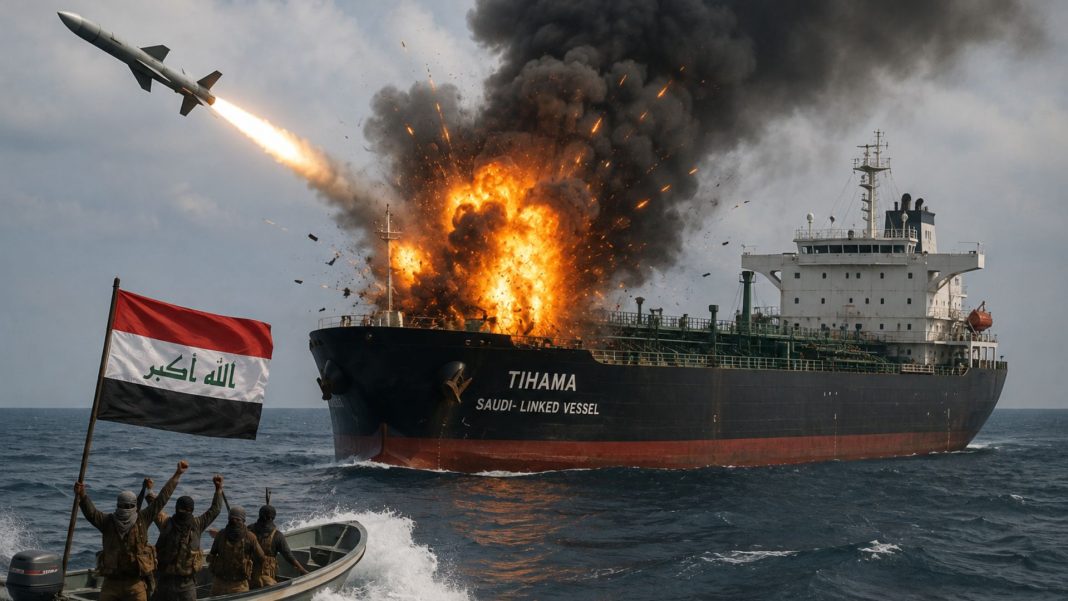

Red Sea Crisis: In a lethal turning point for global maritime trade, a Houthi missile attack on the commercial cargo vessel Tihama in the Bab al-Mandeb Strait left three crew members dead, marking the first fatal incident in the rebels’ recent blockade targeting Saudi-linked shipping.
The attack underscores a compounding global energy and logistics crisis. With the Strait of Hormuz already shut down due to regional hostilities, the worsening blockade in the Red Sea is choking off one of the world’s most critical remaining energy arteries.
Tragedy at Sea: Three Fatalities Confirmed
Red Sea Crisis: The Tanzania-flagged commercial vessel Tihama was targeted while en route from Salalah Port in Oman to Djibouti. According to maritime sources, a missile fired from Houthi-controlled territory struck the vessel near the narrowest stretch of the strait.
The three victims have been identified as two Pakistani nationals and one Indonesian national.
While Houthi forces have targeted several Saudi-linked vessels since declaring a naval blockade on July 20, including the Encelia, Layla, NCC Ghazal, and Wafa, this incident represents the first time a strike on a Saudi-connected ship has resulted in loss of life.
A Dual-Chokepoint Nightmare: Hormuz and Bab al-Mandeb
Red Sea Crisis: The timing of this fatal strike couldn’t be worse for global shipping supply chains. With the Strait of Hormuz effectively closed, Saudi Arabia and neighboring producers shifted a significant portion of their crude exports west, relying heavily on Red Sea routes. Now, with the Bab al-Mandeb Strait becoming increasingly perilous, over 25% of the world’s energy supply faces severe transit disruption.
Transit Drop: Daily ship transits through Bab al-Mandeb have plummeted from a normal average of 50 ships per day down to roughly 32, according to Kpler tracking data.
Cost Escalation: Major shipping lines are rerouting vessels around the Cape of Good Hope in Africa, adding 10–14 days to voyage times, spiking fuel expenses, and straining supply availability for consumer goods.
Tehran’s Blueprint: Taxes on Shipping Routes
Beyond military strikes, the Houthi movement is expanding its control into financial enforcement over Red Sea transit. Reports indicate that following meetings with Iranian advisors in Tehran, Houthi leadership is preparing to implement a formal transit tax or toll on commercial ships navigating the southern Red Sea.
Under this proposed framework, vessels passing through Bab al-Mandeb will be required to pay clearance fees. Notably, Chinese-flagged ships are slated for an exemption, reflecting China’s status as the largest buyer of Saudi oil. This move adds an unprecedented layer of extortion-like costs onto international shipping lines.
Geopolitical Flashpoint: The Proxy War Unravels
The escalation in the Red Sea is rooted in the long-standing geopolitical friction in Yemen:
Proxy Dynamic: Saudi Arabia supports Yemen’s internationally recognized government, while Iran backs the Houthi movement, which maintains control over north-western Yemen and key coastal areas.
Escalation Loop: The Houthis framed their naval blockade as retaliation against long-standing Saudi air and sea restrictions.
Consumer Consequences: With two major maritime corridors simultaneously choked, global markets face imminent spikes in energy prices, elevated freight insurance rates, and shortages of everyday retail goods.
Also Read : The Ultimate Decoy: How Donald Trump Secretly Swapped Planes in Turkey to Foil Assassination Threat