

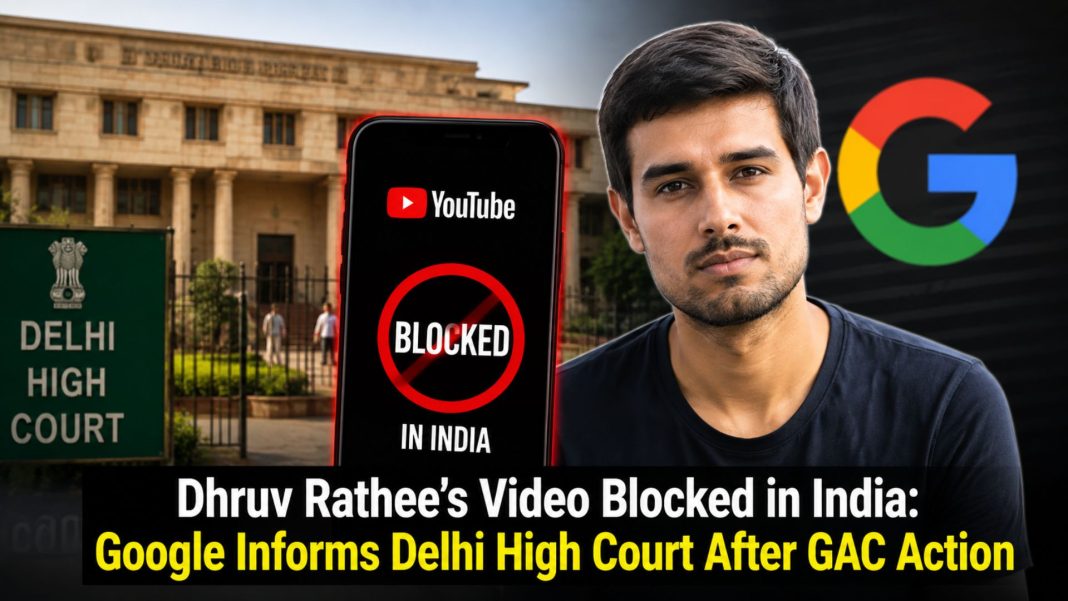

Dhruv Rathee’s Video Blocked in India: Tech giant Google has informed the Delhi High Court that it has restricted access within India to a controversial YouTube video uploaded by social media creator Dhruv Rathee.
According to media reports, the action follows a formal directive issued by the Central Government’s online dispute resolution platform, the Grievance Appellate Committee (GAC).
The submission was made before a single-judge bench of Justice Swarana Kanta Sharma during the hearing of a petition filed by advocate Amita Sachdeva.
The petitioner had sought the complete takedown of the video, alleging that its contents disparaged Hindu deities and hurt communal sentiments.
Background of the Dispute and Allegations
Dhruv Rathee’s Video Blocked in India: According to court filings and media reports, the dispute centers on a 21-minute video uploaded on March 21, 2026, titled “Can Hindus Eat BEEF? | Kerala Story 2 EXPOSED”.
In her petition, advocate Amita Sachdeva alleged that the video contained false, misleading, and provocative commentary regarding ancient texts and dietary practices.
Specifically, the petitioner contended that the video made offensive statements concerning revered Hindu figures, including Bhagwan Shri Ram, Devi Sita, and Bhagwan Shri Krishna, claiming they consumed meat and alcohol during their exile.
Sachdeva argued that these assertions insulted Sanatan Dharma, distorted religious scriptures, and caused injury to the religious beliefs of millions of devotees.
Following the initial release of the video, complaints were submitted to YouTube’s Resident Grievance Officer and the cyber crime unit.
After YouTube initially declined to remove the content on grounds that it did not violate its internal community standards, the petitioner filed an appeal before the statutory Grievance Appellate Committee (GAC).
Court Proceedings and GAC Intervention
Dhruv Rathee’s Video Blocked in India: The matter reached the Delhi High Court after the petitioner highlighted delays in the administrative appeal process. On July 3, 2026, the High Court directed the GAC to decide on the statutory appeal within a 15-day window.
Subsequent to the court’s direction, the GAC issued an order on July 15 instructing Google to remove the video within 24 hours, citing concerns over religious disharmony and public order.
During the hearing on Tuesday, counsel representing Google confirmed that the video had been withheld for viewers residing in India pursuant to the GAC’s administrative order.
Arguments Over Partial Compliance and Global Injunction
Dhruv Rathee’s Video Blocked in India: Advocate Amita Sachdeva argued before the court that restricting access solely within India constituted only partial compliance.
She informed the bench that the video remained accessible outside Indian jurisdiction and could still be accessed locally using Virtual Private Networks (VPNs). On these grounds, the petitioner urged the court to mandate a worldwide takedown of the content.
Representing Google, legal counsel pointed out that the platform had taken all technical measures possible within its local scope based on the regulatory order.
Furthermore, Google submitted that the broader legal question regarding global injunctions and worldwide content removal is currently pending examination before a Division Bench of the High Court.
Addressing the petitioner’s concerns regarding re-uploads by third-party channels, Google maintained that separate legal claims would need to be established for distinct uploads across different accounts.
However, government counsel argued that once content is ruled objectionable by an administrative body, enforcement orders should cover re-uploaded copies to prevent infinite litigation loops.
Acknowledging that Google had complied with the GAC directive locally while the global injunction issue remains under review by the Division Bench, the High Court adjourned the matter for further hearing on September 3, 2026.
Meanwhile, parallel criminal proceedings initiated by the petitioner under relevant provisions of the Bharatiya Nyaya Sanhita (BNS) remain pending before a magistrate court.
Disclaimer: This article is based on publicly available court proceedings, official submissions, and media reports. It is intended solely for informational and news reporting purposes and does not constitute legal advice or opinion. All claims and statements mentioned herein are attributed to the respective parties involved in the matter.
Also Read: FSSAI Seizes 18000 Boxes of Diageo Liquor in Bengaluru Over Recycled Plastic Marking Violations