


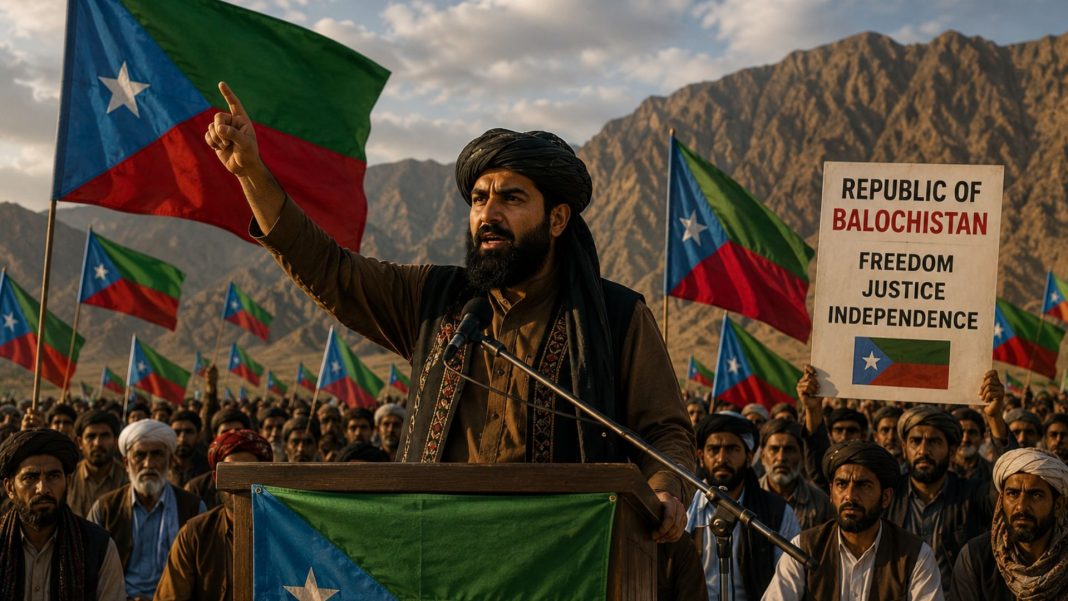

Republic of Balochistan? In a dramatic diplomatic push, a prominent Baloch separatist leader has called on the international community to formally recognise what he terms the “Republic of Balochistan” as an independent sovereign nation.
The appeal, issued on social media by nationalist figure Mir Yar Baloch, coincided with August 11, a date celebrated by Baloch activists as their historic Independence Day.
Urging foreign governments and multilateral bodies to break their silence, the nationalist group demanded an immediate halt to describing Balochistan as a province of Pakistan.
“The Republic of Balochistan demands from the entire world that from this day onwards, instead of calling, writing or referring to Balochistan as a province of Pakistan, it should be written, read and called an independent country,” the statement declared.
A High-Stakes Appeal to Global Bodies
Republic of Balochistan? The appeal directly addresses key international organizations, including the United Nations, the European Union, ASEAN, the African Union, and the Organisation of Islamic Cooperation (OIC), asking them to grant political, diplomatic, and moral legitimacy to their cause.
In his message, Mir Yar Baloch expressed special appreciation for global media organizations, particularly media outlets, research institutions, and think tanks in India, for keeping the spotlight on the Balochistan issue.
The group portrayed Balochistan not as a dependent territory, but as a resource-rich land capable of standing on its own feet. According to the nationalist leadership, an independent Balochistan would not seek foreign aid; instead, its wealth in mineral and energy resources could fund global humanitarian, health, and educational programs.
Building the Framework of a State
Republic of Balochistan? Beyond symbolic declarations, the separatist leadership claims it is actively building the infrastructure required for independent governance.
Preparations are reportedly underway to establish:
Diplomatic Missions & Foreign Affairs: Taking full control over international relations and strategic defence.
National Identity & Economy: Issuing passports, introducing a national currency, and creating financial institutions.
Civil Infrastructure: Launching independent media houses and commercial trade regulatory bodies.
Efforts are also reportedly in progress to bring diverse Baloch political factions under a single unified banner to present a consolidated front to the international community.
The Historical Backstory: Why August 11?
The choice of August 11 is deeply tied to the end of British colonial rule in 1947.
Baloch nationalists point out that the Khanate of Kalat, which encompassed major parts of modern Balochistan, declared independence on August 11, 1947, three days before the creation of Pakistan.
Though the ruler signed an Instrument of Accession to Pakistan months later in March 1948, separatists contend the annexation was forced and maintain that August 11 remains their true day of sovereignty.
Allegations of Internet Blackouts and Heavy Surveillance
As nationalist supporters attempted to host celebrations across the region, the group alleged that Pakistani security forces launched a widespread operational lockdown to suppress public gatherings.
Reports from the ground allege that authorities executed multi-layered security measures, including:
Digital Censorship: Blocking mobile phone signals and shutting down high-speed internet networks across key hubs such as Quetta, Kalat, and Khuzdar.
Defensive Fortifications: Digging perimeter trenches around military installations and police stations to prevent potential insurgent attacks.
Aerial Reconnaissance: Deploying military aircraft, surveillance drones, and armed helicopters over major population centers.
Despite these roadblocks, nationalist organizers reported holding clandestine celebrations, noting that severe internet throttling was responsible for delaying photographs and reports from reaching global audiences.
Global Reality vs. Ground Realities
Despite the ambitious declarations from separatist leaders, the claims remain entirely unrecognised internationally. Both Pakistan and the broader international community continue to view Balochistan as Pakistan’s largest province by land area.
Pakistani authorities consistently reject separatist demands, framing armed rebel groups as illegal insurgencies that threaten national integrity and regional stability. Islamabad maintains that security operations are vital counter-terrorism measures designed to protect state assets and infrastructure projects.
However, human rights observers continue to express concern over persistent reports of missing persons, political detentions, and military operations in the region. As both sides hold firm to opposing narratives, this latest declaration marks another escalating chapter in one of South Asia’s longest-running geopolitical conflicts.
Also Read : Red Sea Crisis: Houthi Missile Strike Kills 3 Crew Members on Saudi-Linked Vessel Tihama