


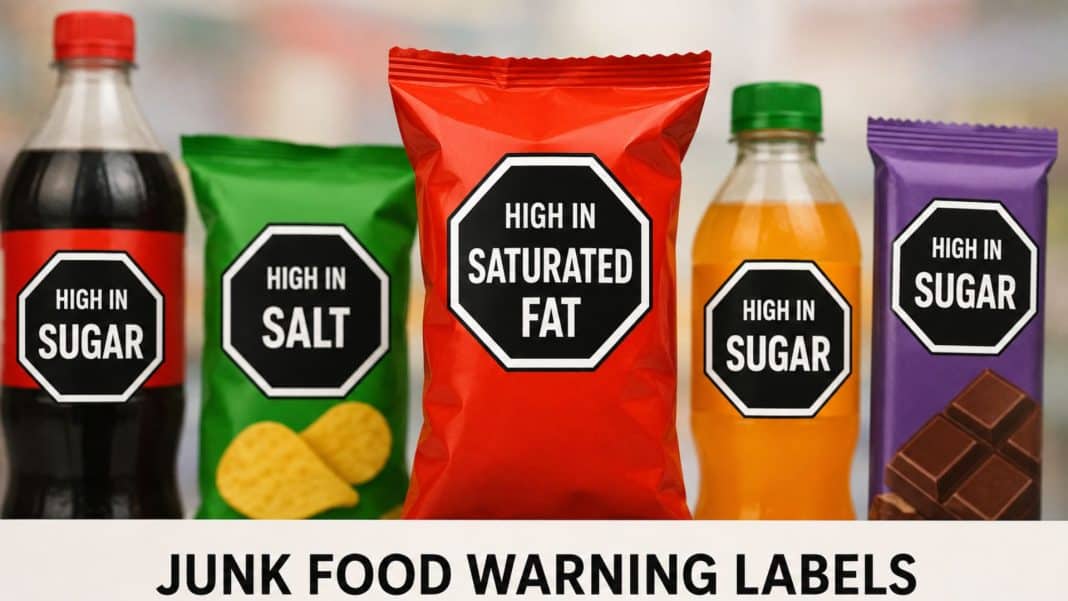

Junk Food Warning Labels in India: In a significant move aimed at safeguarding public health, the Supreme Court of India has issued a firm directive to the Food Safety and Standards Authority of India (FSSAI), giving the apex regulator a two-week deadline to reconsider its stance on introducing front-of-pack warning labels (FOPL) on packaged foods.
The top court expressed strong dissatisfaction with the slow regulatory progress regarding mandatory warnings on products containing high levels of sugar, salt, and saturated fats (HFSS).
A bench comprising Justices J. B. Pardiwala and K. Vinod Chandran made it clear that the court’s previous directions were binding, stating firmly, “We do not suggest, we direct.”
Questioning the regulator’s reluctance to mandate simple warning labels, the bench asked, “Do you not want people to be healthy?” signaling that decisive action on food labeling may finally be on the horizon.
The Public Health Context Behind the Legal Battle
Junk Food Warning Labels in India: The ongoing legal proceedings stem from a Public Interest Litigation (PIL) filed by the Kerala-based non-profit organization 3S and Our Health Society.
The petition invoked the Right to Health under Article 21 of the Indian Constitution, highlighting the alarming rise of non-communicable diseases (NCDs) across the country.
According to media reports, non-communicable lifestyle diseases such as type-2 diabetes, hypertension, cardiovascular conditions, and obesity account for over 6 million deaths annually in India.
Health experts have frequently warned that diabetes has reached epidemic proportions, affecting nearly one in four Indians.
The widespread availability and consumption of ultra-processed junk food, especially among children and young adults, are widely recognized as primary drivers of this crisis.
Front-of-Pack Warning Labels vs. Complex Nutrition Tables
Junk Food Warning Labels in India: The central debate before the Supreme Court revolves around how nutritional information should be presented to the average consumer.
The court has advocated for clear, interpretive front-of-package declarations such as “High in Sugar,” “High in Salt,” and “High in Saturated Fat.”
However, FSSAI’s proposed compliance affidavit submitted in August recommended displaying daily recommended limits alongside standard numerical nutrition tables specifically listing benchmarks like 25 grams of added sugar, 10 grams of saturated fat, and 5 grams of salt.
Petitioners argue that numerical tables force consumers to read fine print, calculate values, and assess limits manually, which is largely ineffective in driving quick choices at the retail level.
To support the need for clear visual warnings, studies cited during the court proceedings highlight key differences in consumer comprehension:
| Labelling Format Evaluated | Consumers Correctly Identifying “High In” Nutrients |
|---|---|
| Front-of-Pack Warning Labels | 60.8% |
| Standard Numerical Tables | 55.0% |
| Star-Rating System | 45.0% |
Public health advocates also criticized the star-rating system proposed earlier by the regulator, arguing it creates a misleading “health halo” where ultra-processed foods high in salt or sugar might still receive favorable ratings due to isolated positive ingredients.
Supreme Court Dismisses Regulator Arguments
During the hearing, the Supreme Court firmly rejected arguments suggesting that warning labels would unfairly target traditional Indian packaged snacks, such as namkeen.
Bench observations emphasized that public health standards in India must align with global best practices rather than compromising consumer awareness.
The court noted that front-of-package warning labels are vital for creating immediate awareness, particularly for parents and children who are increasingly reliant on packaged convenience foods.
The bench cautioned against further delays, underscoring that the regulatory exercise carried out so far had failed to deliver concrete public health benefits.
What the Impending FSSAI Decision Means for Consumers
If FSSAI complies with the Supreme Court’s direction and implements front-of-pack warning labels, India will join several international jurisdictions such as Chile, Mexico, and Israel that have successfully adopted black-box warning labels to curb junk food consumption.
A mandatory warning label regime in India would mean:
Instant Clarity: Shoppers can immediately spot high-risk ingredients without decoding complex tables.
Incentive for Reformulation: Food manufacturers may be driven to reduce sugar, salt, and saturated fat levels to avoid prominent warning badges on their packaging.
Protection for Younger Audiences: Clear visual alerts offer better protection for children and adolescents vulnerable to targeted junk food marketing.
With the Supreme Court’s strict two-week window now active, the coming days will determine whether India finally adopts direct warning labels on packaged junk foods or continues relying on traditional numerical disclosures.
Disclaimer: This article is based on ongoing legal proceedings and public health reports. The information provided is for educational and news awareness purposes only and should not be considered medical or legal advice.
Also Read: FSSAI Seizes 18000 Boxes of Diageo Liquor in Bengaluru Over Recycled Plastic Marking Violations