


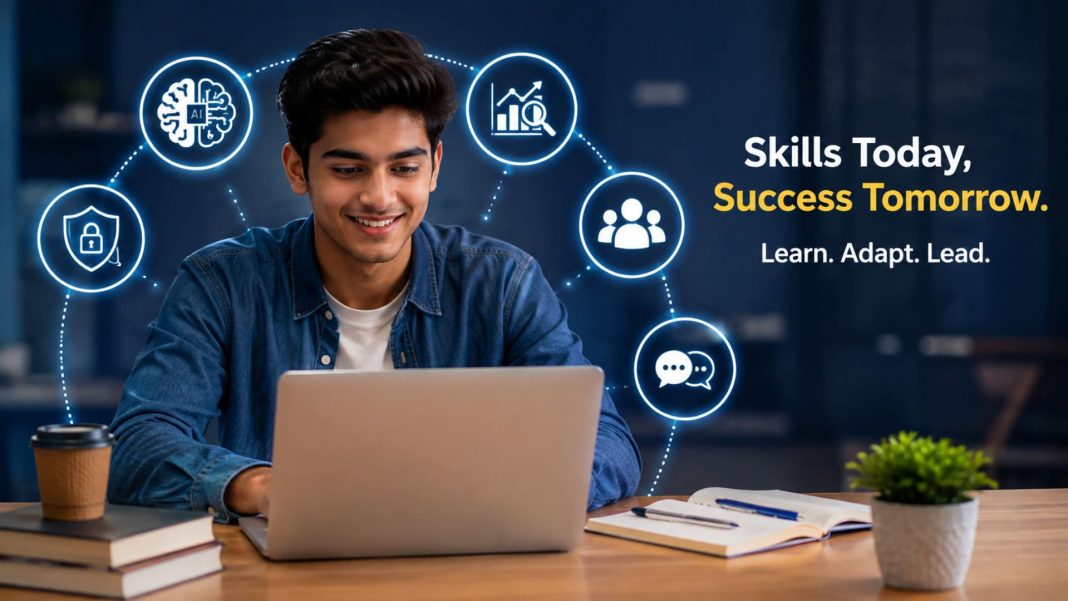

Essential Skills for College Students in 2026: As the global job market undergoes rapid structural changes driven by automation, corporate restructuring, and technological integration, traditional university degrees are no longer a sole guarantee for immediate employment.
According to recent media reports, modern hiring practices are shifting heavily toward “skills-first” recruitment strategies.
To remain competitive in 2026, college students must cultivate a balanced portfolio consisting of advanced technical competencies, digital fluency, and irreplaceable human-centric capabilities.
This comprehensive breakdown highlights the most critical skill sets shaping the corporate landscape in 2026 and outlines actionable steps for students to master them before entering the job market.
1.Artificial Intelligence Literacy and Automation Integration
Essential Skills for College Students in 2026: AI literacy has transitioned from a specialized tech domain into a fundamental workplace requirement across almost every field, including finance, marketing, healthcare, and engineering.
Industry observations indicate that employers no longer expect every graduate to build complex neural networks from scratch; rather, they demand individuals who can effectively integrate AI into daily operational workflows.
Key Focus Areas:
Prompt Engineering & Workflow Automation: Crafting precise inputs to maximize the utility of large language models (LLMs) and context-aware tools.
AI-Assisted Research & Synthesis: Using smart agents to extract insights from vast datasets while maintaining factual accuracy.
Ethical AI Application: Understanding bias, compliance, copyright issues, and privacy risks when deploying algorithmic tools in corporate environments.
2.Data Fluency and Analytics
Essential Skills for College Students in 2026: According to market analysts, organizations across the globe generate massive volumes of unstructured data daily.
However, raw data remains unproductive without professionals who can interpret patterns, extract actionable metrics, and communicate findings to key decision-makers.
Regardless of academic majors, gaining proficiency in foundational data tools provides a distinct advantage:
Core Analytics Tools: Advanced Excel, SQL, and data visualization software like Tableau or Power BI.
Data Storytelling: Translating technical metrics into concise narrative insights for non-technical leadership teams.
3.Critical Thinking and Human-Centered Problem Solving
As generative automation takes over repetitive technical tasks and basic code writing, unique human attributes are gaining substantial enterprise value.
Reports highlight that critical thinking remains one of the hardest capabilities for automated systems to replicate, making it an imperative asset for future management roles.
Developing Systemic Problem-Solving Skills:
First-Principles Reasoning: Deconstructing complex operational bottlenecks down to their fundamental elements.
Scenario Planning: Anticipating dynamic market disruptions and creating multi-layered contingency frameworks.
Evaluating AI Outputs: Applying rigorous analytical skepticism to detect algorithmic hallucinations or flawed assumptions.
4.Cybersecurity Awareness and Digital Hygiene
With hybrid work configurations and cloud infrastructure serving as standard practice across multinational firms, digital exposure has grown significantly.
Industry coverage stresses that enterprise security is no longer strictly the domain of IT departments; every employee represents a potential entry point for security vulnerabilities.
Core Principles to Understand: Data protection regulations, identity security, network access management, and threat identification (e.g., social engineering, targeted phishing).
Specialized Avenues: For students pursuing dedicated security careers, training in cloud platform security (AWS, Azure) and ethical hacking provides direct entry into high-growth job segments.
5.Professional Communication and Adaptive Agility
Technical capabilities open doors for initial interviews, but soft skills dictate long-term career growth and leadership trajectory. According to workplace studies, cross-functional collaboration and emotional intelligence (EQ) stand out as primary differentiators among entry-level job candidates.
| Skill Focus Area | Practical Application in Workplace |
|---|---|
| Written & Verbal Clarity | Draft concise project proposals, pitch ideas clearly, and communicate across international teams. |
| Cross-Cultural Collaboration | Coordinate smoothly with geographically dispersed hybrid teams using modern platforms. |
| Adaptability Mindset | Unlearn obsolete procedures rapidly and adjust quickly to evolving software environments. |
Strategic Roadmap for College Students in 2026
Building a future-ready professional portfolio requires structured, incremental effort alongside degree work:
Build Real-World Projects: Apply theoretical knowledge by creating tangible open-source code repositories, digital marketing portfolios, or market research case studies.
Earn Recognized Certifications: Supplement academic credentials with industry-validated certifications from established digital platforms or enterprise vendors.
Engage in Industry Communities: Participate in hackathons, join relevant professional associations, and build strategic networks on LinkedIn to track emerging industry movements.
Ultimately, surviving and thriving in the 2026 job market relies on combining functional technical knowledge with continuous adaptability. Students who actively bridge the gap between human creativity and technology will be best positioned to land high-impact opportunities.