

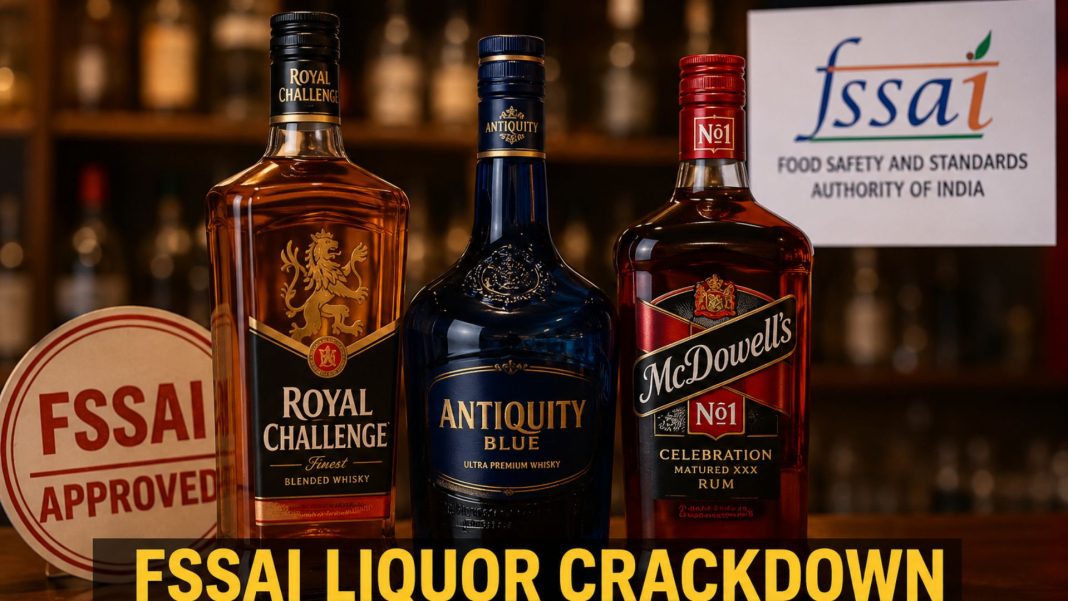

FSSAI Liquor Crackdown: Global spirits leader Diageo and its Indian subsidiary, United Spirits Limited (USL), have agreed to modify the recipes of several flagship whisky and rum offerings in India.
According to media reports citing government sources and regulatory filings, the decision follows severe regulatory objections raised by the Food Safety and Standards Authority of India (FSSAI) over external flavouring substances, age-related claims, and packaging compliance.
The regulatory intervention represents one of the largest food-safety and labelling enforcement actions targeting India’s $40 billion alcoholic beverage sector.
Which Diageo Brands Are Impacted by the Mandate?
FSSAI Liquor Crackdown: The primary products affected by the regulatory enforcement include:
Royal Challenge Whisky: Manufactured in Madhya Pradesh, this flagship brand is among United Spirits’ highest volume sellers, recording over 4.5 million nine-litre cases annually.
Antiquity Blue Whisky: Premium domestic whisky portfolio item produced at facilities in Madhya Pradesh.
McDowell’s No. 1 Celebration Matured XXX Rum: Manufactured out of Maharashtra facilities, representing one of India’s top-selling dark rum lines.
Media reports indicate that the reformulation requirement will not be restricted to isolated regional batches; the altered manufacturing recipes will apply uniformly across all production sites in India.
Core Regulatory Objections Raised by FSSAI
FSSAI Liquor Crackdown: The dispute between the food safety authorities and liquor manufacturers stems from three primary operational concerns:
External Flavouring Substances: According to official FSSAI notifications, the regulator objected to adding “whisky flavour” to whisky or “rum flavour” to rum.
FSSAI maintained that standard spirit characteristics must develop naturally through raw ingredients, fermentation, distillation, and cask maturation rather than external artificial or nature-identical taste additives.
Misleading Maturation and Age Claims: Regulators scrutinised front-of-pack claims on products such as Royal Challenge.
FSSAI raised concerns over descriptions referencing “matured in American oak casks” or “Scotch” when significant proportions of the blend consisted of unaged grain neutral spirit (GNS).
Packaging and Recycled Plastics: Beyond liquid formulations, Indian enforcement officers seized approximately 18,000 cases of Diageo spirits over alleged failures to display required compliance markings regarding the safety of recycled plastic packaging materials.
Agreement Reached and Implementation Timeline
To resolve the sales restrictions imposed in select states, Diageo engaged with regulatory authorities to establish a structured transition pathway:
Removal of Added Flavours: The company will phase out disputed artificial and nature-identical whisky and rum flavourings across all domestic manufacturing lines.
90-Day Transition Window: Media reports highlight that manufacturers have been granted a 90-day execution period to complete reformulation processes while permitting the sale of existing inventory under clear front-of-pack disclosure guidelines.
Interim Label Disclosures: Until revised formulations reach retail shelves, packages will carry updated front-of-pack declarations detailing the exact nature of added flavourings to maintain consumer transparency.
Broader Enforcement Across the Indian Spirits Sector
The regulatory action extends beyond Diageo’s portfolio. FSSAI issued similar enforcement directives and sales restrictions to other major industry participants, including Inbrew Beverages (for Bagpiper Deluxe Whisky and Old Cask Deluxe XXX Rum) and Mohan Meakin (governing variants of Old Monk Rum).
State-level authorities have also aligned with the national directive; for instance, Tamil Nadu’s state retailer TASMAC suspended sales of multiple liquor categories following non-compliance reports regarding artificial flavouring additives.
Strategic Outlook for the Indian Liquor Market
This regulatory precedent marks a significant structural shift in how India’s alcoholic beverage industry operates.
Regulators are moving beyond basic alcohol content and chemical safety metrics toward strict verification of manufacturing processes, ingredient purity, and label accuracy.
While companies face short-term operational adjustments and recipe revisions, the agreement provides clear regulatory clarity, allowing major commercial brands to remain on the market while aligning with standardized national safety codes.