


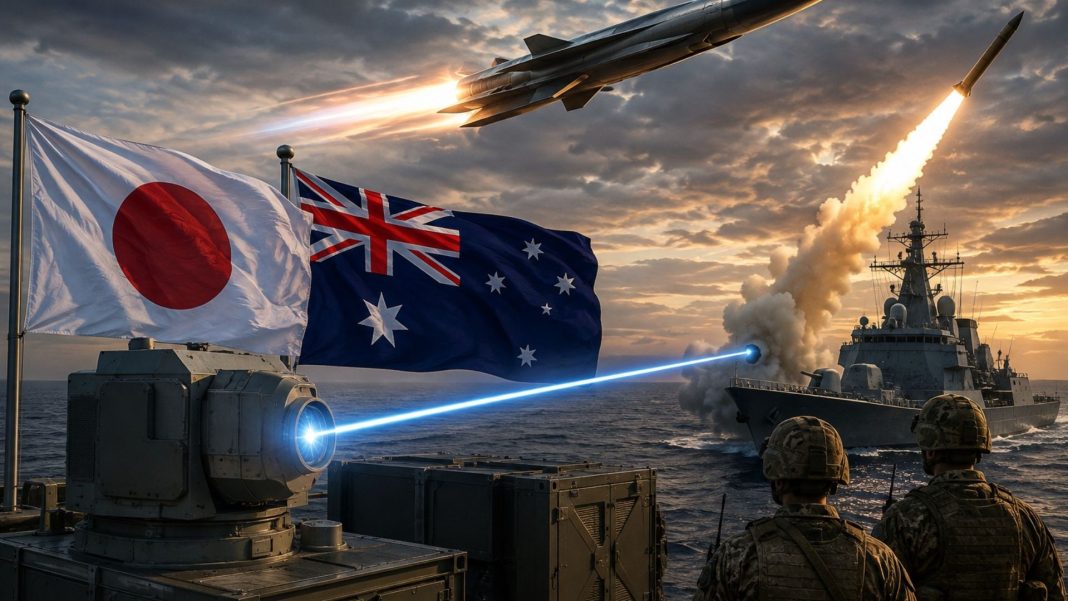

Indo-Pacific Power Shift: In a landmark geopolitical shift, Japan and Australia have forged an unprecedented defense alliance to counter escalating Chinese aggression in the Indo-Pacific region. As regional dynamics undergo a radical transformation following the rollback of American military assets, Tokyo and Canberra are stepping up.
By partnering on advanced military hardware, including hypersonic missile testing on Australian soil and the joint development of a cutting-edge ‘Boobook’ laser system, these two middle powers are actively filling the security vacuum left by shifting U.S. priorities.
The Geopolitical Catalyst: Why Japan and Australia Are Uniting
Indo-Pacific Power Shift: The strategic landscape of the Indo-Pacific has experienced turbulence over the past year. Driven by shifting foreign policies under U.S. leadership, including the scaling back of regional military assets, the sidelining of the Quad, and the putting of AUKUS on the backburner in pursuit of Washington-Beijing diplomatic resets, regional nations have been forced to rethink their security architectures.
Rising Chinese Provocations: Over the last year, Beijing has intensified its coercive actions across the Indo-Pacific, persistently harassing maritime neighbors including Japan, Australia, and the Philippines.
The Leadership Response: Japanese Prime Minister Sanae Takaichi has responded by aggressively boosting national defense spending, expanding domestic weapons production, and cementing regional partnerships.
Middle Powers Coalition: To counter the looming threat from Beijing, a robust coalition of middle powers, featuring India, Japan, Indonesia, Australia, and the Philippines, has rapidly mobilized over the past year to secure regional stability and maritime freedom.
The Defense Pact Breakdown: Missiles, Lasers, and the ‘Boobook’ Project
Indo-Pacific Power Shift: During a joint address, Japanese Defense Minister Shinjiro Koizumi and Australian Defense Minister Richard Marls announced a series of breakthrough military agreements that span missile technology and directed-energy weaponry.
A. Hypersonic Missile Testing Down Under
Minister Koizumi hailed the new defense pact as “unprecedented.” Under the agreement, the Japan Self-Defense Forces will gain access to Australian territory to test long-range strike capabilities, including hypersonic missiles.
“If the Japan Self-Defense Forces are able to test long-range missiles such as hypersonic missiles in Australia, it will be an unprecedented achievement. Therefore, we will accelerate discussions to make this goal a reality.”
— Shinjiro Koizumi, Japanese Defense Minister
Testing grounds in Australia offer vast, remote expanses that are ideal for developing high-velocity, precision-guided delivery systems necessary to deter hostile naval expansion.
B. Project ‘Boobook’: The Dark-Sight Laser System
In addition to traditional missiles, the two allies are launching a joint defense technology initiative named ‘Boobook’, inspired by the native Australian owl renowned for its exceptional nocturnal vision.
The Technology: A sophisticated laser system designed to detect and neutralize potential threats in low-visibility environments.
Deployment: According to Minister Marls, the system features “advanced laser capability that can be fitted to ground combat platforms as well as littoral platforms.”
Strategic Utility: It provides rapid-response counter-measures against drone swarms, fast-attack crafts, and missile threats along sensitive coastlines.
Deepening Industrial Ties: The Multi-Billion Warship Deal
This defense cooperation builds upon an existing, deep-rooted industrial partnership. In a historic $6 billion agreement finalized last year, Australia committed to purchasing at least three advanced warships from Japan over the coming decade.
Phased Production: The initial vessels will be constructed directly in Japan to ensure rapid delivery, followed by a seamless transition into co-development and co-production programs within Australian shipyards.
Operational Focus: The Royal Australian Navy plans to deploy these cutting-edge warships for:
Anti-submarine warfare (ASW)
Surface and air defense operations
Strategic Lifeline: These assets will safeguard critical maritime trade routes and secure northern approaches spanning the Indian and Pacific Oceans against expanding Chinese naval patrols.
Outlook: A Resilient Security Architecture for the Future
As great-power equations fluctuate, the alliance between Tokyo and Canberra demonstrates that regional democracies are fully prepared to take charge of their own security destiny.
By combining Japan’s cutting-edge technological prowess in defense manufacturing with Australia’s vast geographic testing grounds and strategic maritime positioning, the Japan-Australia axis is establishing a powerful deterrent.
Project Boobook and upcoming hypersonic missile trials are not just bilateral milestones; they are foundational pillars of a resilient, self-reliant security architecture designed to keep the Indo-Pacific open, free, and stable for decades to come.