


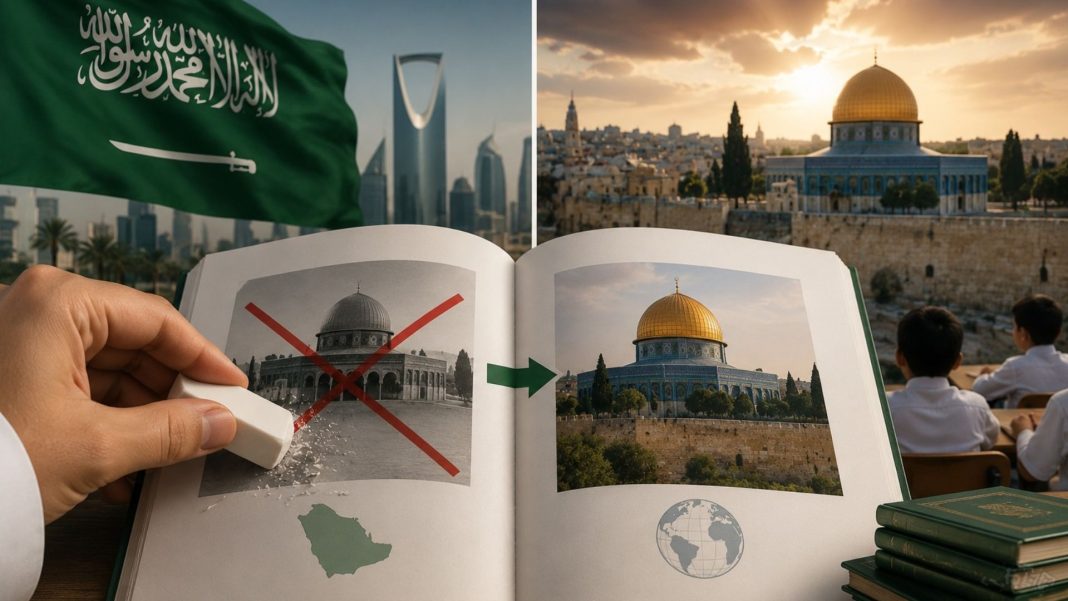

Saudi Arabia Textbook Overhaul: Education has always been a powerful mirror reflecting a nation’s political landscape and cultural aspirations. Recently, Saudi Arabia made a quiet yet significant update to its educational curriculum. The kingdom removed a sentence reading, “Muslims will never abandon Jerusalem,” from its school textbooks.
While textbook revisions happen globally as nations update their educational frameworks, this specific change caught the eye of international observers, Israeli research groups, and political analysts alike.
Against the backdrop of shifting geopolitics in the Middle East, this adjustment offers a fascinating glimpse into how history and regional narratives are being framed for the next generation.
What the Change Was and Why It Mattered
Saudi Arabia Textbook Overhaul: According to a report released in late July by IMPACT-se, an Israel-based research institute that monitors school textbooks for peace and tolerance, the removed sentence carried deep ideological weight.
The Context of the Phrase: The textbook had previously stated that Muslims would never abandon Jerusalem.
The Analyst’s View: Researchers pointed out that the sentence subtly implied that Muslim control or presence in Jerusalem was under imminent threat.
The Conflict Connection: According to the institute, the phrasing could be interpreted as fueling an ongoing religious or territorial struggle between Muslims and other groups, specifically Israel.
By removing this line, educational reformers have trimmed language that could be seen as inflammatory, leaning instead toward a more neutral pedagogical approach. Naturally, this drew immediate praise from IMPACT-se, which lauded the move as a step toward fostering a less confrontational narrative in the classroom.
The Timing: A Delicate Regional Climate
Saudi Arabia Textbook Overhaul: What makes this textbook revision particularly sensitive is the timing. This news comes to light amid heightened tensions surrounding one of the world’s most contested holy sites: Al-Aqsa Mosque in Jerusalem.
For years, critics and regional leaders have accused certain Israeli political figures of pushing agendas that threaten the historic status quo of the compound. Recently, tensions spiked even further when Israeli authorities permitted Jewish worshippers to formally pray inside the Al-Aqsa Mosque compound in occupied East Jerusalem.
Breaking Decades of Tradition: This decision broke a decades-old arrangement that governed how the holy site is shared and managed.
Heightened Anxiety: Such moves have amplified fears across the Muslim world regarding the future of the third-holiest site in Islam, making any news regarding Jerusalem, even textbook edits, a matter of intense public discussion.
Navigating Change and Continuity
When we look at regional updates like this, it is easy to view them simply as chessboard moves in high-stakes diplomacy. However, they also represent how countries attempt to balance deep-rooted cultural identities with modern diplomatic realities.
Saudi Arabia has been gradually refining its national curriculum over the past few years to modernize its educational system, weed out extremism, and promote a vision of economic and social progress under Vision 2030. Textbooks are carefully combed to ensure they align with a vision of global engagement, while still honoring national heritage.
Yet, this balancing act is never easy. While research organizations abroad praise the removal of phrases tied to regional conflict, local populations and regional allies watch closely to ensure that fundamental principles, historical truths, and solidarity with Palestinian rights are not sidelined in the pursuit of modernization.
Looking Ahead
The removal of a single sentence from a schoolbook might seem small at first glance, but in the complex world of Middle Eastern politics, words matter. It highlights how education is continuously utilized as a tool for shaping peace, perception, and regional diplomacy.
As Saudi Arabia continues to navigate its role as a regional powerhouse, every page turned in its classrooms is watched by the world, reminding us that the battle for peace often begins with how the next generation is taught to read the world around them.