


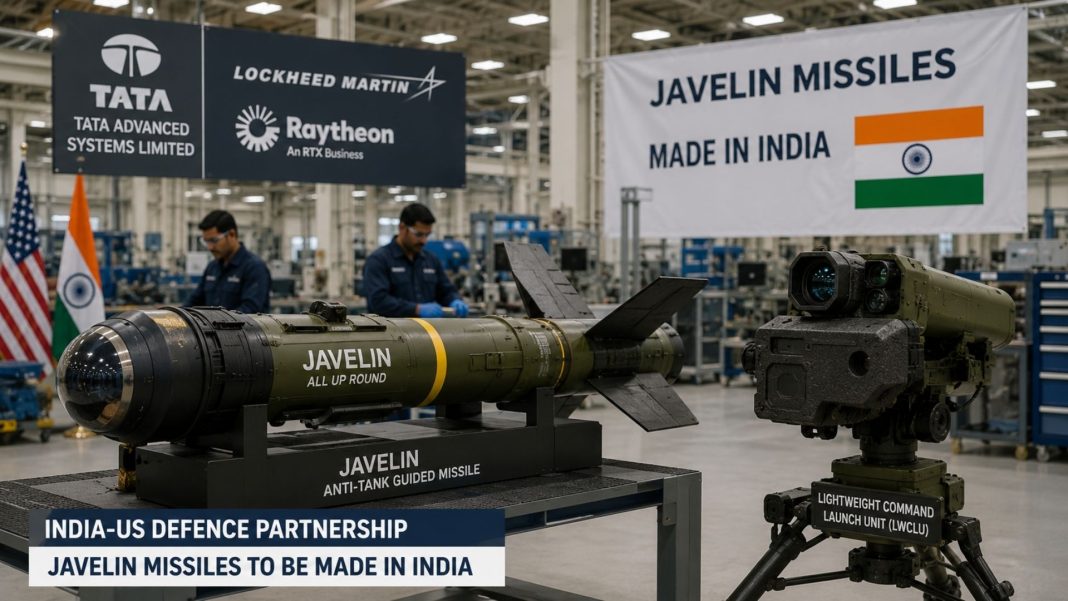

Tata to Make US Javelin Missiles in India: In a major development for India’s aerospace and defence manufacturing sector, Tata Advanced Systems Limited (TASL) has entered into a Memorandum of Understanding (MoU) with the Javelin Joint Venture (JJV) a partnership between defense giants Lockheed Martin and Raytheon (an RTX business) to explore the co-production of the Javelin All Up Round (AUR) missile in India.
According to media reports, TASL was chosen as the prime industrial partner following an extensive evaluation process of multiple domestic firms by the US firms based on capability, infrastructure, and technical expertise.
The landmark MoU outlines plans to evaluate setting up a dedicated final assembly and integration facility, along with localized component production capabilities within India.
The announcement closely follows the Indian Army signing a Letter of Offer and Acceptance (LOA) with the United States government to acquire the battle-tested Javelin anti-tank guided missile (ATGM) system under the Foreign Military Sales (FMS) framework.
Understanding the Co-Production Framework and Industrial Supply Chain
Tata to Make US Javelin Missiles in India: Under the proposed arrangement, critical sub-assemblies and advanced guidance electronics will continue to be manufactured at specialized American facilities including Lockheed Martin’s plant in Troy, Alabama, and Raytheon’s facility in Tucson, Arizona.
These sub-assembly kits will then be transferred to India, where TASL will undertake the final assembly, system integration, and testing of the complete missile systems.
According to industry analysts, this collaborative model offers distinct advantages to both nations:
Technology Transfer & Skilled Workforce: Brings high-end assembly, integration expertise, and technical knowledge into the Indian defence ecosystem while generating skilled high-tech manufacturing jobs.
Global Supply Chain Resiliency: Helps address global supply bottlenecks and rising international demand for anti-tank weaponry by adding an operational assembly node in Asia.
Sustaining U.S. Production: Secures multi-year production lines for sub-assembly components produced in the United States.
Faster Operational Fielding: Provides the Indian Armed Forces with localized, timely access to combat-ready anti-tank capabilities while ensuring rapid response times for spare parts and maintenance.
Procurement Details and Emergency Capabilities
Tata to Make US Javelin Missiles in India: The initial government-to-government transaction establishes an immediate capability buffer for the Indian Army while domestic missile projects continue maturation.
According to media reports, the Foreign Military Sales deal includes 100 Javelin All Up Rounds along with 25 Lightweight Command Launch Units (LwCLU).
U.S. officials and diplomatic representatives have hailed the acquisition agreement as a significant milestone in deepening bilateral military interoperability.
The Defense Security Cooperation Agency (DSCA) noted that integrating the Javelin system strengthens the U.S.-India strategic relationship and enhances regional security and operational stability across the Indo-Pacific region.
Tactical Advantage: Why the Javelin Remains Indispensable
The FGM-148 Javelin is widely recognized as one of the world’s most effective shoulder-fired, man-portable anti-tank guided missile systems.
Designed to destroy modern heavily armored main battle tanks, fortified structures, and low-flying targets, the system offers distinct battlefield capabilities:
Fire-and-Forget Guidance: Utilizes an advanced infrared seeker that tracks the target automatically after launch, allowing operators to immediately seek cover or maneuver to safety.
Top-Attack Capability: Climbs to strike armored vehicles from above, targeting the thinner top armor where tanks are most vulnerable.
Soft-Launch Design: Minimizes initial blast signature, allowing troops to fire safely from enclosed urban spaces, bunkers, or concealed positions.
Boosting Self-Reliance in India’s Defence Sector
Speaking on the partnership, TASL leadership highlighted that localized assembly of the Javelin All Up Round aligns directly with national goals of defense self-reliance (Atmanirbhar Bharat).
By establishing assembly, integration, and supply-chain capabilities locally, India expands its domestic defence industrial base while ensuring sustained readiness for its armed forces along critical border sectors.