


₹4 Crore cheque, Just ₹3 in the Account: When it comes to deep-seated devotion, stories from the sacred grounds of Ayodhya often capture the nation’s heart.
From teary-eyed pilgrims walking hundreds of miles to humble offerings of life savings, expressions of faith are everywhere. But every once in a while, a headline emerges that leaves everyone scratching their heads.
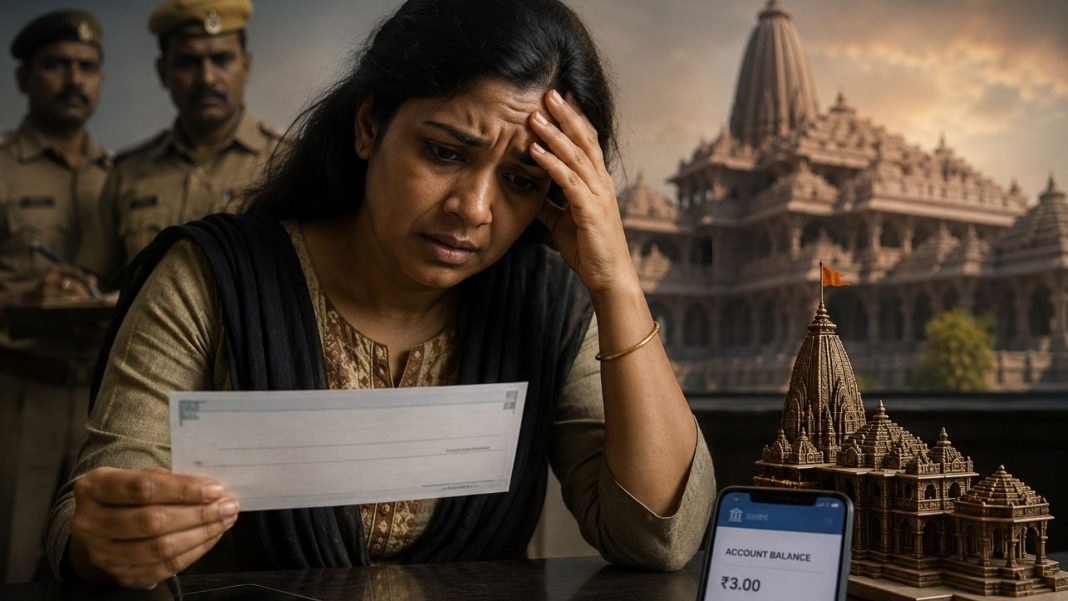
Enter the strange case of S. Mahalakshmi, a devotee from Chennai who handed over a staggering ₹4 crore (40 million rupees) cheque to the Shri Ram Janmabhoomi Teerth Kshetra Trust. Sounds like a headline-making act of extreme generosity, right? Well, the twist came when the bank tried to cash it: the account had a princely balance of just ₹3.
Let us dive deep into this bizarre incident, look at the strange conditions attached to the donation, and understand what the law says about cheques bouncing for such astronomical amounts
A Grand Gesture That Left Bank Officials Stunned
₹4 Crore cheque, Just ₹3 in the Account: The story began when S. Mahalakshmi traveled from Chennai to Ayodhya with a very specific mission. She intended to contribute significantly to the temple, presenting a cheque worth ₹4 crore directed at the Shri Ram Janmabhoomi Teerth Kshetra Trust.
For temple authorities handling massive inflows of donations, large checks are not uncommon. However, when this particular cheque was processed through banking channels, reality hit hard. The bank account linked to the cheque did not just fall short of ₹4 crore, it barely held enough to buy a cup of tea, resting at a hollow balance of three rupees.
Adding an even more perplexing layer to the incident, the devotee did not leave empty-handed or tight-fisted everywhere else. Alongside this massive, unfunded cheque, she reportedly handed over a separate cash donation of ₹10,000 during her Darshan and made sure to collect a valid receipt for it.
The Odd Condition: A Demand for Specific Spending
₹4 Crore cheque, Just ₹3 in the Account: Why would someone issue a multi-crore cheque with practically empty pockets? Media reports surrounding the incident point toward a very unusual condition set by the donor.
Before handing over the cheque, Mahalakshmi reportedly demanded a written assurance from the temple authorities. Her condition? She wanted a guarantee that her massive contribution of ₹4 crore would be used exclusively for the salaries and welfare facilities of the temple staff, rather than general construction or other trusts funds.
While looking out for temple workers sounds noble on the surface, attaching rigid conditions to a cheque drawn on a virtually empty account has turned what could have been a philanthropic discussion into a legal headache. The bank is now reportedly preparing to issue formal legal notices regarding the failed transaction.
When Faith Meets the Law: What Happens When a cheque Bounces?
In the financial and legal world, issuing a cheque without having adequate funds in your account is not just an embarrassing mistake, it is a serious criminal offense.
Under Section 138 of the Negotiable Instruments Act, 1881, bouncing a cheque due to insufficient funds carries heavy legal consequences. Here is how the legal machinery rolls into action in such cases:
The Bank Memo: When a cheque bounces, the bank issues a formal memo stating the exact reason for the failure (in this case, insufficient balance).
The Legal Notice: Armed with this memo, the victim or the aggrieved party must send a formal legal notice through an advocate to the cheque issuer within 30 days of receiving the memo.
The 15-Day Window: Once the notice is delivered, the issuer is given a grace period of 15 days to clear the due amount.
Court Action: If the payment is not made within this window, the complainant has the right to file a formal criminal case in a Magistrate Court within the next 30 days.
If convicted under this section, the penalties can be severe. An individual can face imprisonment for up to 2 years, a fine that can extend to twice the amount of the original check, or both. Given the sheer size of the ₹4 crore figure, the legal stakes are remarkably high.
A Look Back: The History of Bounced Checks in Ayodhya
This is not the first time financial paperwork has created drama around the grand Ram Mandir. Back in 2020, when the nationwide Nidhi Samarpan Abhiyan (fundraising campaign) was launched, the scale of donations was historic. Over a span of just 45 days, the trust managed to collect roughly ₹3,500 crore through voluntary public contributions.
During that massive wave of devotion, millions of people used checks to transfer their contributions. Because of technical glitches, bank processing errors, and occasional clerical oversights, a staggering ₹100 crore worth of cheque bounced initially.
However, the trust handled those situations systematically:
The Recovery Phase: Many of those bounced cheque were resubmitted after coordinating with donors, and the money was successfully recovered.
Unresolved Balances: Despite successful follow-ups, reports indicated that a significant sum, around ₹22 crore worth of checks, ultimately could not be recovered due to closed accounts or permanent non-payment.