


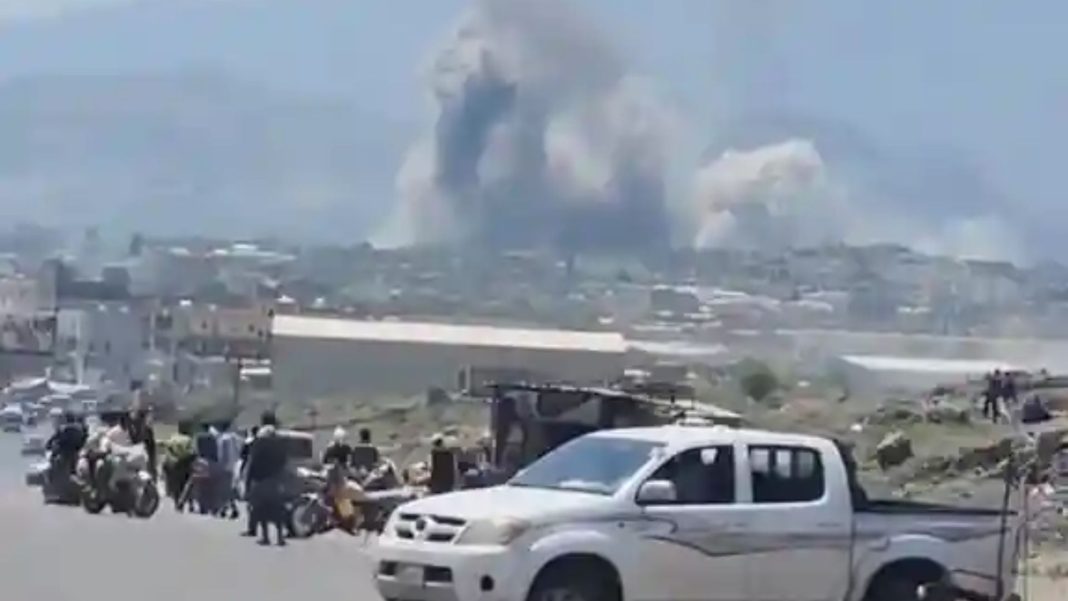

Yemen Market Attack: A devastating airstrikes struck a busy market in Yemen’s southern Taiz province on Sunday, killing at least seven people, including young children, and leaving more than 40 others injured, according to local health officials controlled by the Houthi movement.
The attack marks a sharp escalation in a multi-front conflict that has fractured the Arabian Peninsula nation for over a decade. Eyewitnesses reported severe damage to commercial shops and local vendor stalls in the market area, where emergency responders spent hours digging through rubble to rescue survivors and transport the wounded to nearby hospitals.
Yemen Government Defends Strikes, Points to Houthi Military Encampment
Yemen Market Attack: In a statement released shortly after the attack, Yemen’s internationally recognized government confirmed its armed forces carried out targeted military operations in the region. Military officials maintained that the strikes were directed strictly at Houthi military camps, weapons depots, and combat vehicles, rather than civilian infrastructure.
Sources within the Yemeni government told Reuters that Houthi rebels had recently set up a fortified military base in close proximity to the populated market area. Government spokespersons argued that the rebels were intentionally using civilian installations as human shields to protect their operational hubs, putting local residents directly in harm’s way.
UN Raises Alarm Over Surging Civilian Displacement and Death Toll
Yemen Market Attack: The deadly strike in Taiz is the latest incident in a rapid escalation of violence across Yemen. According to the United Nations, renewed intense fighting over the past two months alone has claimed the lives of more than 700 people, including a significant number of non-combatants.
The UN Refugee Agency (UNHCR) highlighted a humanitarian breakdown, noting that over 82,000 individuals have been forcibly displaced from their homes since the beginning of September. Relief organizations warn that medical facilities in Taiz and surrounding provinces are overwhelmed, facing severe shortages of basic surgical supplies, clean water, and emergency shelter.
The Fragile Peace Crumbles: How the 2022 Ceasefire Unraveled
Yemen has been plunged into a devastating civil war since 2014, when Iran-backed Houthi insurgents marched on the capital, Sanaa, overthrowing the official government. The conflict subsequently broadened into a complex regional war when a military coalition led by Saudi Arabia intervened in support of the recognized Yemeni administration.
A UN-brokered truce in 2022 offered a temporary reprieve and lowered overall violence across major battlefronts. However, the fragile peace agreement has completely broken down in recent months. Cross-border missile launches, armed drone incursions, and heavy retaliatory airstrikes have resumed with dangerous intensity, shattering hopes for a diplomatic resolution in the near term.
Cross-Border Warfare: Houthis Launch Drone and Missile Raids into Saudi Arabia
The latest airstrikes in Taiz follow a series of aggressive cross-border maneuvers by Houthi forces. Yemeni military sources reported that the rebel group launched two explosive-laden drones aimed directly at the Saudi capital, Riyadh. Saudi air defense systems successfully intercepted and destroyed both unmanned aerial vehicles before they could reach their targets.
In a simultaneous operation, Houthi fighters fired a high-payload ballistic missile toward the southern Saudi border region of Khamis Mushait. Civil defense authorities in Saudi Arabia issued air raid alerts across the southwestern cities of Abha and Jizan overnight, advising residents to stay indoors as defense batteries engaged incoming aerial threats.
Escalating Tensions: Why Houthis are Targeting Saudi Infrastructure
The continuous cross-border strikes stem directly from Saudi Arabia’s diplomatic and military backing of the official Yemeni government. Seeking to force the coalition to halt its air campaigns and raise the economic cost of intervention, the Houthis have dramatically expanded their target list inside Saudi territory.
Since July, rebel forces have launched dozens of coordinated drone and missile attacks targeting major Saudi metropolitan areas, including:
Capital & Metropolitan Hubs: Riyadh, Jeddah, and Taif.
Border Cities: Abha, Jizan, and Najran.
Industrial Centers: Port facilities and energy infrastructure in Yanbu.
These strikes have regularly targeted international airports, military outposts, and critical oil processing plants, while naval units have attempted to disrupt Saudi shipping traffic in the Red Sea. In response, Saudi-led coalition warplanes have intensified airstrikes against Houthi command centers in Yemen, creating a dangerous cycle of retaliation.
Maritime Security Threat: Houthi Advances Near Bab al-Mandeb Strait
Beyond the land war, the conflict is increasingly threatening international maritime commerce. Houthi fighters have made rapid territorial gains along the Red Sea coast, seizing strategically vital zones near the Bab al-Mandeb Strait.
The Bab al-Mandeb Strait serves as a crucial nautical gateway connecting the Red Sea to the Gulf of Aden and the Indian Ocean. Millions of barrels of global oil shipments and commercial cargo transit through this narrow passage every day.
Following their recent advances, Houthi military leaders warned that all commercial vessels associated with Saudi Arabia or carrying cargo bound for Saudi ports would be treated as legitimate military targets. Maritime security experts warn that any prolonged disruption in these waters could trigger global supply chain bottlenecks and spike international oil and freight prices.
Also Read : UN Assembly Disarray: 75 Nations Walk Out as Netanyahu Mocks Critics as ‘Moral Cowards’