


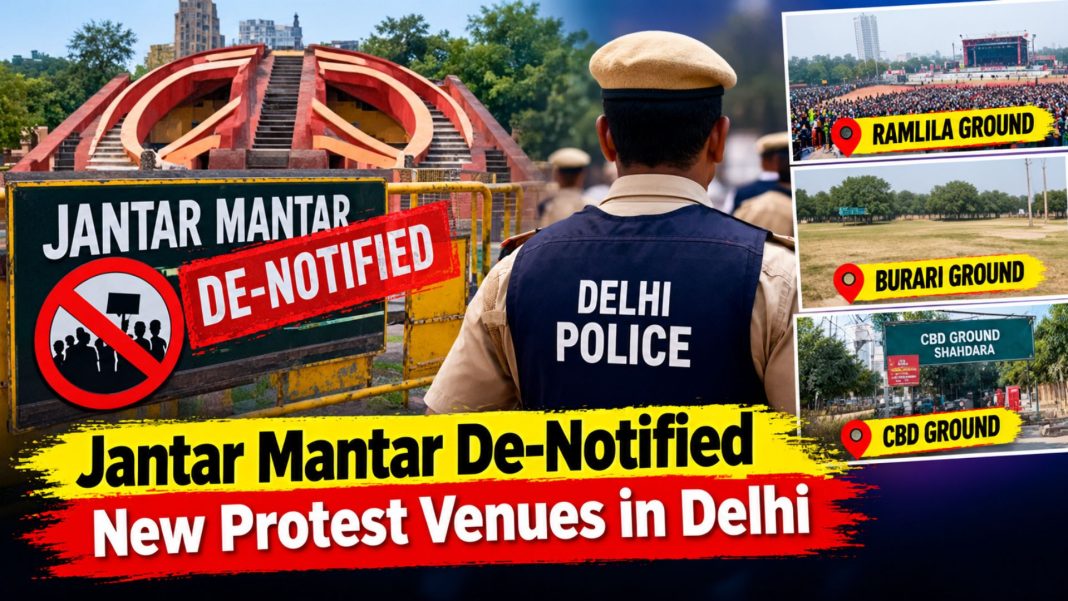

Jantar Mantar De-Notified as Protest Site: In a major administrative shift impacting public gatherings in the national capital, the Ministry of Home Affairs (MHA) has officially de-notified Jantar Mantar in Lutyens’ Delhi as a designated protest site.
According to a Delhi Police circular issued on Monday, three new designated venues spread across different parts of the city have been established for citizen demonstrations and public agitations.
The decision follows recommendations from a high-level committee constituted by the Ministry of Home Affairs to evaluate alternative, manageable locations for public gatherings. The newly designated venues for protests in Delhi are:
Ramlila Ground (Central Delhi)
Burari Ground (North Delhi)
CBD Ground in Shahdara (East Delhi)
According to official notifications, Delhi Police will issue detailed and revised Standard Operating Procedures (SOPs) governing the organization of demonstrations and assemblies at these three locations separately.
Security Concerns and Commercial Relief in Lutyens’ Delhi
Jantar Mantar De-Notified as Protest Site: According to media reports, the decision to de-notify Jantar Mantar stems primarily from security considerations, frequent traffic congestion, and disruptions to local commerce in Central Vista and Lutyens’ Delhi.
Situated barely one to two kilometers from Parliament House, Raisina Hill, and key central ministries, Jantar Mantar had increasingly become a flashpoint for intense public mobilizations.
The move has drawn strong support from local business associations. According to statement releases by the New Delhi Traders Association (NDTA), commercial establishments around Connaught Place and Jantar Mantar suffered revenue losses during recent demonstrations due to road blockades, metro station closures, and traffic diversions affecting commuter access to the New Delhi Railway Station.
Recent Unrest and Political Opposition Reaction
Jantar Mantar De-Notified as Protest Site: Jantar Mantar had served as the focal point for several high-profile youth and political movements in recent months.
According to news reports, the venue witnessed sustained demonstrations led by the Cockroach Janta Party (CJP), founded by activist Abhijeet Dipke, which previously centered on education sector reforms.
More recently, the site became the epicenter of intense political agitations regarding the Special Intensive Revision (SIR) electoral process, resulting in mass preventive detentions over the weekend.
Following the issuance of the de-notification order, CJP founder Abhijeet Dipke expressed strong opposition to the government’s move on social media platforms, stating that removing Jantar Mantar as an official site would only shift public demonstrations across the wider country.
Historical Context: The Legacy of Jantar Mantar Agitations
For over two decades, Jantar Mantar served as India’s premier symbolic ground for grassroots activism, union rallies, and civic protests.
Situated within walking distance of key administrative buildings including NITI Aayog, Akashvani Bhawan, and major ministerial complexes it offered activists direct proximity to decision-makers.
Over the years, the site hosted several defining public movements in modern Indian political history, including:
The 2012 Nirbhaya Movement seeking legal reforms on safety.
The 2015 One Rank One Pension (OROP) agitations by military veterans.
The 2017 Tamil Nadu Farmers’ Protests highlighting agricultural distress.
The 2021 ‘Kisan Sansad’ during the broader agrarian agitations.
The 2023 Wrestlers’ Protest against sports administration officials.
With Ramlila Maidan located roughly 4 kilometers away, CBD Ground Shahdara 12 kilometers away, and Burari Ground 18 kilometers away, the relocation effectively decentralizes public demonstrations away from the administrative core of Lutyens’ Delhi.