


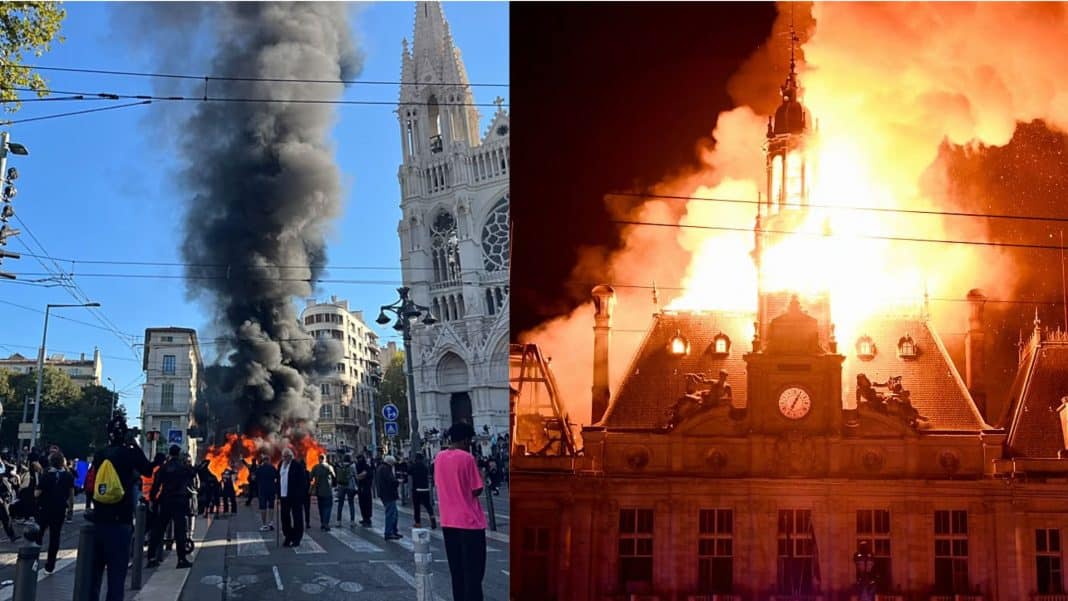

France Protests: France witnessed one of its most turbulent days in recent months as over 1,200 people were arrested nationwide following a wave of intense protests. What began as a student-led movement demanding better school conditions quickly expanded into a sweeping display of anger over the rising cost of living, deteriorating public services, and systemic economic inequality.
Across major cities, peaceful marches turned into chaotic clashes between security forces and rioters, prompting police to deploy tear gas and heavy crowd-control measures.
From Classrooms to City Streets: How the Unrest Began
France Protests: The spark for this nationwide mobilization originated in the economically disadvantaged northern suburbs of Paris. Students and parents initially took to the streets to highlight severe teacher shortages, crumbling school infrastructure, and concerns over aggressive policing.
However, deep-seated economic frustrations soon transformed local educational rallies into a broader public uprising. Appeals circulated heavily on social media, urging working-class citizens, pensioners, farmers, and labor groups to unify under a common cause.
Key demands from the movement include:
Educational Reform: Addressing severe teacher shortages and upgrading dilapidated school facilities.
Justice & Safety: An end to police violence in school zones during demonstrations.
Economic Relief: Tackling inflation, capping the rising cost of living, and raising minimum wages and pensions.
Public Welfare: Protecting and reinvesting in essential public services nationwide.
Flashpoints Across the Nation: Violence Erupts in Paris and Marseille
France Protests: While thousands marched peacefully to voice their concerns, high-tension spots across France saw severe disruptions and property damage.
Escalation in Central Paris
Near Place de la République, masked individuals hurled fireworks and paving stones at law enforcement lines. Opportunistic crowds damaged bank branches, ransacked a sports outlet, and looted luxury boutiques along Boulevard Magenta.
Flaming debris and burning vehicles sent thick plumes of tear gas and smoke into residential neighborhoods, forcing locals to lock doors and close windows.
Voice from the Crowd:
“We’re taking the Bastille!” shouted one protester amidst the chaos in central Paris, reflecting the revolutionary rhetoric echoing through the streets.
Conflict in Marseille
In Marseille, demonstrator groups pulled down security barricades to ram the entrance of the city’s municipal town hall. A small group briefly gained entry, tagging wall surfaces with anarchist symbols before being pushed back by police units. Rubbish bins were set on fire across downtown streets as security personnel worked to restore order.
Government Response: Nuñez Denounces “Opportunistic Delinquents”
Addressing the nation late on Saturday, French Interior Minister Laurent Nuñez condemned the violence while clarifying the government’s stance on safety measures.
Key Points from the Interior Ministry:
Arrests Made: Over 400 individuals were detained directly in high-conflict areas late Saturday, with the national total surpassing 1,200 arrests across all cities.
Protest Hijacking: Nuñez emphasized that the core student demonstrations were hijacked by opportunistic rioters (casseurs) seeking chances to loot and damage property.
No State of Emergency: The ministry confirmed there are currently no immediate plans to declare a state of emergency, assuring that law enforcement will identify and prosecute offenders firmly.
Echoes of 2018: The Yellow Vests Resurface
Saturday’s turnout carried strong echoes of the gilets jaunes (yellow vests) movement that heavily challenged President Emmanuel Macron’s administration in 2018. Demonstrators donning high-visibility jackets set up road blockades across regional transport routes, signaling renewed frustration with national economic policies.
Economic anxiety remains a dominant concern across the country. According to an October survey of 2,000 citizens, approximately 45% of the French population expressed deep worry regarding inflation and the squeeze on household budgets.
Trade unions, including the powerful CGT, backed the wider calls for action, advocating for:
Substantial increases in minimum wages and pensions.
Stricter price controls on essential goods.
Greater state investment in public education and healthcare.
Political Tug-of-War: Left and Right Target the Crisis
The widespread unrest has intensified political debates across the spectrum, with rival factions seizing on the momentum ahead of upcoming legislative discussions.
Far-Left Position (France Unbowed)
Fully endorses the student and worker protests.
Blames severe public underfunding for deteriorating social conditions.
Demands broader wealth redistribution and increased public spending.
Far-Right & Conservative Position
Extends firm support to police forces and security personnel.
Calls for strict law and order enforcement to curb unrest.
Strongly condemns street violence and damage to private property.
Jean-Luc Mélenchon, leader of the far-left France Unbowed party, publicly joined demonstrators to endorse the youth movement and challenge the government’s fiscal stance. Conversely, conservative and far-right figures directed their support toward police forces, calling for tougher enforcement against “ultra-left” groups and street rioters.
As cleanup efforts continue and authorities review surveillance footage to make further arrests, France remains at a tense crossroads, with public frustration over living standards showing no signs of fading.
Also Read : US Teen Arrested: US Teen Arrested for Planning Mass Shooting at Illinois Hindu Temple