


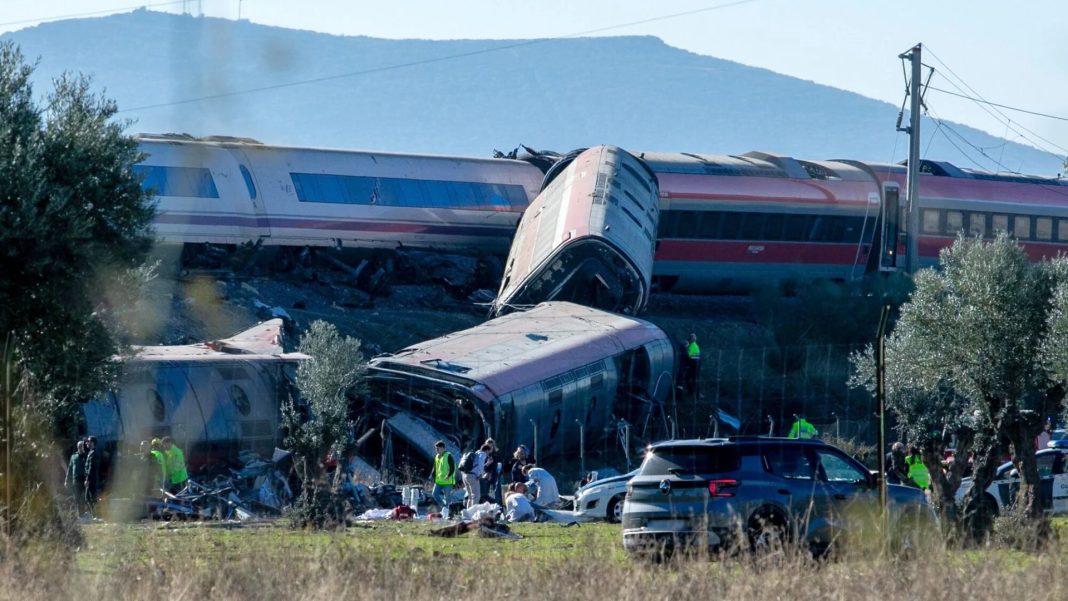

Tragic Rail Disaster in Spain: A catastrophic collision between two high-speed trains in Spain’s central province of Toledo has left at least 46 people dead and scores more injured. The devastating crash, which occurred on Wednesday, has forced authorities to halt all rail operations along the major corridor connecting Madrid with Ciudad Real and the southern region of Andalusia.
The disaster has sent shockwaves across the nation, raising fresh concerns over safety standards on one of Europe’s most extensive high-speed rail networks.
Disastrous Impact: Rear-End Collision Causes Carriage Derailments
Tragic Rail Disaster in Spain: According to media reports, the tragedy unfolded when two high-speed trains traveling in the same direction collided on the tracks. One train reportedly slammed into the rear of the other with immense force.
The violent impact threw two passenger carriages off the tracks, twisting metal and trapping commuters inside. Spain’s national rail infrastructure operator, ADIF, officially confirmed the accident shortly after it occurred, though officials noted that full details surrounding the exact technical cause remain under investigation.
Videos circulating on social media platforms paint a harrowing picture of the crash site: shattered debris scattered across the tracks, damaged rail cars, and first responders working frantically against the clock under difficult conditions to reach trapped survivors.
Emergency Response: Local Towns Mobilize to Assist Victims
Tragic Rail Disaster in Spain: In the immediate aftermath of the crash, nearby municipalities rushed to support rescue teams and provide relief to traumatized survivors.
Manuel Galan, the mayor of the neighboring town of Urda, confirmed that civil protection authorities had requested emergency assistance from local officials. In response, the local administration immediately moved to transform a community sports pavilion into a temporary reception and triage center for injured passengers and their families.
Similarly, Jesus Perez, mayor of the adjacent village of Los Yebenes, described the incident as extremely severe as emergency vehicles flooded the area. Regional authorities quickly coordinated efforts to streamline medical evacuations and clear the damaged rail lines.
National Leadership Responds: Prime Minister “Shocked” as Authorities Coordinate Relief
Spanish Prime Minister Pedro Sanchez expressed profound grief over the loss of life, stating publicly that he was “shocked” by the scale of the tragedy.
In a statement shared on social media, Prime Minister Sanchez assured the public that the government was deploying every available resource to manage the crisis. He confirmed that he remains in continuous communication with the Minister of Transport as well as Emiliano Garcia-Page, the regional president of Castilla-La Mancha.
“Emergency services are working on the ground to assist those affected and ensure their safety, in coordination with all the involved administrations,” Sanchez wrote.
Regional President Garcia-Page also confirmed he traveled directly to the accident site to oversee relief operations and coordinate assistance for victims’ families.
Consternado ante el grave accidente de trenes en Toledo. Permanezco en constante contacto con el ministro de Transportes, @oscar_puente_, y con el presidente de Castilla-La Mancha, @garciapage.
— Pedro Sánchez (@sanchezcastejon) October 28, 2026
Los servicios de emergencia están trabajando sobre el terreno para atender a las…
International Support: Global Leaders Express Solidarity
As news of the disaster spread, international figures offered their condolences to the people of Spain. Italian Prime Minister Giorgia Meloni was among the first foreign leaders to speak out, offering strong words of support during this national crisis.
“In these such difficult hours, the Italian Government is close to Spain and the Spanish people for the dramatic railway accident that occurred near Toledo,” Meloni stated in an official expression of solidarity.
In queste ore così difficili, il Governo italiano è vicino alla Spagna e al popolo spagnolo per il drammatico incidente ferroviario avvenuto nei pressi di Toledo.
— Giorgia Meloni (@GiorgiaMeloni) October 28, 2026
I miei pensieri e quelli di tutto il nostro Governo vanno ai familiari delle vittime, ai feriti e a quanti stanno…
Heightened Concerns: A Troubling Pattern on Spanish Rail Lines
Wednesday’s collision comes at a sensitive time for Spain, occurring just months after another deadly rail catastrophe in January. In that earlier incident, 45 people lost their lives in southern Spain when a derailed train collided with an oncoming service.
That tragedy was marked as Spain’s worst rail accident since the 2013 Santiago de Compostela derailment, which claimed 80 lives. With two major loss-of-life train accidents occurring within a short span, questions are mounting regarding signal safety, automated braking systems, and track maintenance across the country’s high-speed lines.
As rescue teams continue their operations in Toledo, investigation teams from transport safety boards are working to determine whether technical malfunction, human error, or signal failure led to the fatal rear-end crash.
Also Read : China Giant Billboards: China Swaps Pop Icons for Genius Scientists on Giant City Billboards