


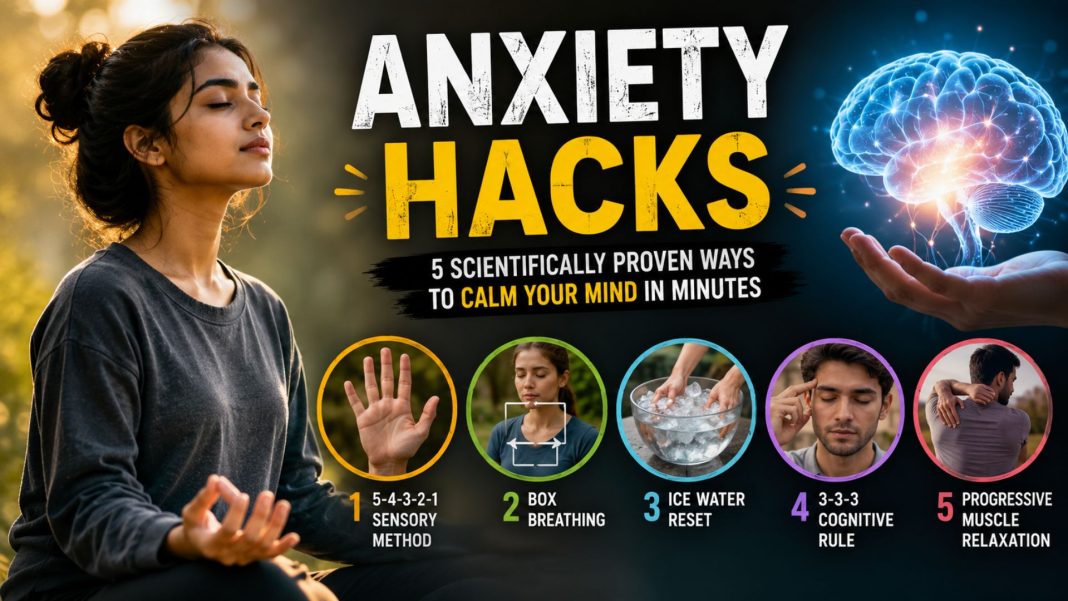

In today’s hyper-connected, fast-paced world, anxiety has become a silent epidemic. Whether it is triggered by an upcoming corporate presentation, financial stress, or the constant influx of digital notifications, an anxiety attack can strike without warning.
When anxiety takes over, your brain’s emotional center the amygdala hijacks your rational thinking, plunging your body into a state of fight-or-flight. Your heart races, your breath shortens, and your mind spins out of control.
While long-term stress management requires lifestyle adjustments, you often need immediate relief when a wave of panic hits. This is where grounding techniques come into play.
Grounding is a therapeutic practice designed to detach you from emotional pain and looping anxious thoughts by refocusing your awareness on the present moment.
Here are 5 scientifically proven grounding techniques to reset your nervous system and calm your mind in a matter of minutes.
1.The 5-4-3-2-1 Sensory Method
Perhaps the most famous cognitive behavioral therapy (CBT) hack, the 5-4-3-2-1 method, forces your brain to shift its focus from internal chaos to your external environment using your five senses.
By actively seeking out specific stimuli, you force your prefrontal cortex to come back online, overriding the panic response.
How to practice it:
Take a deep breath and look around you to identify:
5 things you can see: A clock on the wall, a plant, a coffee mug, or a patch of sunlight.
4 things you can feel: The texture of your jeans, the hard surface of your desk, or the wind on your face.
3 things you can hear: The hum of the air conditioner, traffic outside, or birds chirping.
2 things you can smell: The scent of your hand sanitizer, a nearby candle, or the aroma of coffee.
1 thing you can taste: The lingering flavor of toothpaste or a sip of fresh water.
2.Box Breathing (The Navy SEAL Reset)
When anxiety strikes, your breathing naturally becomes shallow and rapid, which signals your brain that you are in immediate danger.
Box breathing is a powerful somatic grounding tool used by high-stress professionals, including Navy SEALs and first responders, to instantly lower cortisol levels and activate the parasympathetic nervous system (the “rest and digest” mode).
How to practice it:
Imagine a box or a square with four equal sides.
Follow this rhythmic pattern:
Inhale deeply through your nose for a count of 4.
Hold your breath at the top for a count of 4.
Exhale completely through your mouth for a count of 4.
Hold your lungs empty at the bottom for a count of 4.
Repeat this cycle four to five times. The deliberate pauses disrupt the chemical cascade of panic, bringing your heart rate back to baseline.
3.The “Ice Water” Mammalian Dive Reflex
If your mind is racing too fast for mental exercises, you need a physical “circuit breaker” to interrupt the panic loop. Submerging your face or hands in ice-cold water triggers a biological phenomenon known as the Mammalian Dive Reflex.
When your body senses a sudden drop in temperature around the nasal area, it automatically slows down your heart rate and redirects oxygenated blood to your vital organs.
It acts as an instant biological brake for severe anxiety or panic attacks.
How to practice it:
Fill a large bowl with cold water and ice cubes.
Hold your breath and submerge your face for 10 to 15 seconds.
Alternatively, hold an ice cube firmly in the palm of your hand or run freezing cold water over your wrists for a minute.
The intense physical sensation forces your brain to focus on the immediate physical stimulus, completely derailing anxious thought patterns.
4.The 3-3-3 Cognitive Rule
When anxiety makes you feel detached from reality (a sensation known as derealization), you need a quick mental anchor.
The 3-3-3 rule is a rapid micro-grounding tool that you can practice anywhere in a crowded subway, during a business meeting, or at a social gathering without anyone noticing.
How to practice it:
Look around and name 3 objects out loud or in your head (e.g., laptop, chair, door).
Listen closely and identify 3 distinct sounds (e.g., someone typing, a fan spinning, footsteps).
Move 3 parts of your body (e.g., wiggle your toes, roll your shoulders, rotate your ankles).
This simple tri-step process successfully derails the brain from future-oriented “what-if” scenarios and anchors you firmly back into the physical world.
5.Progressive Muscle Relaxation (PMR)
Anxiety doesn’t just live in your head; it manifests physically as tightly clenched jaws, elevated shoulders, and muscle tension.
Developed by American physician Edmund Jacobson, PMR is a systematic technique where you intentionally tense and then release specific muscle groups.
The sudden release of tension sends a powerful neurological signal to your brain that the danger has passed.
How to practice it:
Start at your toes. Curl them tightly for 5 seconds, then completely let go and feel them relax.
Move up to your calves, thighs, glutes, stomach, hands, shoulders, and face.
Squeeze each muscle group tightly, hold for 5 seconds, and exhale as you release the tension.
By the time you reach your facial muscles, you will experience a profound sense of physical lightness and mental ease.
The Path Forward: Choosing the Right Hack for Your Mind
Not every grounding technique works the same way for everyone. Some people find physical triggers like ice water highly effective, while others prefer the mental structure of the 5-4-3-2-1 method.
The key is to practice these “anxiety hacks” when you are calm, so your brain knows exactly how to utilize them when a stressful situation arises.
By taking conscious control of your sensory inputs and breathing, you can reclaim your peace of mind within minutes.
Also read: 8-Hour Shift Hiked Energy: 4 Simple Habits to Stay Energetic After Work