


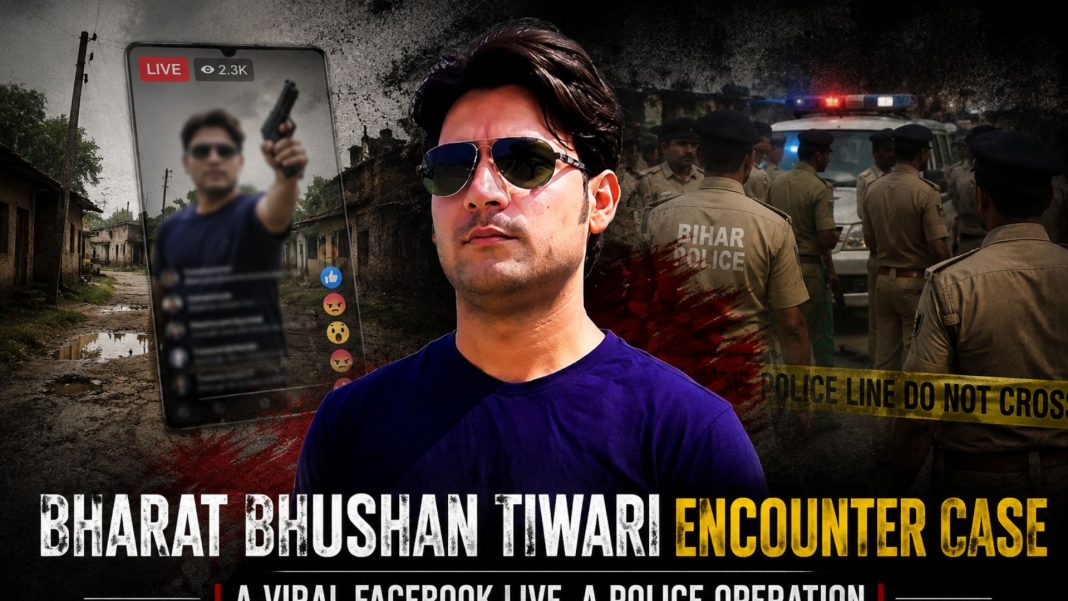

Bharat Bhushan Tiwari Encounter Case: A fatal police encounter in Bihar’s Bhojpur district has ignited a fierce public debate regarding law enforcement practices, human rights, and the rule of law.
On June 16, a 28-year-old man went live on Facebook, brandishing a pistol and openly challenging local police. By the very next day, June 17, official reports confirmed his death in a police encounter.
The deceased, identified as Bharat Bhushan Tiwari, was a resident of Bilauti village in the Shahpur police station area of Bhojpur.
Following his death, numerous legal and administrative questions have been raised regarding the state’s law enforcement operations and the authenticity of the encounter.
From Student Activist to Police Target
Bharat Bhushan Tiwari Encounter Case: According to media reports and local residents, Bharat Bhushan Tiwari was not a professional criminal or a history-sheeter. Instead, he was a BSc student who maintained an active presence on social media.
Family members and fellow villagers claim that Tiwari had been a vocal advocate for his community, frequently raising his voice on digital platforms regarding long-standing local issues.
These included broken village roads, annual flooding, and soil erosion in Bilauti village.
Local accounts describe him as an educated youth driven by civic issues rather than criminal intent. However, his digital activities took a sharp turn, leading to immediate police surveillance and culminating in the fatal confrontation.
The rapid transition from a local activist highlighting civic negligence to a target in a police shootout remains a central point of confusion and anger among the local population.
Conflicting Narratives: Self-Defense vs. Fake Encounter
Bharat Bhushan Tiwari Encounter Case: The local administration and the victim’s family have offered completely contradictory versions of the events that transpired on June 16 and 17.
According to police authorities, images and videos of Tiwari brandishing firearms had gone viral on social media platforms, prompting action.
When a team from the Shahpur police station visited his residence on June 16 to investigate, Tiwari reportedly did not cooperate.
The police further alleged that on the morning of June 17, when a joint team of the Special Task Force (STF) and local police returned to execute an operation, Tiwari opened fire on the personnel.
Senior officials claimed that police fired in self-defense, targeting his legs. Following the shootout, he was rushed to Patna Medical College and Hospital (PMCH), where he succumbed to his injuries.
Conversely, the parents of the deceased have leveled grave allegations against the police, calling the incident a pre-planned conspiracy and a staged encounter.
Tiwari’s father, in statements given to media outlets, asserted that his son was attempting to surrender.
The family claims that Tiwari had thrown his pistol down and raised his hands in full view of the officers, but the police opened fire on the unarmed young man regardless of his submission.
The Mystery of the Missing Footage
Adding to the complexity of the case is the digital trail left behind on social media. Initial viral video clips show Tiwari holding a weapon, with audible sounds of gunfire in the background.
However, independent observers and media reports have highlighted a significant gap in the visual evidence: no footage or video clips have emerged showing the exact moment when Tiwari came into close proximity with the police forces.
The visual narrative abruptly cuts off before the final confrontation. This missing link has left the public divided.
One segment questions whether Tiwari continued firing until his last moments, leaving the police with no choice but to retaliate, while others view the absence of final footage as a potential cover-up supporting the family’s claim of an extrajudicial execution.
Administrative Action and Political Contradictions
The incident has triggered severe administrative and political repercussions in Bihar.
Observers have pointed out that if the police version of events was entirely accurate and the shooting was strictly an act of self-defense, the subsequent disciplinary action raises doubts.
Following the public outcry, Bihar Police suspended four personnel, including the Shahpur Station House Officer (SHO).
This immediate suspension has intensified public suspicion, with critics questioning if the disciplinary action points to procedural lapses or wrongdoing during the raid.
Furthermore, statements from political leaders, including the Deputy Chief Minister and officials supervising the Home Department, have faced scrutiny for apparent inconsistencies.
Early reports cited political statements describing the youth as mentally disturbed, suggesting that he needed medical hospitalization rather than an encounter.
Critics have asked why an on-the-spot encounter approach was utilized instead of non-lethal methods to subdue a single, isolated individual without causing loss of life.
The Legal Framework and Pending Investigations
Under Indian jurisprudence, an encounter or the use of lethal force by law enforcement must always be treated as a measure of last resort rather than a primary tool of compliance.
To address the mounting public pressure, senior police officials have ordered a comprehensive investigation into the incident.
The forthcoming post-mortem examination and forensic analysis are expected to clarify critical details, including the distance from which the bullets were fired and the precise ballistic conditions at the scene.
Until the official investigative reports are finalized, the incident stands as a significant challenge to the state’s claims of maintaining structured policing and the rule of law.
Note: The matter is currently under investigation. The article is based on statements made by police officials, family members, and media reports available at the time of writing. Final findings will depend on the outcome of the official inquiry and forensic reports.
Also Read: BLOODSHED IN PAKISTAN: Twin Blasts Kill 7 in Khyber Pakhtunkhwa, Terror Wave Escalates