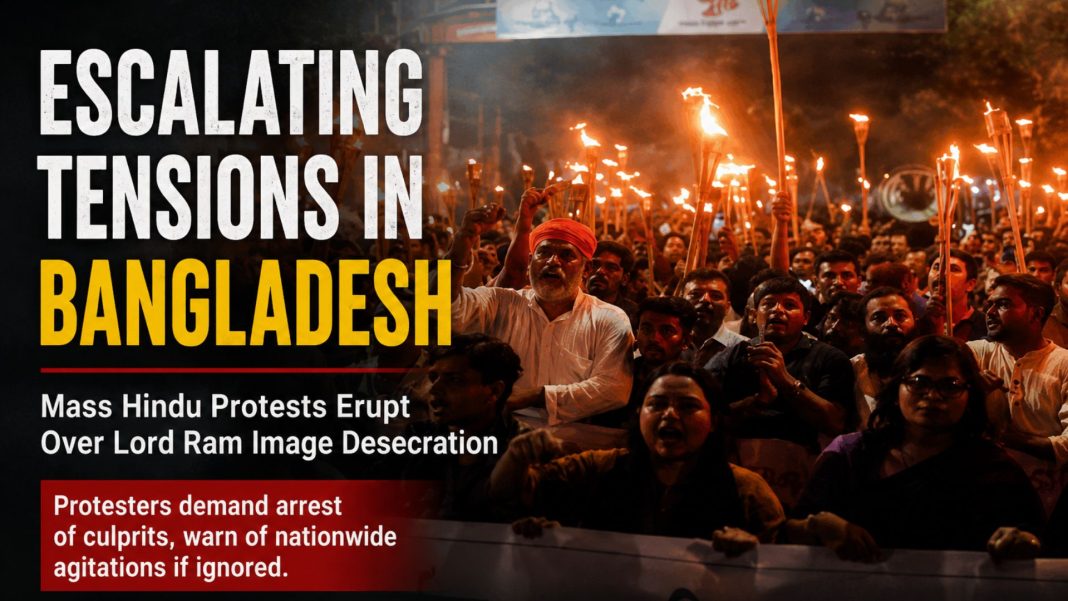

Bangladesh Hindu Protest: A wave of mass demonstrations has swept through Bangladesh’s capital city, Dhaka, as thousands of minority Hindus took to the streets to protest the alleged desecration of an image of Lord Ram.
According to media reports, the unrest was further intensified by the forced suspension of a major temple construction project in northern Bangladesh following continuous threats from radical Islamist outfits.
On Friday, a massive turnout of protesters gathered at the landmark Shahbagh intersection before marching toward the National Press Club.
Carrying flaming torches and chanting religious slogans, the demonstrators issued a strict 72-hour ultimatum to the newly formed government, demanding the immediate identification and arrest of those responsible for disrespecting the Hindu deity.
The situation remains highly volatile, with community leaders warning of nationwide agitations if their concerns are left unaddressed by the administration.
The Trigger: Image Vandalism in Gaibandha
Bangladesh Hindu Protest: According to local rights groups and media accounts, the immediate spark for the countrywide anger occurred earlier this month in the Palashbari upazila of Gaibandha district, located under the Rangpur division.
Local Hindu groups alleged that during an anti-statue demonstration organized by a hardline Islamist mob, a portrait of Lord Ram was severely disrespected when an individual placed a shoe on it.
Student bodies, including members of the Dhaka University Jagannath Hall Students’ Union and the Bangladesh Student Unity Council, strongly condemned the act, stating that it deeply wounded the religious sentiments of the minority community.
Although local police authorities have reportedly registered an official case regarding the vandalism, community leaders expressed deep dissatisfaction over the fact that no suspects have been arrested so far, prompting the massive mobilization in Dhaka.
Heavy-Budget Temple Project Forced Into Limbo
Bangladesh Hindu Protest: The underlying issue fueling the communal friction is an ambitious religious complex being developed by the Sri Sri Radha Govinda Temple committee in Palashbari.
The highlight of the project is a proposed 81-foot-tall statue of Lord Ram, which is slated to become the tallest statue of the deity in Bangladesh.
According to temple authorities, nearly 80 percent of the construction work on the structure had already been completed.
The entire mega-project, estimated to cost approximately 22 crore Bangladeshi Taka (around Rs 15.6 crore), was also designed to include a 50-foot statue of Lord Krishna and a 30-foot statue of Lord Shiva.
However, according to statements given to the media by Haridas Chandra Das, the president of the temple committee, work had to be abruptly suspended due to severe security challenges.
Organizers cited explicit public threats from radical preachers including warnings that the structure would be demolished with bulldozers which created an atmosphere of fear among workers and temple officials.
In an official briefing, the committee stated that the decision to pause construction was reluctantly taken to preserve local law and order and maintain social harmony.
Administrative Backlash and Demands for Intervention
The handling of the crisis has drawn sharp criticism from prominent minority representative groups, such as the Bangladesh Hindu Buddhist Christian Unity Council and factions of the Hindu Mahajot.
During a press conference held at the Dhaka Reporters Unity (DRU) building, leaders accused the state machinery of failing to take decisive action against extremist forces that openly disrupt minority religious projects.
The Hindu Mahajot has taken a defiant stance, asserting that if the government fails to ensure the peaceful completion of the Palashbari statue, the community will initiate the construction of Ram temples across all 64 districts of Bangladesh.
Meanwhile, minor scuffles were reported in Rangpur where local law enforcement attempted to intercept and disperse Hindu demonstrators, further escalating regional anxieties.
Minority Vulnerability and the Political Stance
The ongoing friction has renewed international focus on the vulnerability of Hindus, who comprise just under 8 percent of Bangladesh’s total population of over 17 crore, making them the largest religious minority.
Independent rights monitoring organizations noted that the current escalation follows a turbulent period for minorities, with reports indicating over 130 documented incidents of localized communal violence during the first quarter of the year alone.
The escalating protests present a critical governance test for Prime Minister Tarique Rahman, who took administrative charge in February 2026 following previous institutional transitions.
While Prime Minister Rahman has publically reassured the nation that the state belongs equally to all citizens and that religious freedom will be protected, minority leaders emphasize that verbal assurances must be backed by concrete legal prosecution of radical groups to ensure lasting stability and safety.
Also Read: Bharat Bhushan Tiwari Encounter Case: What Happened After the Viral Facebook Live?