


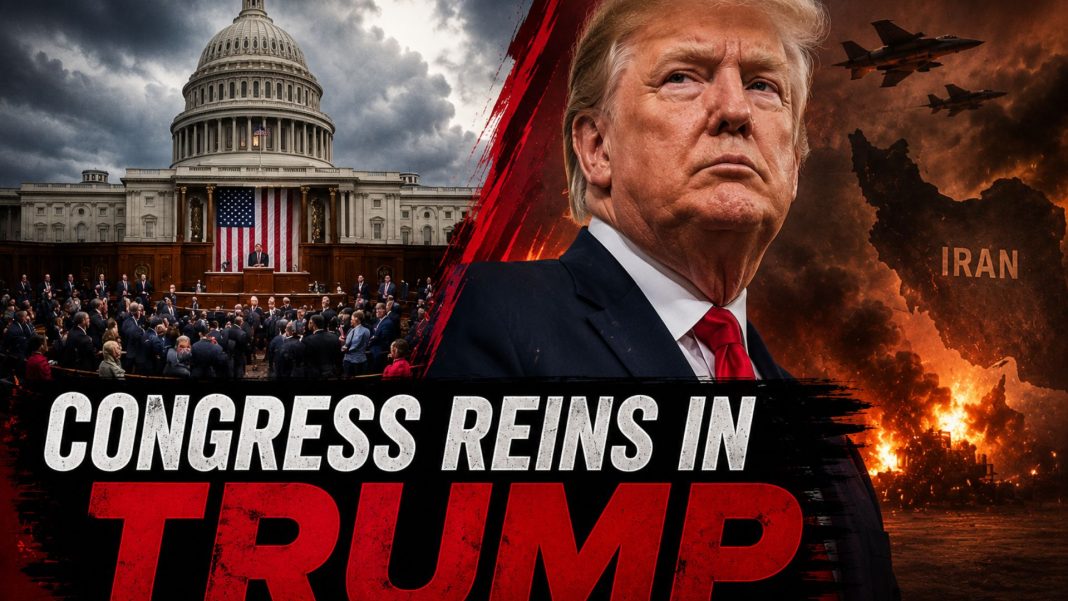

Congress Reins in Trump: In a direct challenge to presidential authority, the U.S. House of Representatives has passed a crucial resolution aimed at stopping ongoing military operations against Iran. The war powers resolution explicitly states that President Donald Trump cannot continue unilateral military action without express approval from Congress.
The legislative move signals a widening debate over executive overreach and America’s foreign policy trajectory in the Middle East.
Bipartisan Crackdown: House Votes 215-208 to Restrict Presidential War Powers
Congress Reins in Trump: The resolution cleared the Democratic-controlled House with a 215-208 vote. While the voting largely followed party lines, the true political shockwave came from within the President’s own ranks. Four Republican lawmakers broke ranks with their party, voting alongside Democrats to curb Trump’s military ambitions.
This internal defection underscores growing unease on Capitol Hill regarding how modern administrations deploy military force without legislative oversight. Under the terms of the newly passed resolution:
Mandatory Authorization: President Trump must seek explicit congressional approval for any further military escalations against Iran.
Troop Withdrawal: In the absence of a formal declaration of war or specific congressional authorization, U.S. military forces engaged in hostilities must be safely withdrawn.
The Upcoming Battle: Next Stops, the Senate and a Looming Veto
Congress Reins in Trump: While the House vote marks a significant symbolic and legislative victory for critics of the administration’s foreign policy, the resolution faces a steep uphill battle before becoming law.
The Senate Hurdle: The legislation now moves to the Senate. Unlike the House, the Senate holds a Republican majority, making the passage of such a restrictive measure highly unpredictable and legally complex.
The Veto Threat: Even if the Senate surprises political analysts by passing the resolution, it must ultimately land on President Trump’s desk. Political insiders widely expect the President to exercise his veto power to kill the bill and preserve his executive authority over the military.
“My Own Decision”: Trump Defends Lone-Wolf Strategy on Iran
The House vote follows provocative statements made by President Trump regarding his administration’s aggressive posture toward Tehran. Speaking in a recent podcast interview, Trump firmly defended his unilateral approach to foreign policy, dismissing notions that he was being swayed by hawkish advisors.
“Someone didn’t provoke or influence me for this. This was my own decision,” Trump stated during the interview, reinforcing his stance as an independent commander-in-chief who does not feel bound by traditional congressional consultations.
Cracks in the Party and Public Panic Over Surging Fuel Prices
Political analysts view the legislative showdown as a turning point, highlighting growing dissent within the Republican Party over prolonged foreign conflicts.
The willingness of Republican lawmakers to openly challenge a sitting president from their own party reveals deep fractures regarding America’s role as the “world’s policeman.”
Beyond the halls of Congress, public anxiety is mounting. Domestic support for a new war in the Middle East remains incredibly thin. As tensions with Iran simmer, American citizens are increasingly worried about the immediate economic fallout at home, most notably, skyrocketing fuel and energy prices that threaten to destabilize the domestic economy.
With the resolution now heading to a divided Senate, the conflict between executive privilege and constitutional checks-and-balances is set to intensify.