


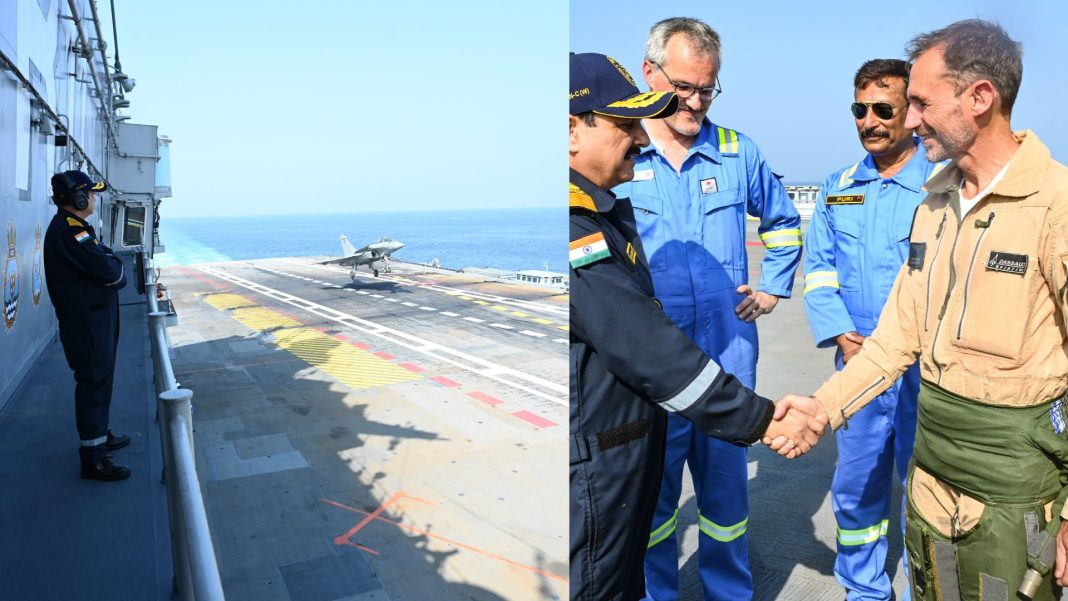

Historic Landing at Sea: In a major breakthrough for Indian naval aviation, a French Navy Rafale Marine (Rafale-M) fighter jet achieved a flawless maiden landing on board India’s indigenously built aircraft carrier, INS Vikrant, on October 29.
Flown by a French Navy test pilot, the advanced naval fighter successfully completed the touchdown on its very first attempt during ongoing operational compatibility trials off the Indian coast.
According to media reports, these comprehensive sea trials mark a crucial first phase in evaluating, validating, and adapting the French-built aircraft for seamless operation from Indian warships.
While India has agreed on the acquisition roadmap for the fighter fleet, official deliveries of the Rafale Marine jets to the Indian Navy are scheduled for a later timeline. The successful landing signals the start of a rigorous integration process to make the jet fully operational within India’s maritime security framework.
Bridging the Engineering Gap: CATOBAR vs. STOBAR Systems
Historic Landing at Sea: Naval aviation on the high seas poses challenges drastically different from conventional land-based fighter operations. Aircraft launched from marine carriers must withstand intense gravitational forces, extremely short deck lengths, and constant ocean roll.
The primary technical hurdle for the French Rafale-M on INS Vikrant involves reconciling two fundamentally different aircraft carrier launching mechanisms:
CATOBAR (Catapult Assisted Take-Off But Arrested Recovery):
Historic Landing at Sea: This launch design relies on a steam-driven or electromagnetic catapult system to accelerate heavy fighter jets from a standstill to flight speeds within a short distance. The French Navy’s flagship carrier, Charles de Gaulle, operates on this mechanism. The Rafale Marine was originally built and optimized specifically for CATOBAR-based decks.
STOBAR (Short Take-Off But Arrested Recovery):
In contrast, STOBAR carriers do not use catapult propulsion. Instead, fighters launch using their own engine thrust, sprinting up an angled, upward-curved ski-jump ramp built into the bow of the ship. Both of India’s operational aircraft carriers—INS Vikrant and INS Vikramaditya, utilize this STOBAR infrastructure.
Technical Feasibility & Compatibility Testing
The core objective of the trial is to verify whether a fighter jet engineered for catapult-assisted takeoff can smoothly adapt to the ski-jump deck design and arrester-wire setup of an Indian STOBAR carrier.
As highlighted by media reports, the successful first-time landing confirms the structural resilience, landing gear stability, and software compatibility of the Rafale-M when making contact with the flight deck of INS Vikrant. Further trials will focus on deck handling, elevator dimensions, taxying procedures, and ski-jump takeoff dynamics.
Strategic Impact for the Indian Navy
Once fully integrated and inducted, the Rafale Marine will provide a substantial boost to India’s carrier-based air wing, adding long-range strike precision, superior radar capabilities, and multi-role air defense at sea. This milestone trial brings the Indian Navy one step closer to deploying a world-class platform across its carrier battle groups, reinforcing maritime readiness in the Indo-Pacific region.
Also Read : Noida Airport Renaming: UP Cabinet Approves ‘Narendra Modi International Airport’ Title in Jewar