


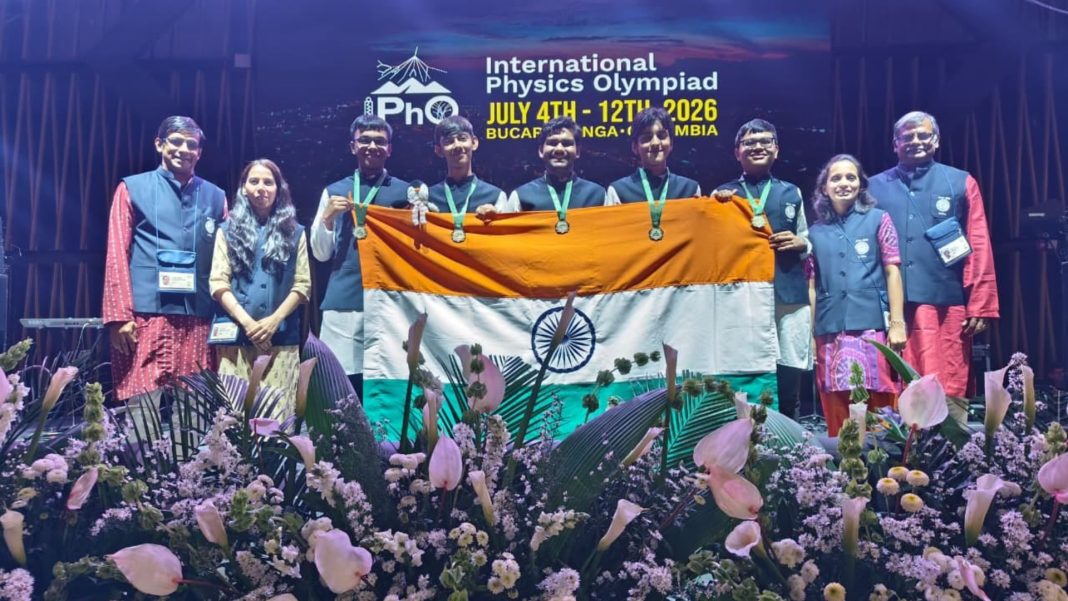

India Shatters Records at Global Stage: In a phenomenal showcase of intellectual dominance, India’s youth power has taken the global stage by storm.
The five-member Indian contingent has achieved a spectacular clean sweep at the prestigious 56th International Physics Olympiad (IPhO) 2026, held in Bucaramanga, Colombia. Every single student representing the nation brought home a Gold medal, securing India the joint World No. 1 position on the global medal leaderboard.
With this perfect golden tally, India stands shoulder-to-shoulder with international science powerhouses including China, Russia, South Korea, Kazakhstan, and Taiwan.
This landmark victory marks only the second time in India’s 27-year history of participating in the IPhO that the entire national squad has scored consecutive gold medals, matching a legendary feat last accomplished in 2018.
Meet India’s Golden Boys: The Five Brains Who Conquered Colombia
India Shatters Records at Global Stage: The rigorous global tournament brought together 381 elite minds from 87 countries, all competing in challenging intellectual tests. Amid intense pressure, these five young Indians emerged victorious:
Kanishk Jain (Pune, Maharashtra)
Riddhesh Anant Bendale (Indore, Madhya Pradesh)
Rishit Garg (Dwarka, New Delhi)
Shresth Suraiya (Mumbai, Maharashtra)
Svarit Joshi (Ahmedabad, Gujarat)
According to official updates from the organizers, the Indian squad displayed incredible academic capability. The team scored near-perfect marks in the highly demanding theoretical component and put up an equally robust performance in complex lab experiments.
Inside the Mental Arena: What Makes IPhO So Difficult?
The International Physics Olympiad is universally regarded as the ultimate test of science and analytical thinking for pre-university students. It goes far beyond typical school curricula, testing deep conceptual understanding under immense time constraints.
This year’s competition was divided into two main components:
The Theoretical Challenge (5 Hours)
Students were forced to solve three massive, highly creative physics problems covering advanced concepts. The topics included:
The complex thermodynamics involved in paramagnetic cooling.
Analyzing light reflections inside a coffee cup, scientifically known as caustics and cusps.
The photoionization of ozone and the complex dynamics of electron-positron pairs.
- The Experimental Challenge (5 Hours)
The laboratory section tested hands-on engineering and critical reasoning skills. Students had to design and analyze experiments focusing on thermodynamic processes in fluids and intricate heat transfer calculations.
Prime Minister and Scientific Chiefs Hail the Historic Win
This flawless victory immediately caught the attention of the country’s highest leadership. Taking to social media platform X, Prime Minister Narendra Modi congratulated the team, hailing it as a proud moment for the country.
“An outstanding performance by our youngsters! Congratulations to the Indian contingent… for winning Gold Medals at the 56th International Physics Olympiad (IPhO) 2026. This achievement is yet another example of the limitless potential of our Yuva Shakti and their passion for science and research.”
— PM Narendra Modi
An outstanding performance by our youngsters!
— Narendra Modi (@narendramodi) July 13, 2026
Congratulations to the Indian contingent of Kanishk Jain, Riddhesh Anant Bendale, Rishit Garg, Shresth Suraiya and Svarit Joshi for winning Gold Medals at the 56th International Physics Olympiad (IPhO) 2026 held in Bucaramanga,… pic.twitter.com/oiAVLy110P
Dr. Ajit Kumar Mohanty, Secretary of the Department of Atomic Energy (DAE) and Chairman of the Atomic Energy Commission, also expressed immense national pride:
“Securing five Gold Medals and jointly attaining the World No. 1 rank at the International Physics Olympiad is a testament to the talent, dedication, and scientific temperament of our students, as well as the unwavering commitment of our training system.”
The Hidden Engine Behind the Win: Intensive Training Ecosystem
While the young prodigies took the spotlight, their historic run was fueled by months of systematic preparation. The Indian Olympiad program is meticulously organized by the Homi Bhabha Centre for Science Education (HBCSE), a national branch of the Tata Institute of Fundamental Research (TIFR), functioning under the Department of Atomic Energy.
The students didn’t just walk onto the global stage; they survived a brutal, multi-tier national elimination process. Before catching their flights to Colombia, the chosen five underwent intensive orientation and pre-departure camps.
Their training involved advanced classroom learning, heavy laboratory drills, and simulation sessions designed to mimic high-pressure exam environments.
HBCSE Director Arnab Bhattacharya highlighted that India’s steady run of medals over the past years isn’t a fluke. Rather, it is the direct outcome of a deeply rooted, decades-long mentoring system supported by the government.
India’s Golden Record: A Decade of Dominance
This victory reinforces India’s legacy as an elite competitor in global science fields. Looking back at India’s long-term performance data, the country’s physics training infrastructure has yielded exceptional results:
27 Years of Excellence: Across all IPhO appearances, an incredible 44% of Indian participants have won Gold, 41% have secured Silver, and 10% have won Bronze.
The Unbroken Streak: Over the last ten years, every single Indian student sent to the IPhO has returned home with a medal.
High-Tier Output: Within this past decade alone, 62% of those medals have been shiny Golds, while the remaining 38% were Silvers.
Beyond the competitive medal tallies and high-stakes rankings, the event serves as an open global forum where young minds connect, swap research ideas, and form cross-border friendships that pave the way for future global scientific breakthroughs.
With this clean sweep in 2026, India has confidently marked its territory on the global map, inspiring thousands of young minds back home to eye careers in deep research, mathematics, and advanced sciences.
Also Read : Tu-214PU Aircraft : Russian ‘Doomsday’ War-Room Jet Lands in Iran After Massive US Strikes