

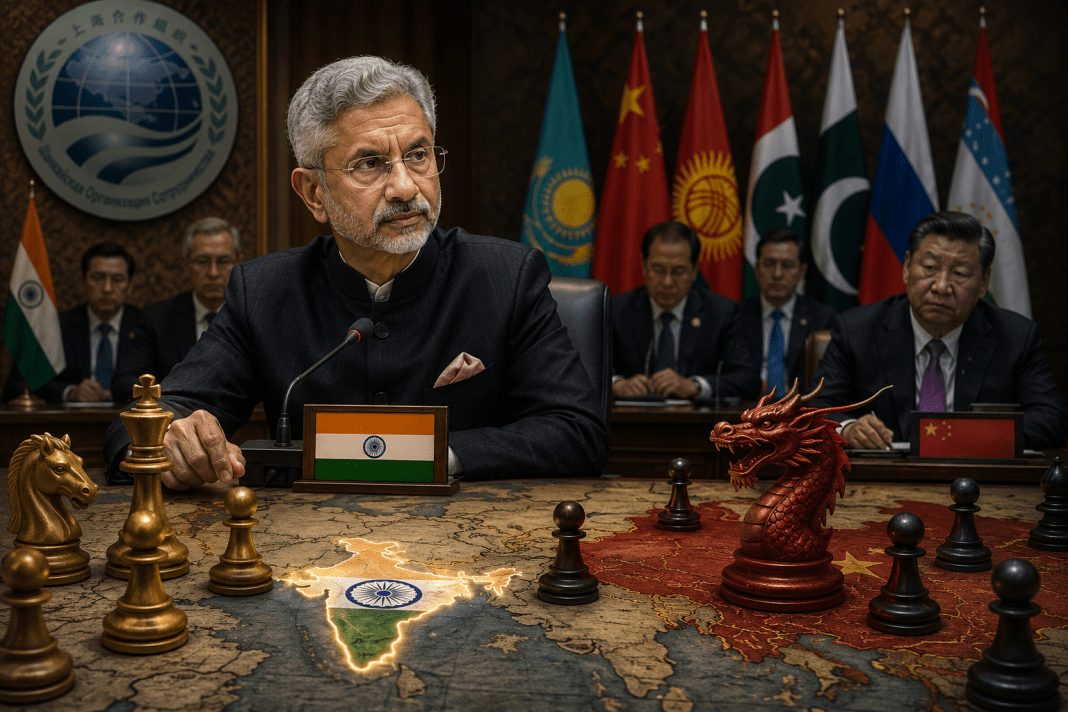

Jaishankar in the Dragon’s Den: The geopolitical chessboard underwent a massive shift as the Shanghai Cooperation Organisation (SCO) Council of Heads of State Summit concluded in Kazakhstan. On the surface, the summit was a routine gathering of Eurasian powers.
However, beneath the diplomatic handshakes and formal banquets lay a high-stakes international chess game involving China, Russia, and India.
For months, global intelligence networks and international think-tanks, including the Observer Research Foundation (ORF), had been tracking a clear trend, Beijing’s quiet attempt to turn the SCO into an anti-Western, China-centric bloc.
With Russia deeply entangled in European conflicts and increasingly dependent on Beijing for economic survival, Chinese President Xi Jinping saw a golden opportunity to dominate the Eurasian landscape.
But the biggest headline of the summit happened before the first speech was even delivered. Indian Prime Minister Narendra Modi decided to skip the event in person, sending India’s External Affairs Minister, S. Jaishankar, instead.
Decoding China’s Multi-Layered Game Plan
Jaishankar in the Dragon’s Den: To understand why India played this card, one must first look at what China and Russia were trying to achieve behind closed doors in Astana.
The Push for an Anti-Western Bloc
With the expansion of the SCO to include countries like Iran and Belarus, Beijing has been aggressively trying to steer the organization away from its original focus on regional security and counter-terrorism. China’s goal is to position the SCO as a direct geopolitical counterweight to the G7 and the West.
The Dilution of Indian Influence
India is a member of both the SCO (historically Eurasian-focused) and the Quad (the Indo-Pacific partnership with the US, Japan, and Australia). By pushing an aggressively anti-Western narrative within the SCO, China hoped to put New Delhi in an uncomfortable spot, forcing India to either alienate its Western partners or look isolated within Eurasia.
The Border Paradox
While China smiles on the diplomatic stage, thousands of its troops remain heavily deployed along the Line of Actual Control (LAC) in Eastern Ladakh. Beijing wanted to create a false narrative of “business as usual” on an international stage, despite keeping bilateral ties frozen through its aggressive border posture.
The Indian Counter-Strategy: Why PM Modi Skipped the Summit
Jaishankar in the Dragon’s Den: New Delhi’s decision to send the Foreign Minister instead of the Prime Minister was not a last-minute scheduling conflict, it was a calculated, deliberate diplomatic signal.
Diplomatic Signal: In international relations, who you send to a meeting matters just as much as what you say. By sending the External Affairs Minister, India effectively downgraded its political participation while ensuring its national interests were still robustly defended.
Refusing the “Photo-Op”: PM Modi’s presence would have provided Xi Jinping with a perfect photo opportunity to show global solidarity, masking the ongoing military standoff at the Indian border. New Delhi made it clear that normal relations are impossible without peace on the border.
Neutralizing the Anti-West Trap: India refused to be a rubber stamp for a China-driven ideological war against the West. By keeping the Prime Minister away, India signaled that it will not be a junior partner in anyone’s geopolitical camp.
Strategic Autonomy in Action: This move proved that “New India” operates strictly on its own terms. It balances its relationships with Russia and the West simultaneously, refusing to bow to external pressure from either Beijing or Washington.
Jaishankar in the Dragon’s Den: Delivering the Hard Truths
When Dr. S. Jaishankar landed in Astana, he did not mince words. In an environment heavily dominated by Chinese and Russian narratives, India’s Foreign Minister delivered a masterclass in clear, unyielding diplomacy, driving home three non-negotiable national priorities.
First, he laid down India’s explicit stance on territorial integrity, firmly stating that all regional connectivity projects must respect national sovereignty. This was a direct, unfiltered nod against China’s Belt and Road Initiative and the China-Pakistan Economic Corridor (CPEC) which cuts through Indian territory.
Second, he addressed regional security by demanding a zero-tolerance approach toward counter-terrorism. He made it clear that the SCO must fight cross-border terrorism without any double standards, political shields, or hidden agendas.
Finally, he pushed for true multipolarity in global governance. Jaishankar reminded the forum that Eurasia cannot be dominated by a single superpower, and that mutual respect among all member states remains non-negotiable for future cooperation.
The Bigger Picture: Balancing Russia and the West
India’s strategy at the SCO cannot be viewed in isolation. It is part of a much larger, highly sophisticated balancing act that New Delhi has mastered over the last few years.
India continuously navigates its Western alliances, like the Quad, the United States, and the European Union, while simultaneously managing its vital Eurasian realities through platforms like the SCO and BRICS. The ultimate anchor of this entire approach is India’s strict adherence to strategic autonomy.
While India maintains deep, historic defense and energy ties with Russia, it is also a critical pillar of the Indo-Pacific security architecture alongside Western democracies.
By participating via its top diplomat rather than its Head of State, India successfully protected its vital stakes in Eurasian security, energy corridors, and counter-terrorism frameworks, all while ensuring its deeply valued partnerships with Western nations remained uncompromised.
The Real Takeaway for New India
The outcome of the summit proved that India no longer merely reacts to global shifts; it actively shapes them. By refusing to let the SCO be used as a tool to undermine its sovereignty, New Delhi successfully protected its national interests on the global stage.
The strategy demonstrated that India can walk into any global forum, look global superpowers in the eye, and establish its boundaries clearly without firing a single shot or causing diplomatic chaos. This quiet, firm, and autonomous approach is precisely what defines the foreign policy of a rising global power.
Also Read : THE OMAN GATEWAY: HOW INDIA’S SILENT ECONOMIC MASTERSTROKE IS REWRITING GULF TRADE