


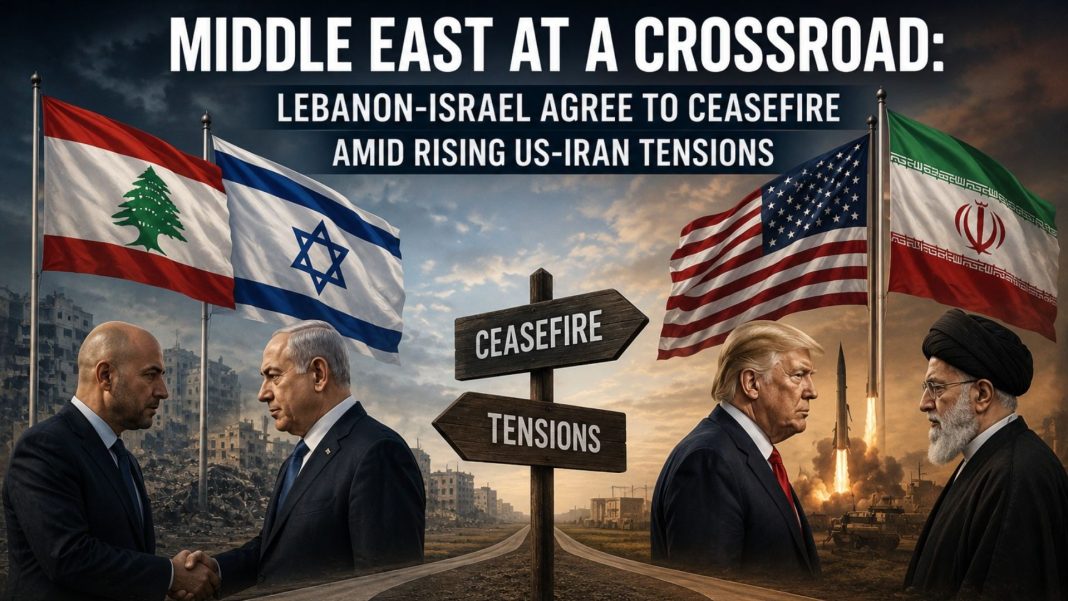

MIDDLE EAST AT A CROSSROAD: In a major diplomatic development, Israel and Lebanon have officially agreed to a ceasefire following intense diplomatic talks in Washington.
The announcement, released via a joint statement by the US State Department on Wednesday, marks a pivotal moment in the ongoing regional conflict.
However, the peace remains fragile. The implementation of the truce is strictly conditional, relying heavily on the complete cessation of hostilities by Hezbollah and the total withdrawal of its operatives from the strategic South Litani sector.
The Paradox: Diplomacy in Washington, Chaos in the Gulf
MIDDLE EAST AT A CROSSROAD: While the ceasefire brings a temporary sigh of relief to the Israel-Lebanon border, the broader Middle East remains on a knife-edge.
The diplomatic victory is starkly contrasted by escalating friction between Washington and Tehran, a standoff that continues to shake the volatile Gulf region.
The negotiation process between the US and Iran has hit another deadlock. Despite the diplomatic stalemate, US President Donald Trump offered a surprisingly optimistic outlook during a White House press briefing, suggesting that a breakthrough with Tehran could happen as early as the weekend.
“Talks are going very well… anything could happen,” President Trump stated, hinting at a potential weekend deal.
Trump’s High-Stakes Gambit: Target on Iran’s Uranium and the Strait of Hormuz
MIDDLE EAST AT A CROSSROAD: President Trump did not mince words regarding his ultimate objectives concerning Iran. He explicitly voiced his intention to secure and neutralize Iran’s enriched uranium stockpiles, signaling a hardline stance even while keeping the doors open for negotiations.
He asserted his firm goal regarding Iran’s nuclear materials, stating clearly that he wants to get it and ensures that the US will achieve this goal.
Furthermore, the vital maritime choke point of the Strait of Hormuz, currently restricted due to regional hostilities, hangs in the balance. Trump promised that the strategic trade route would reopen immediately and very quickly the moment a formal agreement with Tehran is signed.
A Political Blow at Home: Congress Curbs Trump’s War Powers
MIDDLE EAST AT A CROSSROAD: While managing foreign policy crises abroad, President Trump faced a significant political setback on the domestic front. In a direct challenge to executive authority, the US House of Representatives passed a crucial resolution aimed at clipping the President’s wings regarding military escalation.
The newly passed resolution strictly limits the President’s ability to continue or initiate war with Iran without explicit permission and authorization from the US Congress. This legislative move reflects growing domestic anxiety over a potential full-scale military confrontation in the Middle East.
The Domino Effect: Kuwait Catches Chills as Gulf Chaos Deepens
The ongoing Washington-Tehran standoff is not contained to diplomacy; its real-world economic and security fallout is rippling across the Persian Gulf.
Kuwait is currently bearing the maximum brunt of this regional instability due to its geographical proximity and economic vulnerability to Gulf disruptions.
At the same time, the Strait of Hormuz is experiencing shipping bottlenecks, directly impacting global oil supply chains and raising maritime security alarms.
As the weekend approaches, the world watches closely to see if President Trump’s prediction of a “quick deal” with Iran will materialize, or if the regional chaos will swallow the newly minted Israel-Lebanon peace agreement.