
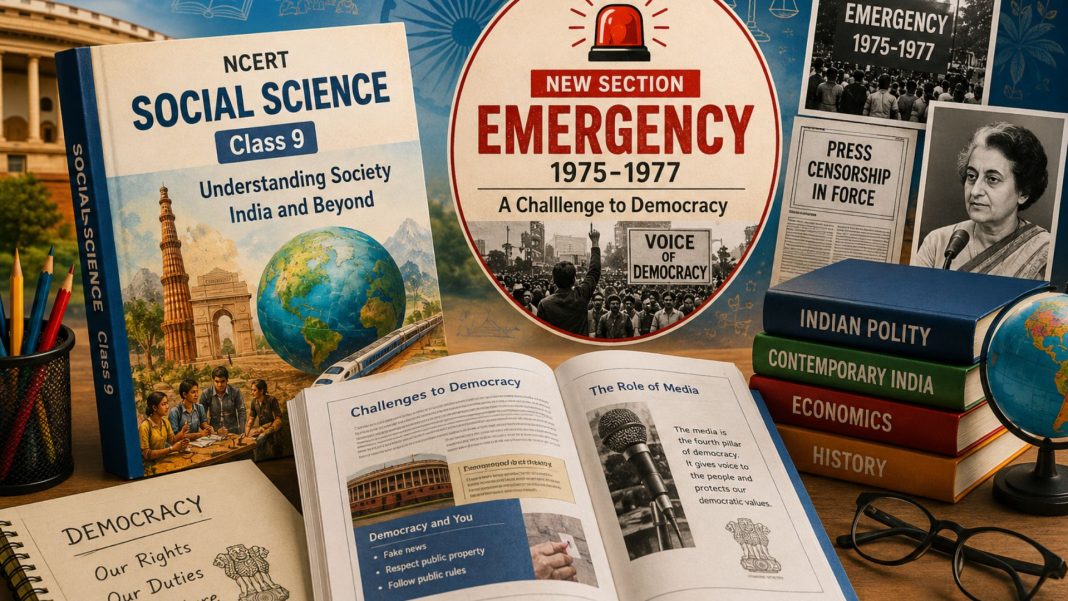

NCERT Class 9 Textbook Adds Emergency Chapter: The National Council of Educational Research and Training (NCERT) has officially revised its social science curriculum, introducing a dedicated section on the 1975–1977 National Emergency in its Class 9 textbooks for the very first time.
According to official announcements and academic reports, this landmark addition frames the historical event under the thematic umbrella of a “Challenge to Democracy,” allowing secondary school students to analyze one of the most critical phases in independent India’s political journey.
The updated content is featured prominently in the newly developed Social Science textbook titled Understanding Society: India and Beyond.
This textbook overhaul aligns with the broader objectives of the National Education Policy (NEP) 2020, shifting the study of the Emergency era down from Senior Secondary classes (Class 12) to the high school level.
The release coincides with the nation marking five decades since the Emergency was declared.
Understanding the Curriculum Shift: Why Class 9?
NCERT Class 9 Textbook Adds Emergency Chapter: Historically, detailed educational modules concerning the constitutional and political breakdowns of the 1975 Emergency were reserved for senior students in Class 12 Political Science.
According to education analysts, introducing these complex constitutional concepts to Class 9 students marks a definitive pedagogical shift.
The primary objective behind this change, as highlighted in NCERT’s curriculum guidelines, is to help students grasp the practical vulnerabilities and the ultimate resilience of democratic structures at an earlier age.
The chapter does not treat the Emergency as an isolated historical event, but presents it as a practical case study within a wider academic discourse examining how democratic systems survive major crises.
What Does the New Emergency Chapter Cover?
NCERT Class 9 Textbook Adds Emergency Chapter: The newly minted section relies on historical records to trace the socioeconomic and political environment of the early 1970s.
According to the textbook excerpts cited by media reports, the chapter attributes the unrest leading up to the declaration to mounting economic distress and civic dissatisfaction.
The chapter highlights several interconnected factors that led to the event:
Socioeconomic Strain: The textbook documents that the early 1970s were marked by growing public dissatisfaction with the administration led by then-Prime Minister Indira Gandhi due to rising unemployment and severe inflation.
Protests and Unrest: Charges and allegations of misgovernance triggered widespread, synchronized civilian and student protests across several states.
- The Declaration: In June 1975, a National Emergency was proclaimed by the government on the grounds of “internal disturbance.”
The Impact on Civil Liberties and Institutions
The chapter details the administrative and constitutional actions taken during the 21-month period.
It explicitly states that the majority of citizens’ Fundamental Rights were suspended, formal press censorship was imposed, and several prominent opposition political leaders and civil rights activists were placed under detention.
The text teaches students that during this phase, democratic institutions encountered severe strain, and individual civic freedoms were heavily restricted.
Highlighting the Role of Lok Nayak Jayaprakash Narayan
A significant portion of the newly added section is dedicated to the popular civilian resistance movements that challenged the state’s actions. The textbook shines a spotlight on veteran political leader and socialist thinker Jayaprakash Narayan, popularly remembered as Lok Nayak.
According to the textbook narratives, mass civilian movements spearheaded by Jayaprakash Narayan successfully mobilized students, youth, and ordinary citizens, most notably in Bihar and Gujarat.
The chapter goes on to describe the resolution of the crisis, noting that the Emergency was lifted in 1977, followed by the declaration of general elections.
The text explains to young learners that the subsequent defeat of the ruling government demonstrated the fundamental strength of the Indian electorate and highlighted the enduring importance of democratic checks and balances.
Weaving History with Modern Challenges: Fake News and Misinformation
Rather than leaving the Emergency as a closed chapter of the past, the NCERT curriculum integrates it into a broader, modern conversation about contemporary threats to a healthy society.
In an effort to keep the content highly relevant to today’s digital age, the textbook positions the 1975 Emergency alongside several modern socio-political hurdles.
Students are encouraged to analyze the Emergency alongside contemporary challenges, including:
The Digital Domain: Issues such as fake news and digital misinformation are flagged as modern threats to democracy.
Civic Responsibility: The text highlights the dangers of damaging public property and the routine violation of public rules.
- Structural Inequalities: Longstanding socio-economic challenges, such as widespread poverty, regionalism, deep-seated social discrimination, and gender inequality, are evaluated as ongoing barriers to ideal democratic practices.
Introducing ‘Democracy and You’ and the Fourth Pillar
To maximize civic engagement, a new interactive segment titled “Democracy and You” has been incorporated into the syllabus.
According to NCERT officials, this section is engineered specifically to help students connect abstract textbook concepts with their practical everyday roles as future voters and active participants in civic life.
Additionally, the book reinforces the foundational pillars of governance. It includes a specialized section detailing the role of the media, explicitly describing it as the “fourth pillar of democracy.”
The lesson emphasizes the media’s ethical responsibility in amplifying the concerns of the public and acts as an essential safeguard for protecting democratic values.
To illustrate the unprecedented scale of the country’s democratic machinery, the textbook presents verified institutional figures, noting that India recorded over 96.8 crore registered voters in 2024, supported by a massive localized polling infrastructure.
It wraps up the module with empirical case studies of grassroots democracy, showcasing successful, inclusive panchayat models in states like Gujarat and Tripura, with a dedicated focus on women’s voting rights and local body reservations.
Also Read: Tamil Nadu Free Gold Ring Scheme: Vijay Govt to Gift 1 Gram Gold for Govt Hospital Deliveries