


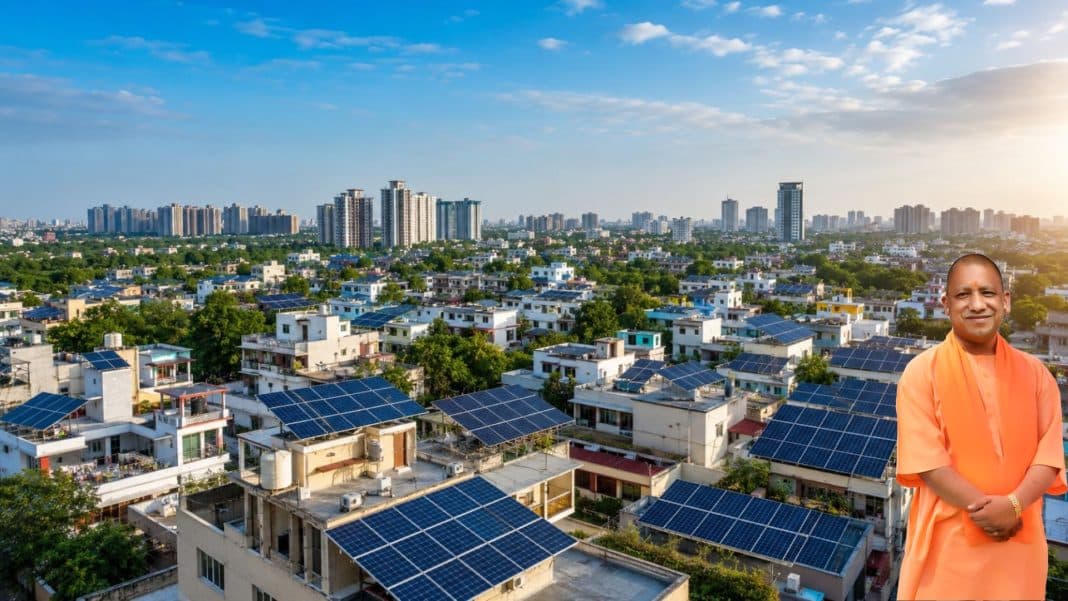

PM Surya Ghar Yojana: The landscape of India’s renewable energy sector has witnessed a historic paradigm shift. In a stunning development, Uttar Pradesh has registered a monumental achievement in the clean energy domain.
At the recently concluded PM Surya Ghar Awards in New Delhi, Uttar Pradesh (UP) swept multiple top honors, cementing its position as a national leader in solar adoption.
The crown jewel of this achievement belongs to the state capital, Lucknow, which has officially become India’s Number 1 solar district under the PM Surya Ghar: Muft Bijli Yojana.
By rapidly scaling up rooftop solar installations, Lucknow has outpaced traditional industrial powerhouses and long-standing solar benchmarks like Surat (Gujarat) and Nagpur (Maharashtra).
The Numbers Behind Lucknow’s Historic Triumph
PM Surya Ghar Yojana: For years, Surat was considered the undisputed benchmark for urban solar adoption in India. However, latest verified data from the official portal showcases how Lucknow engineered a massive turnaround.
Key Performance Statistics:
Total Applications Received: 1,52,041
Completed Solar Installations: 1,07,755
Established Solar Capacity: 381.87 MW
Subsidies Disbursed to Citizens: ₹72,794.87 Lakh (Approx. ₹728 Crore)
In comparison, Nagpur secured the second spot nationally with 92,483 installations.
Surat, slipping to the third position, managed 87,748 functional installations out of 126,491 applications, recording an established capacity of 334.93 MW.
The pace of growth in Lucknow has been staggering. By April 2026, the city had already crossed the 88,000 installation mark, and momentum accelerated fiercely into the summer.
In May 2026 alone, Lucknow added 9,667 systems, peaking on May 31 with a single-day record of 333 unit installations the highest for any district in the country.
Uttar Pradesh Sweeps Multiple National Categories
PM Surya Ghar Yojana: Lucknow’s success is part of a larger, systemic solar revolution across Uttar Pradesh. Under the ambitious central scheme launched in February 2024, UP won first prize in the national ‘Very High Consumer Base‘ category.
The state secured the top position across several critical verticals:
Maximum Consumer Applications
Highest Number of Functional Installations
Maximum Vendor Registrations
Note on State-Wise Standings: While Uttar Pradesh leads the country in monthly installation velocity and overall consumer applications, it ranks third in cumulative nationwide historical installations since the scheme’s inception, with Gujarat and Maharashtra holding the top two spots.
To sustain this momentum, the UP government is actively transforming the arid terrain of the Bundelkhand region into a massive utility-scale solar energy hub, effectively utilizing vast tracts of barren land.
The Ground Reality: From Micro-Entrepreneurs to High-Rises
Aerial surveys of Lucknow’s major residential zones including Indira Nagar, Gomati Nagar, Vikas Nagar, and Aliganj reveal a dense blanket of blue-black monocrystalline and polycrystalline silicon rooftop panels. However, the adoption crosses socio-economic barriers.
From makeshift shanties and roadside stalls to tight, narrow lanes in Old Lucknow, solar energy has become localized.
For instance, micro-entrepreneurs and roadside vendors who previously spent ₹30 a day renting commercial batteries to run a single light and fan are now purchasing small, portable solar panels for around ₹3,000.
This shift cuts operational costs to zero while providing consistent power during intense summer heatwaves.
Strategic Innovation: The ‘Decentralized Implementation’ Model
Senior administrative officials credit the triumph to the “Decentralized Implementation, Centralized Monitoring” model introduced by the state government.
High levels of coordination between the Uttar Pradesh New and Renewable Energy Development Agency (UPNEDA), local distribution companies (Discoms), and district administration streamlined the vendor registration process, preventing bureaucratic bottlenecks.
Comparative Performance Across Districts
The solar push is stabilizing across other key districts in both states, showing a highly competitive distribution network:
| State | District | Notable Performance Metrics |
|---|---|---|
| Gujarat | Rajkot | 1,00,920 Applications |
| Gujarat | Patan | High rural-urban penetration rates |
| Gujarat | Sabarkantha | High rural-urban penetration rates |
| Gujarat | Surendranagar | High rural-urban penetration rates |
| Uttar Pradesh | Varanasi | Second-highest rooftop solar adoption in UP (approximately half of Lucknow’s volume) |
| Uttar Pradesh | Kheri | 6,990 Completed Installations |
| Uttar Pradesh | Mathura | 6,321 Completed Installations |
| Uttar Pradesh | Lalitpur | Steady early-stage baseline integration |
| Uttar Pradesh | Mainpuri | Steady early-stage baseline integration |
| Uttar Pradesh | Maharajganj | Steady early-stage baseline integration |
Why the PM Surya Ghar Yojana is an Economic Gamechanger
Statewise, an estimated 35 lakh homes across Uttar Pradesh now utilize solar infrastructure, generating a cumulative 1,888 MW of rooftop solar power.
To date, beneficiaries have received over ₹3,602 crore in central subsidies, supplemented by an additional ₹1,200 crore from the state government.
The scheme acts as a dual financial incentive. By providing substantial upfront subsidies, it reduces residential electricity bills to zero.
Furthermore, through net-metering provisions, consumers are actively monetizing their surplus power by feeding it back into the regional grid.
Lucknow’s rapid rise proves that combining lower financial barriers with robust vendor availability creates an unstoppable green transition.