


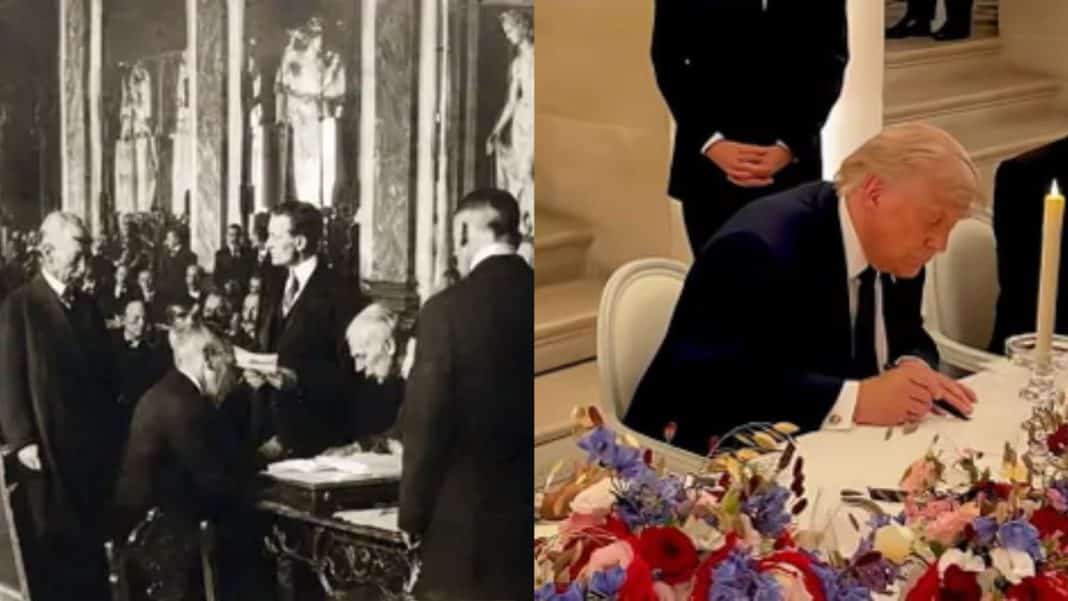

Where World War I Ended: When U.S. President Donald Trump sat down at the iconic Palace of Versailles to sign the historic “Islamabad Memorandum of Understanding (MoU)” with Iran, it was far more than a modern diplomatic breakthrough to halt a devastating regional war. Trump was stepping directly into the footprint of a colossal historical ghost.
Exactly 107 years ago, on June 28, 1919, another American President, Woodrow Wilson, stood in the very same palace to sign the Treaty of Versailles. While that signature officially ended World War I, it accidentally planted the geopolitical seeds for World War II and the terrifying rise of Adolf Hitler.
As Trump celebrates this new deal as a masterclass in modern diplomacy, international historians and political analysts are heavily debating whether this venue choice is a brilliant poetic triumph or a dangerous historical gamble.
The Ghost of 1919: How the Palace of Versailles Birthed World War II
Where World War I Ended: To understand the weight of Trump’s recent signing, we must look at what happened in that gilded palace over a century ago. Modern historians widely view the 1919 Treaty of Versailles not as a true peace agreement, but as a dictated surrender that crippled a defeated Germany.
The Allied powers did not negotiate with Germany; they gave them a brutal ultimatum: sign the treaty within a week, or face an immediate military invasion.
The Cost of the 1919 Treaty on Germany:
Where World War I Ended: Territorial Loss: Stripped of over 26,000 square miles of land and all overseas colonies.
Economic Ruin: Forced to pay roughly $5 billion in immediate reparations (equivalent to hundreds of billions today).
Military Castration: Severe restrictions placed on the size, scope, and weapons of the German army.
This intense national humiliation left a deep, festering wound in the German psyche. A decade later, a radical politician named Adolf Hitler skillfully weaponized this collective resentment.
By promising to tear up the “shameful Treaty of Versailles” and restore Germany’s military might, Hitler rallied the political capital he needed to seize power, ultimately driving the world into World War II.
1919 vs. 2026: Wilson’s Punitive Coercion vs. Trump’s Business Model
Historians are fascinated by how the recent Versailles signing represents a complete inversion of 1919’s strategy. Where Woodrow Wilson and the Allied powers sought to utterly crush an adversary, Trump’s approach with Iran relies on economic incentives and transactional deal-making, a strategy analysts are calling “Business Model Diplomacy.”
The Core Shifts in Global Diplomacy
From Punishment to Concessions: Woodrow Wilson used Versailles as a tool of punitive coercion, demanding forced submission from Germany. In stark contrast, Trump’s 2026 approach with Tehran utilizes massive economic relief, granting Iran access to over $300 billion in previously frozen assets alongside a significant lifting of international sanctions.
The Reversal of Military Containment: While the 1919 treaty famously castrated Germany’s military by stripping its weaponry and limiting its army size, the Islamabad MoU takes a more compromise-heavy route. Iran is allowed to retain partial ballistic capabilities in exchange for a temporary, 60-day nuclear freeze while long-term negotiations continue.
Shifting Geopolitical Objectives: The ultimate goal in 1919 was to permanently neutralize a rising continental power to keep Europe safe. The priority today is immediate global economic stabilization, specifically reopening the blocked lanes of the Strait of Hormuz to stop the soaring inflation of global energy prices.
For a President known for his appreciation of grand architecture and opulence, the Palace of Versailles provided the perfect theatrical backdrop. However, the deal has drawn sharp criticism from foreign policy hawks.
Critics argue that Iran managed to secure billions in economic relief and the removal of sanctions without being forced to fully dismantle its core regional military apparatus.
The Geopolitical Analysis: Will This Versailles Deal Bring Lasting Peace?
French President Emmanuel Macron’s decision to host Trump at Versailles was a brilliant display of diplomatic theater, utilizing the palace’s immense historical prestige to secure a historic signature. For Trump, the deal fulfills his “America First” objective by avoiding another prolonged foreign conflict while securing an immediate economic victory: clearing the naval blockades and dropping soaring global oil prices.
However, as the 60-day final negotiation window begins, the shadow of 1919 looms large. History teaches us that treaties signed in the Hall of Mirrors carry heavy, long-term consequences.