


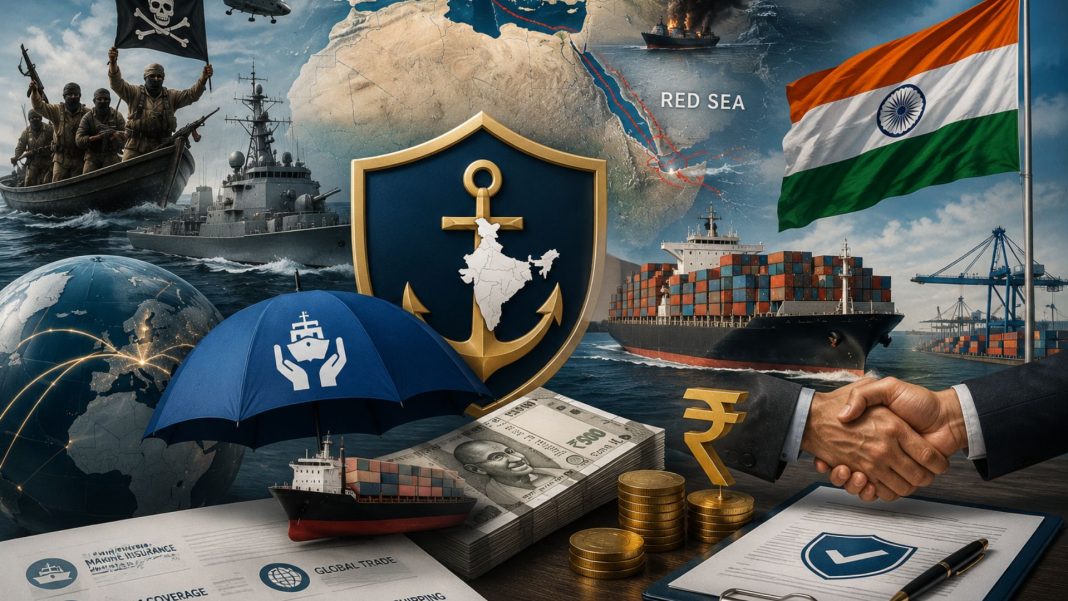

Red Sea Crisis: The global maritime ecosystem is facing its most volatile era since the second World War. For months, drone strikes, missile attacks, and mounting geopolitical hostilities in the Red Sea, the Strait of Hormuz, and the Gulf of Aden have turned vital trade corridors into high-risk war zones.
While these regional conflicts are inherently military in nature, their secondary warfare is economic, fought through the weaponization of maritime insurance.
Historically dependent on Western syndicates, Indian exporters and shipping operations found themselves vulnerable to predatory market shifts. In response to skyrocketing premiums and sudden coverage withdrawals by foreign underwriters, the Government of India launched a massive structural counter-offensive
the Bharat Maritime Insurance Pool (BMIP). Backed by a historic ₹12,980 crore ($1.4 billion) sovereign guarantee, this strategic move establishes India’s financial sovereignty on the high seas, positioning it alongside an elite group of nations capable of self-insuring global trade.
Weaponization of Marine Insurance: The Red Sea Crisis Unmasked
Red Sea Crisis: The modern global economy runs on maritime trade, with over 70% of India’s trade by volume and roughly 95% by value moving across open oceans. However, ships cannot leave ports without comprehensive insurance coverage. This structural vulnerability became a major flashpoint during the recent escalation of conflicts in the Red Sea shipping corridors.
As vessels faced targeted missile and drone strikes, international underwriting syndicates, predominantly concentrated in London and the West, leveraged the crisis to implement predatory pricing models. Insurance premiums for transiting high-risk zones were artificially inflated by up to 400%. Even more critical was the looming threat of total coverage abandonment.
Under the pretext of geopolitical volatility or shifting international sanctions, foreign syndicates reserved the right to unilaterally withdraw insurance policies from ships carrying cargo destined for or originating from non-Western hubs.
For Indian merchants, this was an economic stranglehold. Operating without insurance meant risking catastrophic financial ruin, while paying the exorbitant, cartel-driven premiums forced a steep spike in domestic inflation, threatening to make Indian exports non-competitive globally.
Breaking the Stranglehold: The Architecture of Bharat Maritime Insurance Pool
Red Sea Crisis: Recognizing that economic self-reliance is impossible without financial sovereignty, the Union Cabinet, chaired by Prime Minister Narendra Modi, executed a decisive policy shift. The newly operationalized Bharat Maritime Insurance Pool (BMIP) creates a massive domestic risk-sharing mechanism with an overall underwriting capacity of USD 1.5 billion.
The operational anatomy of the BMIP functions through a multi-tiered financial shield:
First-Line Pool Capacity (~₹950 Crore / $100 Million): This initial tier is funded collectively by domestic pool-member insurers. It is designed to absorb standard, frontline claims before any larger reserves are touched.
Sovereign Backstop (₹12,980 Crore / $1.4 Billion): This acts as the final security blanket provided directly by the Indian government. This massive financial buffer is invoked only if catastrophic war-risk disasters exhaust the domestic insurers’ primary reserves.
Managed administratively by the General Insurance Corporation of India (GIC Re) alongside leading public entities like New India Assurance, the pool ensures end-to-end maritime coverage.
Policies are issued directly by domestic insurers, offering seamless protection across critical risk verticals that were previously outsourced to foreign clubs:
Hull and Machinery: Complete physical damage protection for the ship’s structure.
Cargo Insurance: Secure transit backing for commodities moving in both directions.
Protection & Indemnity (P&I): Handling heavy third-party liabilities, such as environmental oil pollution, wreck removal, and crew repatriation.
War Risk Protection: Active financial insulation against missile strikes, piracy, and kinetic drone warfare in declared high-risk global corridors.
The Geopolitical Masterstroke: Entering the Global Elite Club
By establishing a sovereign-backed insurance framework, India has officially dismantled a century-old dependency on Western maritime infrastructure. For decades, global shipping lines were entirely reliant on the International Group of P&I Clubs based out of Europe.
The launch of the BMIP successfully moves India into an elite league of maritime superpowers, alongside the United Kingdom, Japan, and South Korea, that maintain state-backed protective structures to safeguard national commerce during global crises.
Union Minister of Ports, Shipping, and Waterways, Sarbananda Sonowal, appropriately characterized the initiative as a “transformational milestone” toward achieving the long-term goals outlined in the Maritime India Vision 2030.
This strategy directly insulates India’s crucial imports, most notably discounted Russian crude oil and critical industrial raw materials, from the volatile political whims of external maritime authorities.
Economic Shockwaves: What the BMIP Means for the Indian Consumer
Beyond high-level diplomacy, the domestic economic benefits of the BMIP have manifested rapidly. Within just weeks of its operational roll-out, the insurance pool has actively stabilized trade logistics and fundamentally lowered input costs for Indian industry.
Data indicates that the deployment of domestic underwriting capacity has forced Hull War Risk premiums down by nearly 27%, while Cargo War Risk premiums have plummeted by an astonishing 48%. Major industrial conglomerates, including Vedanta Sterlite Copper and Balrampur Chini Mills, have already successfully transited high-risk conflict waters using these sovereign-backed domestic policies.
For the average Indian citizen, this financial shield acts as an anti-inflationary buffer. By drastically reducing freight volatility and eliminating the predatory margins of foreign insurance cartels, the government has successfully protected domestic fuel prices, electronic components, and everyday commodities from artificial, conflict-driven cost escalations.
The Analytical Verdict: A Sovereign Shield for a Rising Power
The implementation of the Bharat Maritime Insurance Pool is far more than a routine financial readjustment; it is a profound declaration of strategic autonomy and economic resilience.
In an era where global trade routes are routinely weaponized to achieve geopolitical leverage, relying on foreign entities to secure domestic supply lines is a structural liability that a rising global economic powerhouse cannot afford.
Through the BMIP, India has effectively built a financial fortress around its merchant fleet. By shifting the underwriting burden into a domestic ecosystem backed by the financial weight of the Indian state, the nation has protected its immediate macroeconomic interests while laying down a secure foundation toward its ultimate goal of absolute maritime self-reliance.
To gain a broader perspective on how this massive financial shield reshapes India’s economic sovereignty on the high seas, you can watch this comprehensive breakdown on the Bharat Maritime Insurance Pool Launch. This video details the operational mechanics of the pool, explaining how a ₹12,980 crore sovereign guarantee protects Indian shipping lines from geopolitical volatility.
Also Read : Jaishankar in the Dragon’s Den: How India Neutralized China’s Game Plan at SCO